
Immersive Event Technology Malaysia
Immersive event technology can transform guests from passive spectators into active participants throughout a corporate event.
Instead of using technology only on the main stage, interactive and digital experiences can support different moments of the event journey — from guest arrival and registration to the opening show, audience participation, awards and finale.
MyDigital Asia provides immersive and interactive event technology in Malaysia for annual dinners, gala dinners, product launches, conferences, award nights and corporate celebrations.
The objective is not to add more screens or gadgets. Each technology should support a specific moment and make the overall event experience more engaging, efficient or memorable.
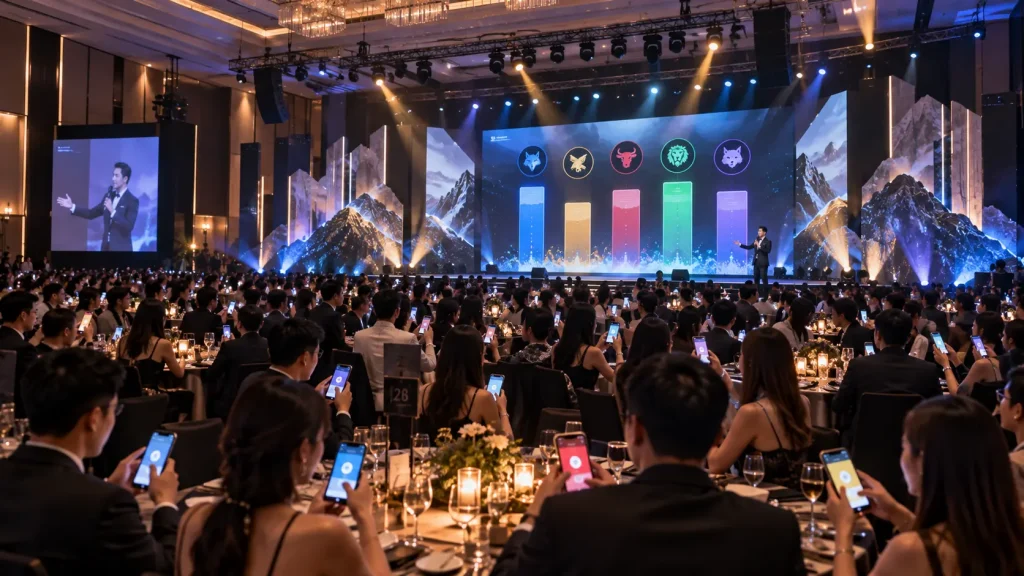
Immersive Event Technology at a Glance
| Event Moment | Possible Technology |
|---|---|
| Guest Arrival | QR registration, interactive entrance, digital welcome experience |
| Pre-Function | AI photo experience, interactive wall, digital signature wall |
| Opening | Projection mapping, visual show, interactive launch gimmick |
| Stage Programme | Live audience games, polling and real-time visuals |
| Awards & Recognition | Dynamic award visuals and interactive presentation systems |
| Lucky Draw | Digital lucky draw and real-time winner display |
| Finale | Immersive visual sequence, audience participation or coordinated show |
What Is Immersive Event Technology?
Immersive event technology refers to digital, interactive and audiovisual systems designed to make guests feel more involved in an event.
This may include projection mapping, interactive screens, audience participation systems, motion tracking, mobile interaction, digital registration, AI-assisted experiences and real-time event content.
However, an event does not become immersive simply because it contains many technologies.
The stronger approach is to connect technology to the programme:
Guest Action → System Response → Shared Event Moment
For example, hundreds of guests may scan the same QR code and participate in a live mobile game while the main LED screen visualises the collective result in real time.
The audience is no longer only watching the screen. Their actions become part of what appears on it.
Planning Technology Around the Event Journey
Corporate events contain several different audience states.
Guests behave differently when arriving, waiting in the pre-function area, watching the stage programme and participating in a game.
Technology should therefore be selected according to each moment.
A typical technology journey could be:
QR Registration → Interactive Pre-Function → Opening Experience → Live Audience Interaction → Awards → Lucky Draw → Finale
Not every event requires every element.
The purpose is to identify where technology can improve the guest experience rather than filling every available space with an activation.
QR Registration and Digital Guest Arrival
The first digital interaction may happen before guests enter the ballroom.
A QR registration system can help manage arrival while creating a smoother transition into the event.
Depending on the event, registration may include:
- Preloaded guest lists
- QR check-in
- Name or employee ID search
- Attendance status
- Table information
- Guest categories
- On-site registration support
The registration experience should prioritise speed.
A visually impressive interface is less useful if guests need to wait in a long queue to enter the event.
Interactive Entrance Experiences
The entrance can become the first experiential moment after registration.
Instead of using only a printed entrance arch, selected events can introduce responsive visual elements.
For example, a digital wall or projection surface may respond as guests walk past, creating movement, particles or themed visual effects around them.
The interaction can remain subtle so it supports the event theme without slowing down guest circulation.
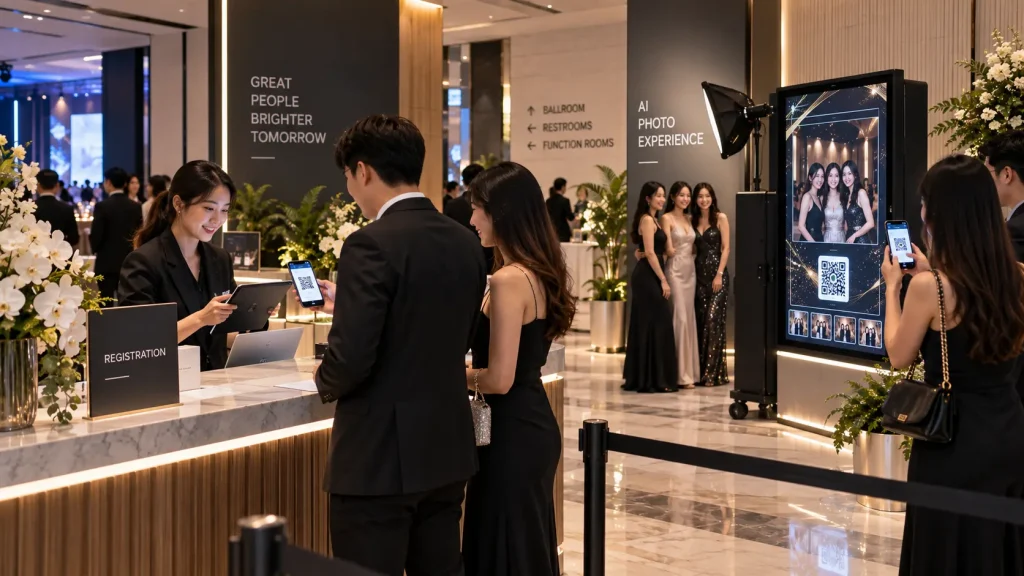
AI Photo Experiences
AI-assisted photo experiences can transform a conventional event photo activity into a personalised digital output.
Guests may take a photograph and receive a visual created around the event theme.
Possible applications include:
- Annual dinner themes
- Corporate celebrations
- Product launches
- Festive events
- Company milestone celebrations
The experience should consider processing time and queue capacity, particularly when several hundred guests arrive within a short period.
A QR retrieval method can allow guests to collect their result on their own phone without creating another collection queue.
Interactive LED Signature Wall
A digital signature experience allows guests to sign or write a message using a touchscreen or tablet while the contribution appears on a larger event display.
Instead of keeping signatures on a small physical board, the event can gradually build a collective digital visual as more guests participate.
This can work well for:
- Corporate anniversaries
- Opening ceremonies
- Weddings and celebrations
- Employee appreciation events
- Launch events
The final composition can also become part of the event’s closing visual or digital keepsake.
Opening Shows and Projection Mapping
The opening is one of the strongest opportunities to use immersive audiovisual technology because the audience is focused on one shared moment.
Projection mapping can transform scenic structures, stage surfaces or architectural elements into animated environments.
Content can be synchronised with:
- Lighting
- Sound effects
- Music
- Performer movement
- Physical product reveals
- Launch mechanisms
For annual dinners, the opening may transition directly into the event theme or management entrance.
For product launches, the visual sequence can build anticipation before revealing the physical product.
See Projection Mapping for Annual Dinners and Projection Mapping for Product Launches for more detailed applications.
Interactive Launch Gimmicks
A launch gimmick can allow executives or guests to trigger a coordinated visual moment rather than relying only on a conventional button press.
The trigger may use:
- Touch
- Object placement
- Gesture
- Motion
- Multiple participants
The action can then trigger a sequence across the stage:
Participant Action → Visual Response → Lighting Sequence → Main Reveal
The trigger itself should be simple and reliable. The impact should come from the coordinated response around it.
Live Audience Games
Interactive games can involve a much larger percentage of the audience than conventional stage games involving only a few volunteers.
Guests may participate through:
- QR web games
- Mobile tapping
- Phone motion
- Live trivia
- Table challenges
- Real-time voting
The main screen can display collective progress, rankings or results while guests participate from their seats.
A simple event flow could be:
Scan QR → Join Game → Participate → Live Screen Responds → Winner Revealed
Because the interaction runs through the guests’ own phones, large audiences can participate without distributing dedicated controllers.
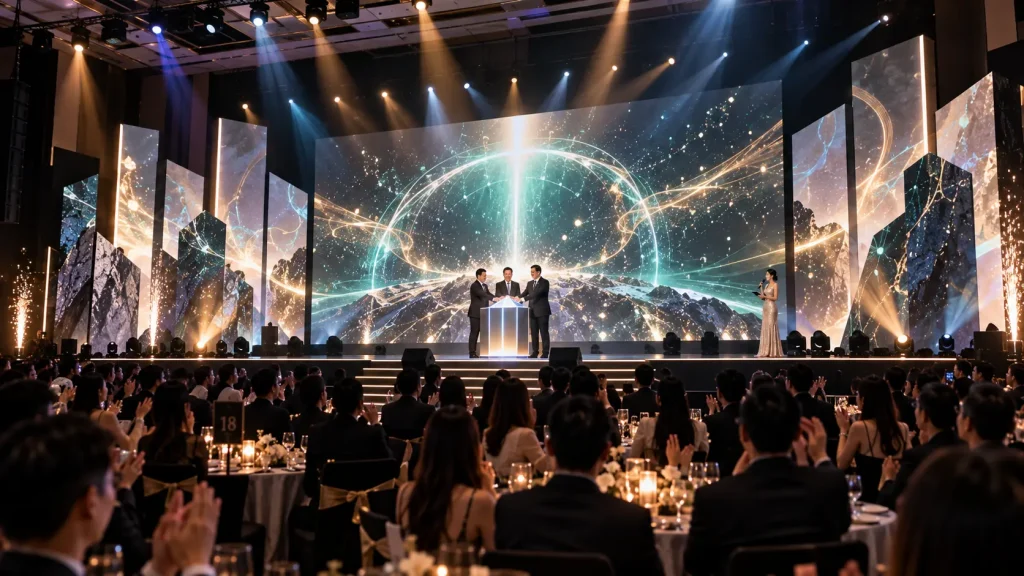
Table vs Table Interactive Games
For annual dinners and gala events, guests are naturally organised into tables.
This creates an opportunity to turn each table into a team.
For example, guests may enter or automatically receive their table number and contribute to the same team score.
The main event screen can visualise how different tables are performing in real time.
This creates a shared competitive experience without requiring hundreds of guests to leave their seats.
Live Polling and Audience Voting
Not every audience interaction needs to be a game.
Live polling allows guests to contribute opinions or make decisions during the programme.
Applications may include:
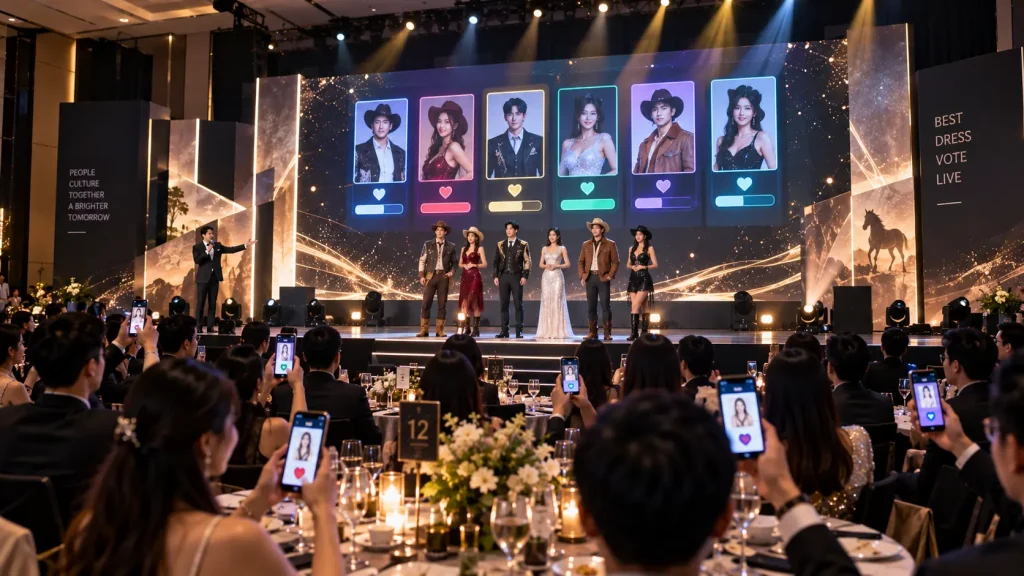
- Best dressed voting
- Audience choice awards
- Event feedback
- Trivia answers
- Prediction questions
- Conference polling
Results can appear on the main screen in real time or remain hidden until the host reveals them.
The interface should be mobile-friendly and simple enough for guests to participate without downloading an application.
Digital Lucky Draw Systems
A digital lucky draw can connect directly with the event’s guest or employee list.
Depending on the requirements, the system can support:
- Imported participant lists
- Attendance eligibility
- Multiple prize rounds
- Prevention of duplicate winners
- Winner history
- Large-screen winner display
For events with many prizes, the system should make it easy for the operator to manage each round while maintaining clear winner records.
The visual presentation can also follow the event theme so the lucky draw feels like part of the programme rather than a separate software screen.
Interactive Kiosks During Events
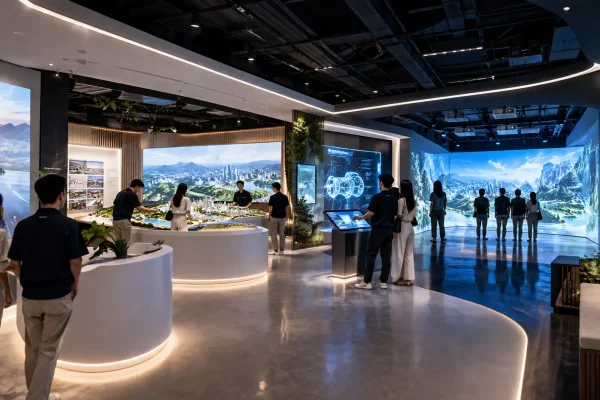
Interactive kiosks can provide individual or small-group activities in pre-function areas, exhibitions or event lounges.
Possible applications include:
- Reaction games
- Trivia
- Product exploration
- Interactive quizzes
- Digital prize games
- Information discovery
Kiosks are useful when guests arrive at different times because participation does not need to begin simultaneously.
For large stage programmes, however, mobile audience systems are generally more suitable when the objective is to involve hundreds of guests at the same time.
Interactive Floors and Walls
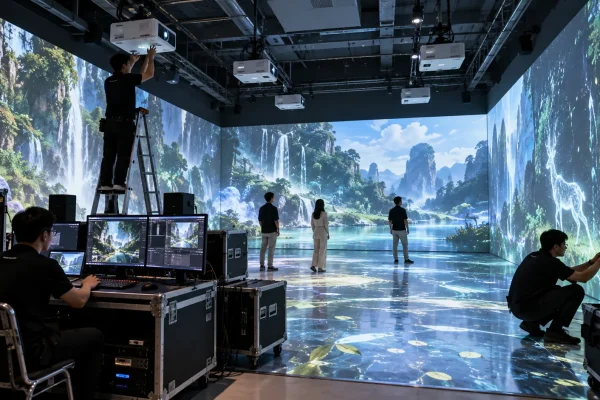
Interactive projection can turn selected event surfaces into responsive environments.
A floor may react as guests walk through an entrance area, while a wall can respond to touch or body movement.
These experiences can support:
- Event themes
- Brand storytelling
- Photo opportunities
- Pre-function engagement
- Interactive games
For more detail, see Interactive Floor Projection Malaysia and Interactive Projection Mapping Malaysia.
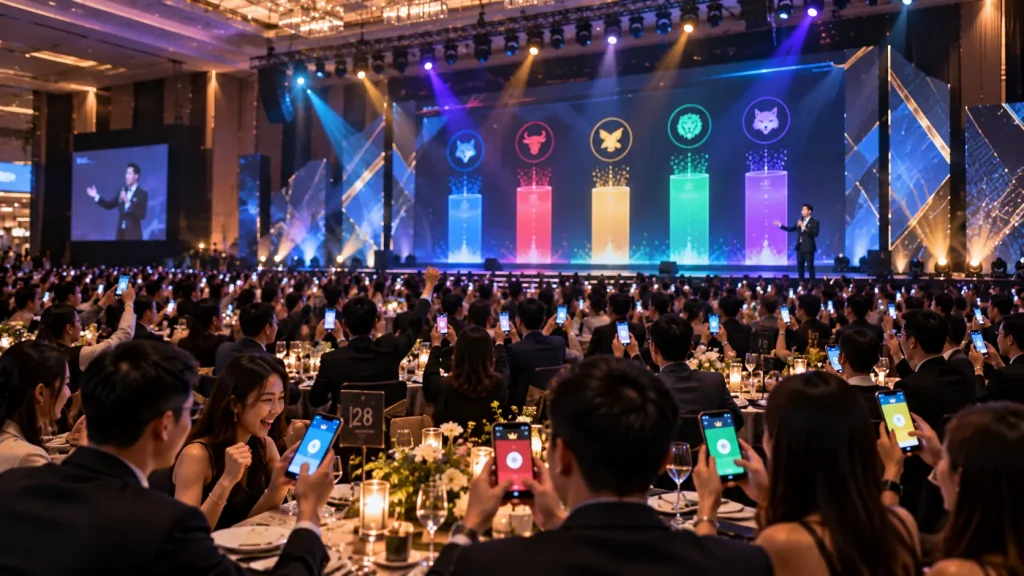
Immersive Stage Environments
An immersive event does not always require a dedicated immersive room.
The main ballroom stage can become part of a larger visual environment by combining LED screens, projection mapping, scenic structures, lighting and coordinated content.
LED screens can continue to handle presentations, live feeds and readable information, while projection extends visual content onto physical scenic surfaces.
This hybrid approach allows the event to retain the practical advantages of LED while creating stronger environmental transformation during key moments.
See Projection Mapping vs LED Screen for a detailed comparison.
How Should Event Technology Be Prioritised?
The strongest technology plan usually begins with the moments that matter most.
| Event Objective | Possible Priority |
|---|---|
| Fast Arrival | QR registration |
| Pre-Function Engagement | AI photo, signature wall or interactive activity |
| Strong Opening | Projection mapping or launch show |
| Audience Energy | Live mobile game or polling |
| Prize Management | Digital lucky draw |
| Memorable Finale | Coordinated visual and audience experience |
For many corporate events, a connected sequence of a few well-designed systems can create more impact than adding many unrelated technologies.
Building One Connected Event Experience
The real value appears when different technologies support the same guest journey.
For example:
QR Registration → AI Photo → Opening Show → Live Audience Game → Best Dressed Poll → Lucky Draw → Finale
Each system performs a different function, but together they create a more complete event experience.
This is the difference between renting individual event technologies and designing an immersive experience around the full programme.
Immersive Technology for Annual Dinners
Annual dinners are particularly suitable for interactive event technology because the same audience remains in the venue for several hours and moves through multiple programme stages.
Technology can support the experience before guests enter the ballroom and continue throughout the main programme.
A typical annual dinner technology journey might include:
Registration → Pre-Function Experience → Opening Show → Audience Interaction → Awards → Best Dressed Voting → Lucky Draw → Finale
The technologies should be coordinated with the event programme so guests are not repeatedly asked to scan different QR codes, learn complicated interfaces or leave their seats unnecessarily.
For example, a mobile audience system can allow guests to join a game, vote and participate in selected programme activities from the same device.
Immersive Technology for Product Launches
Product launches usually require a different balance between spectacle and information.
The opening may focus on creating anticipation, while the experience after the reveal should help guests understand the actual product.
A possible technology sequence could be:
Opening Visual → Interactive Launch Trigger → Product Reveal → Product Exploration → Guest Experience
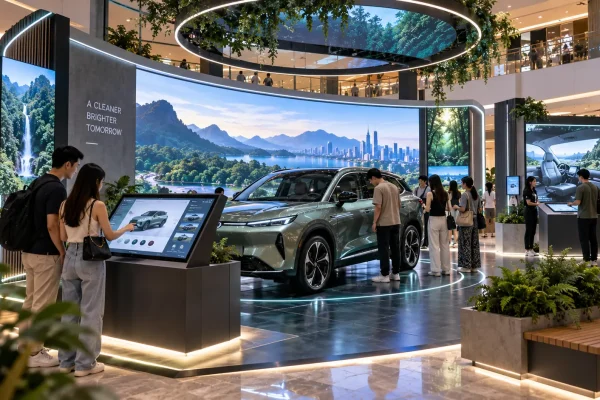
Projection mapping, lighting and sound can create the reveal moment, while interactive touchscreens, product configurators or physical-digital installations can support deeper exploration afterwards.
The physical product should remain the centre of attention. Technology should reveal or explain its value rather than compete with it.
For interactive product experiences, see Immersive Brand Experience Malaysia.
Interactive Technology for Conferences
Conference technology usually prioritises participation, information and audience feedback rather than entertainment.
Useful applications can include:
- Live polling
- Audience questions
- Interactive quizzes
- Session voting
- Digital information kiosks
- Interactive exhibition areas
- Real-time data visualisation
A speaker may ask a question during a presentation and allow the audience to respond from their phones.
The results can then appear on the main screen and become part of the discussion.
This creates a more active conference environment without interrupting the presentation flow.
Technology for Award Nights and Gala Events
Award nights can use digital technology to improve both presentation and audience participation.
Dynamic award visuals can support different categories, while lighting and screen content can change according to each winner or award segment.
Audience voting may also be introduced for selected categories where appropriate.
The objective should remain focused on recognition. Technology should enhance the moment when a winner is announced rather than distracting from the person receiving the award.
Can Interactive Event Systems Support 600 to 2,000 Guests?
Yes, but large audience participation requires different planning from a small interactive installation.
For hundreds or thousands of simultaneous participants, the complete system architecture should consider:
- Expected concurrent users
- Venue internet infrastructure
- Guest mobile connectivity
- Server capacity
- Real-time data handling
- Main screen visualisation
- Registration or identification requirements
- Operator controls
- Backup procedures
The interaction itself should remain simple.
For example, a large table-versus-table challenge may only require guests to scan a QR code, identify their table and perform one action on their phones.
The complexity can remain behind the scenes while the guest experience stays straightforward.
How Can Large Audience Games Work?
Large audience games can collect actions from many individual phones and combine them into one shared visual result.
A simplified system flow is:
Guest Phones → Interaction Server → Real-Time Data → Main Event Screen
For a table competition, individual guest actions can contribute to the score of their assigned table.
The main screen can visualise selected teams, progress or rankings while the activity is running.
The screen design should remain readable from the back of the ballroom. Trying to display hundreds of detailed values simultaneously may make the visual difficult to understand.
Does the Event Need Internet for Audience Interaction?
It depends on the system.
Mobile participation normally requires a network path between guests’ phones and the interaction system.
For large events, relying on an untested public venue Wi-Fi connection can create unnecessary risk.
Technical planning should confirm:
- Venue internet availability
- Wi-Fi capacity
- Mobile network conditions
- Dedicated internet options
- Number of expected simultaneous users
- System architecture
Other event systems may operate locally.
For example, touchscreen games, local media playback, selected lucky draw systems and projection content can often operate without continuous public internet access.
Network requirements should therefore be assessed system by system.
Can Guests Use One QR Code for Multiple Activities?
Yes. Where several audience activities are planned, a unified mobile entry point can reduce confusion.
Instead of asking guests to scan a new QR code for every activity, the same web-based event interface can provide access to selected functions throughout the programme.
For example:
Join Event → Game → Poll → Best Dressed Vote → Selected Event Interaction
The available activity can change according to the programme schedule.
This approach can create a more consistent guest experience and reduce repeated instructions from the emcee.
How Does Event Technology Connect to the Main LED Screen?
Interactive event systems often need to appear on the ballroom’s main LED screen.
The system may provide a dedicated visual output that is routed through the event’s video switching or LED control setup.
This allows the programme to move between:
- Event slides
- Live camera feed
- Interactive games
- Polling results
- Lucky draw visuals
- Award content
For events using multiple LED screens, the required output arrangement should be confirmed before the event.
The centre screen may display the interactive experience while side screens continue showing supporting visuals, live camera feeds or other programme content.
Do We Need a Dedicated Event Technology Operator?
For events using several interactive systems, a dedicated operator is usually useful.
The operator may be responsible for:
- Opening and closing activities
- Loading participant data
- Launching game rounds
- Managing lucky draw rounds
- Displaying poll results
- Resetting interactive systems
- Coordinating screen output
- Responding to technical issues
For more complex events, responsibilities may be divided between the interactive system operator and the main audiovisual team.
Clear communication between the emcee, stage manager, LED operator, audio team, lighting team and interactive technology operator is important when several systems need to respond to the programme in sequence.
Why Is Rehearsal Important?
Interactive technology should be included in the event rehearsal rather than tested separately and assumed to work during the programme.
The rehearsal should verify the complete sequence:
Emcee Cue → Operator Action → System Response → Screen Output → Audio / Lighting Response
This is especially important for:
- Opening gimmicks
- Product reveals
- Large audience games
- Voting
- Award sequences
- Lucky draws
- Finale moments
Rehearsal also helps confirm whether instructions are clear enough for guests to understand quickly.
What Backup Planning Is Required?
Live events operate on fixed schedules, so critical systems should be planned with practical fallback options where appropriate.
Depending on the event, this may include:
- Local copies of essential content
- Backup participant lists
- Alternative screen content
- Spare cables and adapters
- Backup computer or playback option
- Manual programme fallback
- Predefined procedures for network interruption
The appropriate backup level depends on how critical the technology is to the event programme.
A photo activation temporarily going offline is different from an opening trigger that controls the main launch moment.
Temporary Event Installation
Most corporate event technology is installed temporarily.
The system therefore needs to work within limited setup and dismantling periods while coordinating with other event contractors.
Installation planning may involve:
- LED and AV contractor schedules
- Stage construction
- Venue access
- Power availability
- Network setup
- Projector installation
- Sensor positioning
- Registration counters
- Testing and rehearsal time
Technical requirements should be shared early so the event technology is not treated as an isolated last-minute addition.
How Much Does Immersive Event Technology Cost in Malaysia?
There is no single package price because event technology can range from one interactive system to a complete technology journey covering registration, pre-function experiences and the ballroom programme.
Major cost factors include:
- Number of interactive systems
- Custom software development
- Audience size
- Hardware rental
- Projection or sensor requirements
- Custom visual design
- 2D or 3D content production
- Number of event days
- Setup and rehearsal requirements
- On-site operators
- Network requirements
- Venue and logistics
A simple web-based poll for a corporate dinner has a very different scope from a custom 2,000-person real-time audience game with dedicated screen visualisation and system integration.
For broader budgeting considerations, see Immersive Experience Cost Malaysia.
How Should an Event Technology Budget Be Prioritised?
Instead of adding technology to every programme segment, identify where guest participation or visual impact matters most.
| If the Priority Is… | Consider… |
|---|---|
| Smoother Arrival | Registration system |
| Pre-Event Engagement | One strong photo or interactive experience |
| Opening Impact | Projection mapping or coordinated opening show |
| Whole-Room Participation | Mobile audience game or polling |
| Programme Management | Integrated voting and lucky draw systems |
| Overall Experience | Connect selected systems into one guest journey |
A smaller number of well-integrated technologies can often create a stronger experience than many individual activities operating independently.
Immersive Event Technology Project Process
- Event Brief – Understand the event objective, programme, audience and venue.
- Guest Journey – Identify where technology can improve arrival, participation and key programme moments.
- Technology Concept – Select suitable systems for each priority.
- Technical Planning – Confirm LED outputs, network, power, hardware and venue requirements.
- Content & Software Development – Prepare interfaces, games, visuals and interactive logic.
- Participant Data Preparation – Configure guest or employee information where required.
- Installation & Integration – Connect the systems with the venue and main AV setup.
- Testing & Rehearsal – Run important programme sequences with the event team.
- Live Operation – Operate and support the systems during the event.
What Information Is Needed for a Proposal?
Useful information for an initial proposal includes:
- Event type
- Event date and venue
- Expected number of guests
- Event programme or tentative schedule
- Available LED screens
- Pre-function space
- Required interactive activities
- Registration requirements
- Audience participation requirements
- Available guest or employee data
- Event theme and brand assets
- Estimated budget range
If the technology plan has not yet been decided, the event programme can be reviewed first to identify the moments where interaction would add the most value.
Why MyDigital Asia?
MyDigital Asia combines interactive software, digital content and event technology to create connected experiences across different stages of a corporate event.
Depending on the event, our scope can include:
- QR registration systems
- Interactive event kiosks
- AI photo experiences
- Interactive LED signature walls
- Live audience games
- Mobile QR games
- Live polling and voting
- Best dressed voting systems
- Digital lucky draw systems
- Interactive walls and floors
- Projection mapping
- Launch gimmicks
- 2D and 3D event content
- System integration
- On-site technical operation
The objective is to connect the right technology to the right event moment rather than adding interactive systems without a clear role in the programme.
Frequently Asked Questions
Can one system support registration, games, voting and lucky draw?
Selected functions can be connected within a broader event system depending on the project requirements. The exact structure should be planned around the guest journey, participant data and event programme.
Can 1,000 or more guests participate in an interactive game?
Large audience participation is possible, but the system architecture, network conditions and expected number of simultaneous users should be planned and tested for the required scale.
Do guests need to install an app?
Not necessarily. Many mobile event interactions can run through a browser after guests scan a QR code, avoiding the need to install a dedicated application.
Can interactive systems appear on the hotel’s existing LED screen?
Yes, where the venue or AV setup provides a suitable video input path. Screen resolution, aspect ratio and switching requirements should be confirmed with the LED or AV team before the event.
Can the event technology work without venue Wi-Fi?
Some systems can operate locally, while mobile audience experiences require suitable connectivity. The network approach depends on the specific interaction and audience size.
Do you provide on-site operators?
On-site technical operation can be included where required, particularly for systems that need to follow live programme cues such as games, polling, lucky draws and launch sequences.
Create an Immersive Event Experience in Malaysia
Event technology is most effective when guests experience it as part of the programme rather than as a collection of separate digital activities.
Registration can improve arrival, interactive experiences can engage guests before the ballroom opens, visual technology can strengthen the opening and audience systems can turn hundreds of guests into active participants.
MyDigital Asia can support corporate events from interactive concept and software development through digital content, system integration, installation, rehearsal and live technical operation.
Contact MyDigital Asia with your event date, venue, guest count, programme and technology requirements to discuss an immersive event technology solution in Malaysia.
Related Immersive Experience Guides
- Immersive Experience Malaysia
- Immersive Room Malaysia
- Immersive Exhibition Malaysia
- Immersive Museum Malaysia
- Interactive Experience Centre Malaysia
- Immersive Visitor Centre Malaysia
- Immersive Brand Experience Malaysia
- Immersive Experience Cost Malaysia
- How to Design an Immersive Experience
Request a Free Consultation
Looking for Interactive Maps, Interactive Solutions or Event Technology?

LATEST POSTS