
Projection Mapping vs LED Screen: Which Is Better for Your Event?
Projection mapping and LED screens can both create large-scale event visuals, but they solve different problems.
An LED screen provides a bright, reliable rectangular display for presentations, videos, live feeds and event information. Projection mapping, on the other hand, uses physical surfaces such as stage structures, walls, products or buildings as part of the visual experience.
So which should you choose?
The answer depends on what the audience needs to see, the type of venue, the creative objective and how important visual transformation is to the event.
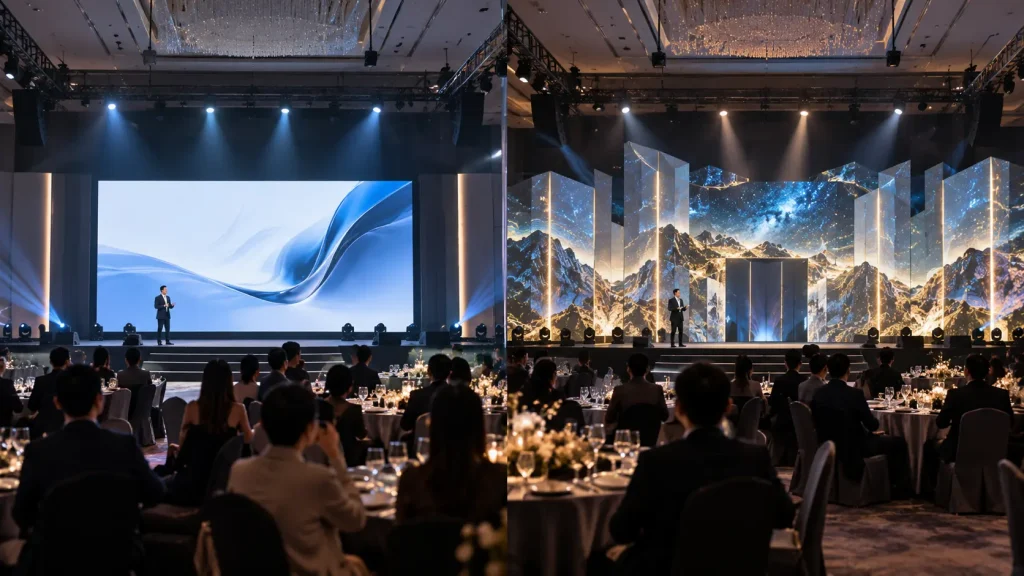
Projection Mapping vs LED Screen: Quick Comparison
| Factor | Projection Mapping | LED Screen |
|---|---|---|
| Main Strength | Transforms physical surfaces and environments | Displays clear, bright screen content |
| Surface | Walls, scenic structures, products, buildings, floors | Fixed rectangular LED display |
| Visual Shape | Can follow irregular physical geometry | Normally rectangular |
| Brightness | More dependent on ambient light and surface conditions | Generally stronger in bright environments |
| Presentations & Text | Possible, but not always the best use | Very suitable |
| Creative Transformation | Very strong | Limited to content displayed inside the screen |
| Physical Integration | Can integrate with architecture, products and scenic design | Screen remains a visible display structure |
| Setup | Requires projector positioning, mapping and calibration | Requires LED structure, processing and signal setup |
| Best For | Opening shows, reveals, storytelling and immersive experiences | Presentations, live feed, videos, information and programme content |
What Is the Main Difference?
The simplest difference is that an LED screen is a display, while projection mapping can turn a physical surface into part of the experience.
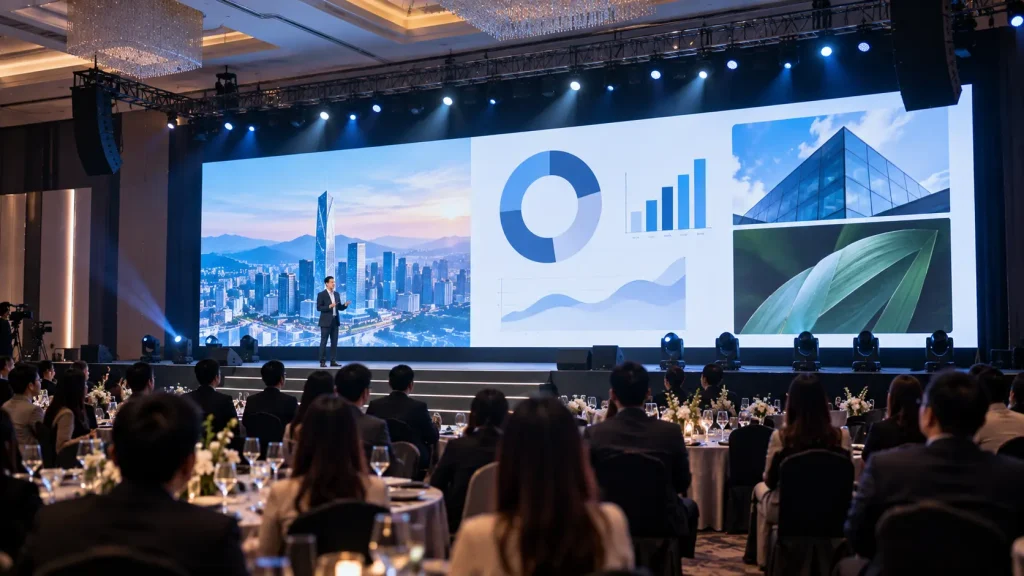
If a company needs to show a CEO presentation, corporate video, sponsor logo, live camera feed or lucky draw result throughout an event, an LED screen is usually a practical solution.
If the objective is to make a stage appear to transform, reveal a product dramatically or animate the architecture of a building, projection mapping provides more creative freedom.
This is why the two technologies should not always be treated as direct substitutes.
When Is an LED Screen the Better Choice?
LED screens are particularly effective when clarity, brightness and continuous information display are the priorities.
Typical applications include:
- Corporate presentations
- Live camera feeds
- Videos
- Speaker slides
- Event agendas
- Lucky draw results
- Award categories
- Sponsor content
- Conference information
LED is also generally easier to view in brighter environments because the display produces its own light.
For events where most of the visual requirement is conventional screen content, using projection mapping simply to reproduce a rectangular screen may add complexity without adding meaningful value.
When Is Projection Mapping the Better Choice?
Projection mapping becomes valuable when the physical environment itself should change visually.
Instead of placing all content inside a rectangle, projection can follow the shape of scenic panels, architectural features, products or other suitable surfaces.
This makes it particularly effective for:
- Opening gimmicks
- Product reveals
- Corporate storytelling
- Stage transformation
- Building projection
- Brand experiences
- Museum installations
- Immersive environments
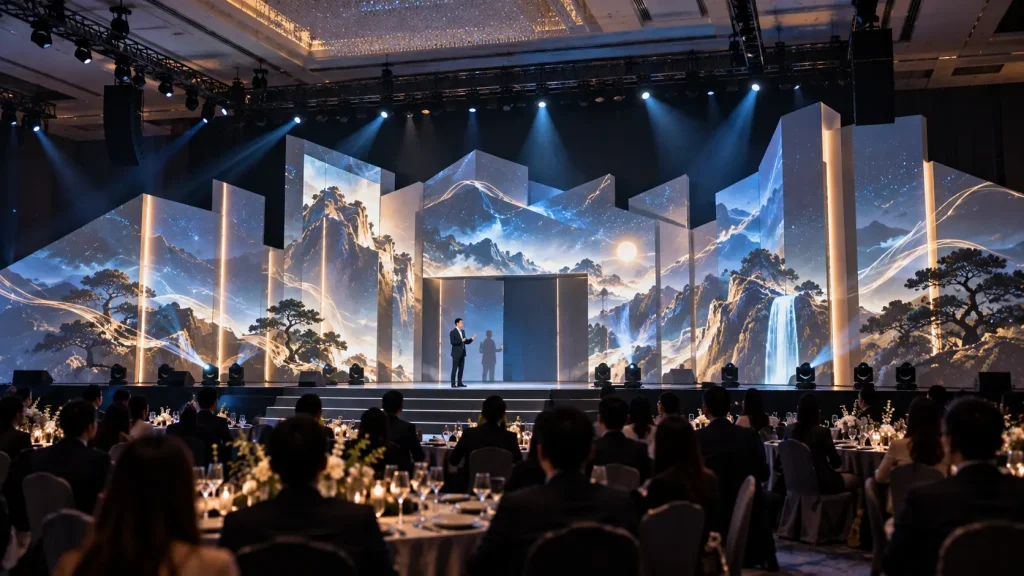
For example, a stage with several physical scenic layers can remain relatively simple before the show. Projection mapping can then transform those same structures into different visual environments during the opening sequence.
Learn more about the broader technology in our Projection Mapping Malaysia guide.
Which Looks More Impressive?
Neither technology is automatically more impressive.
A large, well-designed LED stage can look significantly better than poorly planned projection mapping. Similarly, carefully designed projection mapping can create an effect that a conventional rectangular screen cannot reproduce.
The visual impact depends on whether the technology supports the creative idea.
If the objective is a massive high-resolution digital backdrop, LED may be the stronger choice.
If the objective is to make audiences question where the physical stage ends and the digital content begins, projection mapping has a different advantage.
Brightness: LED Screen or Projection Mapping?
Brightness is one of the most important differences between the two systems.
LED screens generally perform better when the venue has significant ambient light because the LEDs directly emit light toward the audience.
Projection works by reflecting light from a physical surface. Its perceived brightness therefore depends on factors including:
- Projector output
- Projection area
- Surface colour and material
- Ambient lighting
- Throw distance and lens
- Outdoor or indoor conditions
This does not mean projection mapping requires a completely dark venue. It means lighting and projection need to be planned together.
For outdoor building projection mapping, testing is normally carried out under realistic night conditions because surrounding lighting can significantly affect contrast.
Which Is Better for an Annual Dinner?
For many annual dinners, the strongest solution is not choosing only one technology.
The central LED screen can handle practical programme content such as:
- Welcome visuals
- Corporate videos
- Live feed
- Award names
- Lucky draw
- Presentation slides
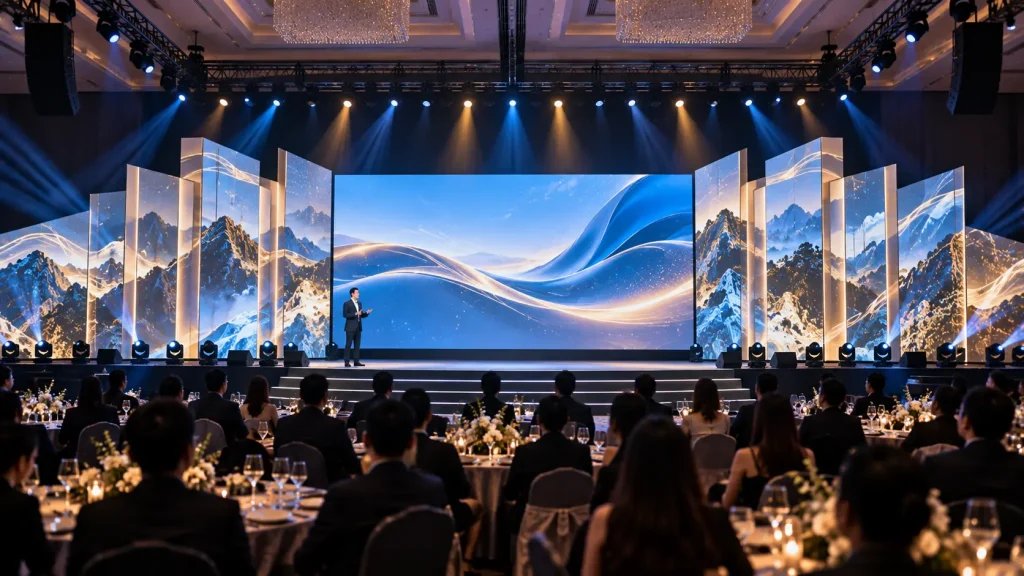
Projection mapping can then be applied to physical scenic structures around the LED screen for selected moments such as the opening show, management entrance, awards or theme transformation.
This creates a useful division:
LED Screen = Information
Projection Mapping = Experience
The projection system does not necessarily need to operate as the main visual source throughout the entire dinner.
See our Projection Mapping for Annual Dinners guide for more examples.
Which Is Better for a Product Launch?
Product launches are another situation where the choice depends on the reveal concept.
An LED screen works well when the launch relies heavily on product films, specifications, presentations and large-format brand visuals.
Projection mapping becomes more interesting when the real product needs to become part of the reveal.
For example, projection may be used to:
- Animate the surface of a vehicle
- Transform scenic structures surrounding a product
- Create visual anticipation before a reveal
- Connect the physical product with animated environments
A launch can also combine both systems: LED provides the main presentation canvas while projection mapping creates the physical reveal moment.
For more examples, see Projection Mapping for Product Launches.
Projection Mapping vs LED for Stage Design
LED screens naturally become visible physical elements of a stage. This can be useful when a large digital backdrop is part of the intended design.
Projection mapping offers a different approach because the scenic structure itself can become the display surface.
A designer can therefore create:
- Layered panels
- Columns
- Geometric surfaces
- Architectural shapes
- Textured scenic structures
These structures can appear relatively neutral before projection and then change dramatically when mapped content begins.
The advantage is not that the projector becomes invisible. The advantage is that the display no longer needs to look like a conventional screen.
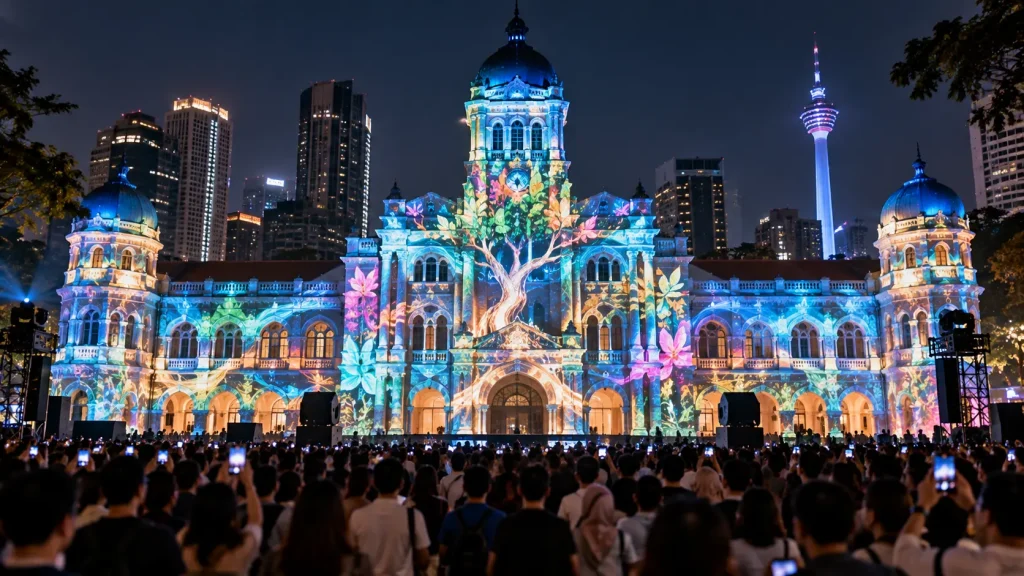
What About Building Projection Mapping?
For architecture, the comparison becomes much clearer.
Installing an LED screen across an entire building facade would fundamentally change the physical appearance and require a large supporting structure.
Projection mapping can instead use the existing facade as the visual canvas.
Windows, columns and architectural details can be incorporated into the animation so the content appears to interact with the building itself.
This makes projection particularly suitable for selected outdoor shows, festivals, celebrations, launches and architectural experiences.
Can Projection Mapping Replace an LED Screen Completely?
Technically, projection can display many types of conventional content, but that does not mean it should always replace LED.
If an event requires hours of presentations, readable text, live feed and programme information, an LED screen may provide a more straightforward main display.
Projection mapping is strongest when its ability to transform physical surfaces contributes to the experience.
The decision should therefore begin with the content and audience requirement—not with the technology name.
Can LED and Projection Mapping Be Used Together?
Yes, and this is often one of the most practical approaches for corporate events.
A central LED screen can remain the reliable content canvas while projection mapping extends the visual design beyond the screen onto physical scenic elements.
During normal programme segments, the projection surfaces can remain subtle.
During important moments, the LED content, mapped surfaces, lighting and audio can be synchronised to create a larger visual sequence.
This hybrid approach provides both:
Functional communication + creative transformation.
Venue Requirements: Which System Is Easier to Use?
Both LED screens and projection mapping require suitable venue conditions, but the requirements are different.
For an LED screen, planning normally focuses on the screen size, supporting structure, power, installation access, viewing distance and signal distribution.
Projection mapping requires additional consideration of the relationship between the projector and the physical surface.
Important factors include:
- Projection distance
- Available projector positions
- Surface size, colour and material
- Ambient lighting
- Audience movement
- Possible shadows
- Ceiling height or rigging positions
- Physical obstructions
This is why a site survey is particularly useful for projection mapping. A concept that works in one ballroom, exhibition hall or outdoor location may require a different technical configuration in another venue.
Which Requires More Setup and Calibration?
Projection mapping generally requires more visual calibration because the projected image must align accurately with the real physical surface.
Depending on the project, setup may include projector positioning, lens adjustment, warping, masking, edge blending and content alignment.
LED installation has its own technical requirements, including panel assembly, structural support, processing and signal configuration, but the final display surface remains a predictable digital canvas.
For projection mapping, the venue itself becomes part of that canvas.
This makes adequate setup and testing time important, particularly for complex scenic structures, multiple projectors or large architectural surfaces.
Content Production: Is the Same Video Used for Both?
Not always.
Conventional 16:9 videos, presentation slides and live camera feeds naturally suit a rectangular LED screen.
Projection mapping content should ideally be designed according to the dimensions and geometry of the mapped surface.
For example, if a stage contains several physical columns and layered panels, the animation can be created so visual elements move between those individual structures.
Similarly, building projection mapping content can be designed around windows, columns and architectural features.
Existing videos and brand assets can still be incorporated, but additional motion design or 3D content may be required when the objective is to create a convincing transformation effect.
Which Is Better for Live Feed, Slides and Readable Information?
For conventional event information, LED is usually the more practical choice.
Presentations, spreadsheets, speaker slides, names, schedules and live camera feeds benefit from a predictable rectangular display with strong visibility.
Projection mapping can display text and video, but using a creatively mapped scenic structure as the primary presentation screen may reduce readability.
This is another reason hybrid setups can work well: keep information on LED and use projection mapping where visual transformation adds value.
Projection Mapping vs LED Screen Cost
There is no universal rule that projection mapping is cheaper or more expensive than LED.
The cost depends on the scale and requirements of the project.
| Cost Area | Projection Mapping | LED Screen |
|---|---|---|
| Display Hardware | Projectors, lenses, mounting and playback | LED panels, processors and supporting structure |
| Content | May require customised mapped animation | Can often use standard video formats |
| Installation | Positioning and calibration required | Panel assembly and structural installation required |
| Scenic Requirement | May use existing architecture or custom scenic surfaces | Requires the physical LED display structure |
| Scale | Cost changes with projection area and projector coverage | Cost changes with total LED screen area and specification |
A small projection mapping installation should not be compared directly with a very large LED wall, and a complex multi-projector building show should not be compared with a simple indoor screen.
The more useful question is:
Which solution achieves the required experience within the available budget?
For projection-specific budget factors, see our Projection Mapping Cost Malaysia guide.
Can Projection Mapping Reduce Scenic Construction?
In some projects, projection mapping can allow one physical scenic structure to support several visual looks.
Instead of physically changing the stage for every scene, mapped content can alter its apparent colour, texture, depth and atmosphere.
However, this does not mean projection removes the need for physical scenic design.
The physical surface still needs to provide a suitable canvas, and the strongest results often come from planning scenic design and projection content together.
Which Is Better for Temporary Events?
Both technologies are widely suitable for temporary events.
LED may be preferable when the event requires a dependable main screen for long programme hours.
Projection mapping becomes attractive when selected moments need a stronger visual transformation, such as:
- Opening sequences
- CEO entrances
- Product reveals
- Award segments
- Theme transitions
- Closing shows
For many corporate events, projection mapping does not need to replace the main screen or operate at maximum intensity throughout the programme.
Which Is Better for Permanent Installations?
The decision for a permanent installation depends heavily on the intended experience.
LED can be suitable for information displays, digital walls, dashboards and content that needs to remain bright and readable throughout operating hours.
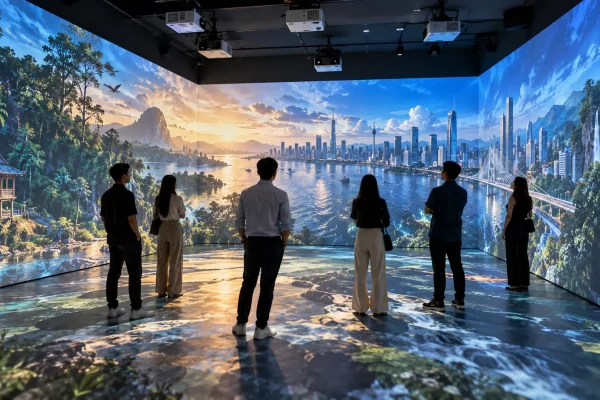
Projection is useful when the physical environment needs to become part of the content, such as in museums, visitor centres and immersive projection experiences.
Permanent projection systems also require planning for projector access, alignment, ventilation, playback equipment and future maintenance.
How to Choose Between Projection Mapping and LED
A practical way to choose is to begin with what the audience needs to experience.
| If Your Priority Is… | Consider… |
|---|---|
| Presentation slides and readable information | LED Screen |
| Live camera feed throughout the event | LED Screen |
| High visibility in a bright environment | LED Screen |
| Transforming physical stage structures | Projection Mapping |
| Animating a building facade | Projection Mapping |
| Creating a dramatic product reveal | Projection Mapping or Hybrid |
| Corporate annual dinner with programme content and opening show | Hybrid |
| Immersive museum or visitor experience | Projection Mapping / Immersive Projection |
When Should You Use Both?
Using both technologies makes sense when an event has two different visual requirements:
1. Information that needs to remain clear and readable.
2. Selected moments that need to feel visually transformative.
For example, an annual dinner may use a central LED screen throughout the programme while projection mapping covers physical scenic structures surrounding it.
During speeches, the LED remains the main information display.
During the opening show, the LED, projection mapping, lighting and audio can work together as one visual environment.
The same principle can be applied to product launches, conferences, exhibitions and corporate celebrations.
Avoid Choosing Technology Before the Experience
One common mistake is deciding that an event needs projection mapping or a large LED screen before defining what the audience should actually experience.
A better process is:
- Define the important event moments.
- Identify what information the audience needs to see.
- Determine where visual transformation adds value.
- Review the venue and physical surfaces.
- Choose LED, projection mapping or a combination based on those requirements.
This helps prevent unnecessary technology from being added simply because it looks impressive in a reference video.
Planning Projection Mapping with MyDigital Asia
MyDigital Asia develops projection mapping and interactive visual experiences for corporate events, product launches, annual dinners, exhibitions, buildings, museums and immersive environments in Malaysia.
Depending on the project, we can support:
- Projection mapping concept development
- Venue and surface evaluation
- Projector and lens planning
- Scenic projection planning
- 2D and 3D mapped content
- Multi-projector alignment and edge blending
- Interactive projection
- Immersive projection environments
- Playback and show control
- On-site installation and calibration
Where an LED screen is already provided by the venue or event production team, projection mapping can also be designed to complement the existing screen rather than replace it.
Frequently Asked Questions
Is projection mapping better than an LED screen?
Not in every situation. LED is often better for bright, readable and continuous screen content, while projection mapping is stronger when physical surfaces need to become part of the visual experience.
Is projection mapping cheaper than LED?
Not necessarily. Pricing depends on the projection area, projector requirements, content production, installation and venue conditions. LED pricing also varies according to screen size, specification and supporting structure.
Can projection mapping work beside an LED screen?
Yes. A central LED screen can display presentations and live content while projection mapping extends visuals onto surrounding physical scenic structures.
Can projection mapping be used in a hotel ballroom?
Yes, subject to projector positions, ceiling conditions, lighting, scenic surfaces and available setup time. This approach is particularly relevant for annual dinners and corporate events.
Which is better for a product launch?
LED is useful for product videos and presentations. Projection mapping can add more value when the launch requires a physical product reveal, vehicle mapping or scenic transformation. Many launches can benefit from combining both.
Do I need projection mapping throughout the entire event?
No. Projection mapping can be reserved for key moments such as the opening, reveal, awards or closing sequence while other display systems handle the rest of the programme.
Projection Mapping or LED Screen? Plan Around the Experience
The best solution is not determined by which technology is newer or more visually impressive.
It depends on what the audience needs to see and what the event needs them to feel.
If the priority is clear information, presentations and continuous visual content, an LED screen may be the right foundation.
If the objective is to transform architecture, scenic structures, products or an entire environment, projection mapping offers possibilities beyond the boundaries of a conventional screen.
And when an event needs both functions, the two technologies can work together.
Planning an event or projection mapping project in Malaysia? Contact MyDigital Asia to discuss your venue, visual concept and technical requirements.
Related Projection Mapping Guides
- Projection Mapping Malaysia
- Projection Mapping Cost Malaysia
- Projection Mapping for Corporate Events
- Building Projection Mapping Malaysia
- Projection Mapping for Product Launches
- Projection Mapping for Annual Dinners
- Interactive Projection Mapping Malaysia
- Interactive Floor Projection Malaysia
- Immersive Projection Malaysia
Request a Free Consultation
Looking for Interactive Maps, Interactive Solutions or Event Technology?

LATEST POSTS