
Immersive Experience Malaysia
An immersive experience transforms a physical space into an environment that visitors can explore, interact with and remember.
Instead of relying on a conventional screen or static exhibition panel, an immersive experience can combine digital content, projection, touchscreens, sensors, interactive walls, physical exhibits, lighting and sound into one connected visitor journey.
MyDigital Asia develops immersive experiences in Malaysia for museums, visitor centres, exhibitions, corporate spaces, brand activations and events.
The objective is not to add technology everywhere. It is to use the right combination of physical and digital elements to help visitors understand, participate in and connect with the story.
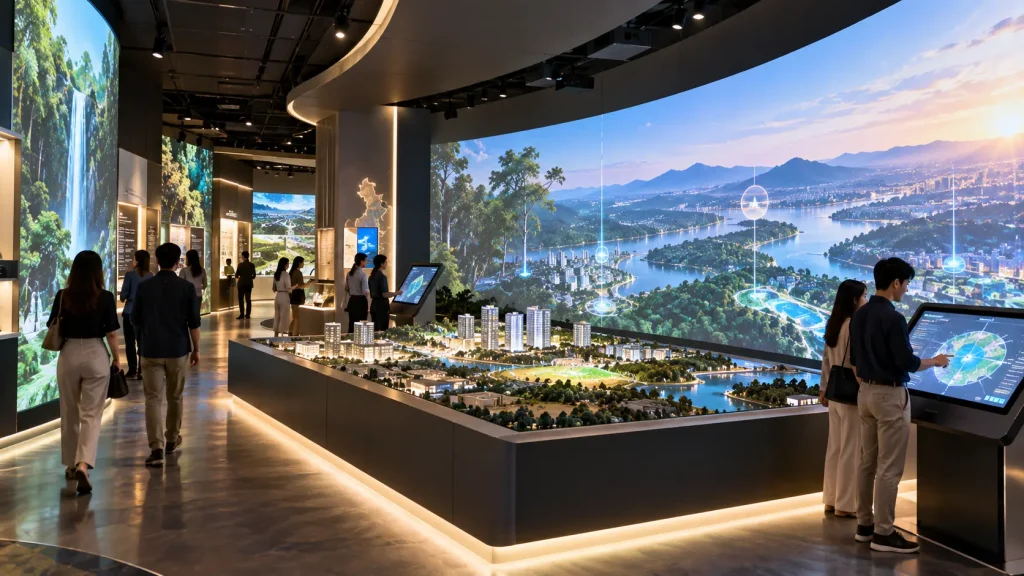
Immersive Experience at a Glance
| Application | What Visitors Experience | Possible Technology |
|---|---|---|
| Museum | Explore stories, environments and exhibits | Projection, touchscreens, sensors, audio |
| Visitor Centre | Understand a development, destination or organisation | Interactive maps, projection, physical models, touch displays |
| Exhibition | Enter, explore and interact with a branded experience | Interactive walls, games, projection, RFID |
| Experience Centre | Move through a complete digital visitor journey | Multiple interactive and immersive systems |
| Brand Activation | Participate, create and share | Motion tracking, interactive content, games, digital installations |
| Corporate Event | Experience selected high-impact moments | Projection, interactive installations, launch technology |
What Is an Immersive Experience?
An immersive experience is designed around what visitors see, hear and do inside a physical environment.
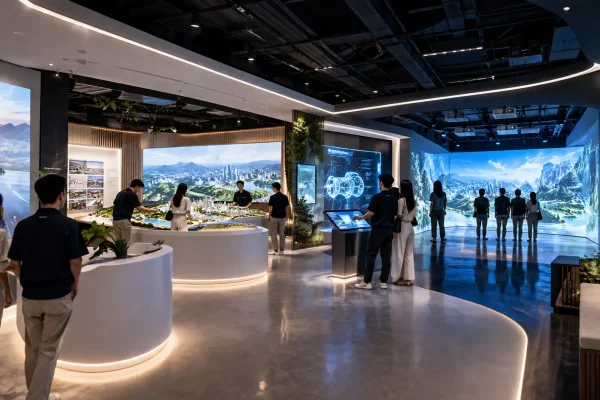
For example, a visitor may enter a gallery and see a physical model of a future development. Touching a nearby interactive display highlights a selected location on the model while surrounding visuals explain the area, infrastructure and future plans.
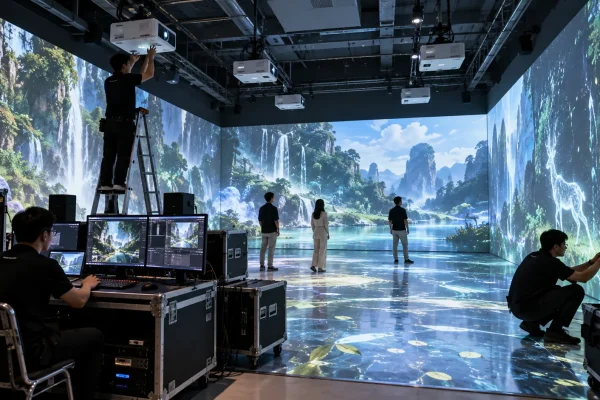
In another experience, visitors may walk into a room where multiple walls become a continuous digital environment. Motion tracking can then allow selected visuals to respond as people move through the space.
Both are immersive experiences, even though the technology and visual style are very different.
The important question is therefore not:
“Which technology should we install?”
It is:
“What should visitors experience in this space?”
What Can an Immersive Experience Include?
An immersive installation can combine several technologies depending on the project.
Immersive Projection
Multiple physical surfaces can become part of a digital environment using projection and mapped content.
This can range from a panoramic wall to a multi-wall room with floor projection. Learn more in our Immersive Projection Malaysia guide.
Interactive Touchscreens
Touchscreens allow visitors to explore information at their own pace, including maps, timelines, products, videos, specifications and stories.
They can also act as control points for other elements in the space instead of functioning only as standalone kiosks.
Interactive Walls and Floors
Tracking systems can detect movement and allow projected content to respond to visitors.
An interactive wall may react to hand or body movement, while an interactive floor can respond to footsteps and visitor position.
Physical Exhibits and Models
Immersive does not mean everything needs to become digital.
Real products, artefacts, architectural models and scenic elements can remain central to the experience while digital technology adds information, animation or interaction around them.
Sensors and Tracking
Sensors can detect movement, proximity, gestures or interaction with selected areas of an installation.
This allows digital content to respond in real time rather than playing the same sequence regardless of what the visitor does.
RFID and Object-Based Interaction
Physical cards, products or objects can also become triggers.
For example, placing a tagged object at a specific station could activate related content on a nearby screen or projection surface.
Lighting and Audio
Lighting and sound help connect individual installations into a consistent environment.
A change in content can be supported by changes in lighting, music or sound effects, helping the visitor feel that the entire space is responding as one experience.
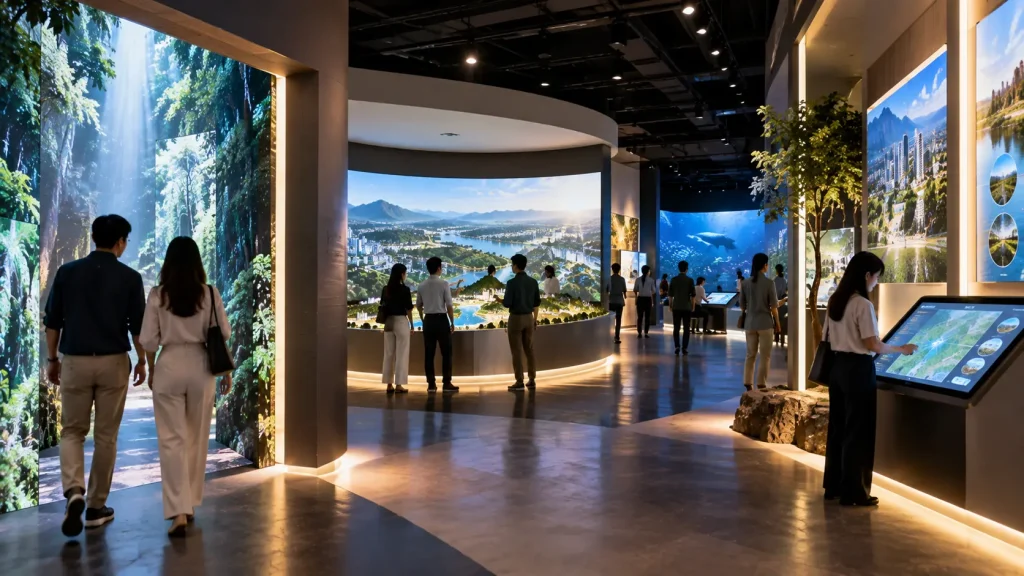
Immersive Experience for Museums
Museums can use immersive technology to complement physical artefacts and traditional interpretation.
A historical object may remain inside a real display case while surrounding projection recreates the environment in which it was originally used.
Visitors can then explore additional information through interactive displays instead of placing every detail on static wall panels.
This creates a layered experience:
Real Artefact → Digital Context → Visitor Interaction
The technology supports the story without replacing the physical collection.
Immersive Experience for Visitor Centres
Visitor centres often need to communicate information that is difficult to understand through conventional displays alone.
This may include:
- Property masterplans
- Infrastructure projects
- Urban development
- Tourism destinations
- Corporate history
- Sustainability programmes
- Government initiatives
A visitor journey could begin with a large overview, continue to an interactive physical model or map, and then allow visitors to explore individual topics through touchscreens or immersive environments.
Instead of presenting every piece of information simultaneously, content is revealed according to the visitor journey.
Immersive Experience for Exhibitions
At an exhibition, immersive technology can help turn a booth into an experience rather than simply another display area.
A visitor might:
- Notice a moving digital installation from the aisle.
- Enter the booth and trigger an interactive experience.
- Explore a product or story through touch or physical interaction.
- Complete a short challenge or personalised experience.
- Continue to a product demonstration or conversation with the brand team.
This is different from placing several unrelated screens inside a booth.
The individual touchpoints should support one visitor journey.
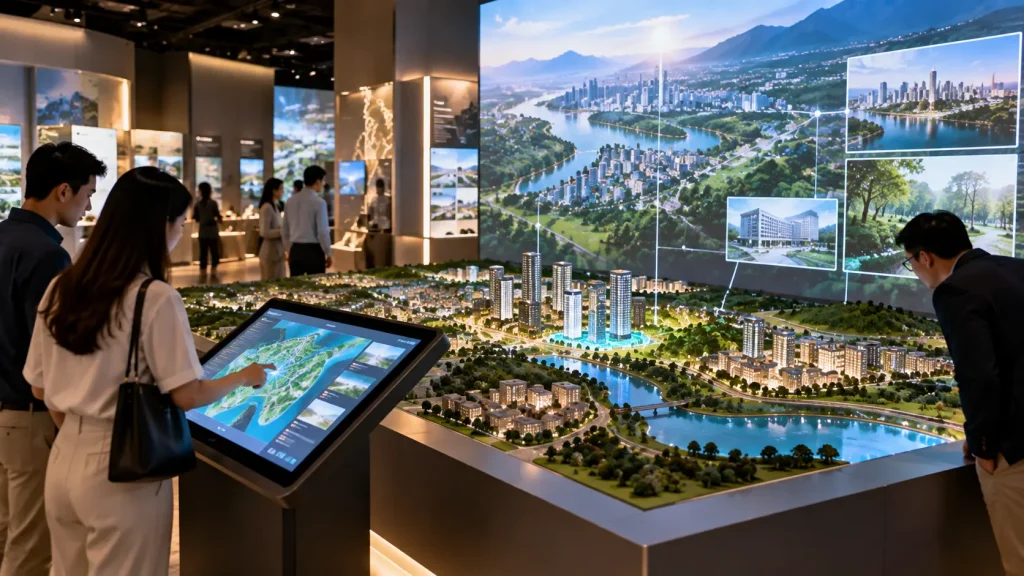
Immersive Brand Experiences
Brand activations often benefit from shorter and more participatory experiences.
Instead of asking visitors to watch a long presentation, the experience can encourage them to perform an action and receive an immediate visual response.
Examples include:
- Motion-controlled visual installations
- Interactive product exploration
- Digital games
- Responsive projection
- Personalised content
- Interactive photo experiences
The strongest activation is not necessarily the one with the most technology. It is the one where visitors quickly understand what to do and want to participate.
Immersive Experiences for Corporate Events
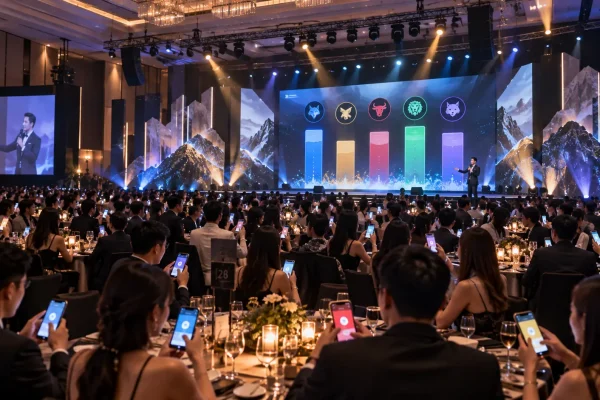
Corporate events usually do not require the entire venue to become immersive.
Instead, immersive technology can be concentrated at selected moments or locations such as:
- Entrance experiences
- Pre-function areas
- Opening sequences
- Product launch zones
- Interactive exhibition areas
- Brand storytelling installations
This allows the main ballroom or conference programme to remain practical while giving guests a memorable experience before or during the event.
What Makes an Immersive Experience Effective?
Technology alone does not make a space immersive.
A successful experience usually connects four elements:
| Element | Question |
|---|---|
| Story | What should visitors understand or feel? |
| Space | How should visitors move through the environment? |
| Interaction | What should visitors actually do? |
| Technology | Which system delivers that experience effectively? |
If technology is selected before these questions are answered, the result can become a collection of impressive devices without a clear visitor journey.
For MyDigital Asia projects, the better starting point is therefore:
Visitor Journey → Experience Concept → Physical Space → Content → Technology
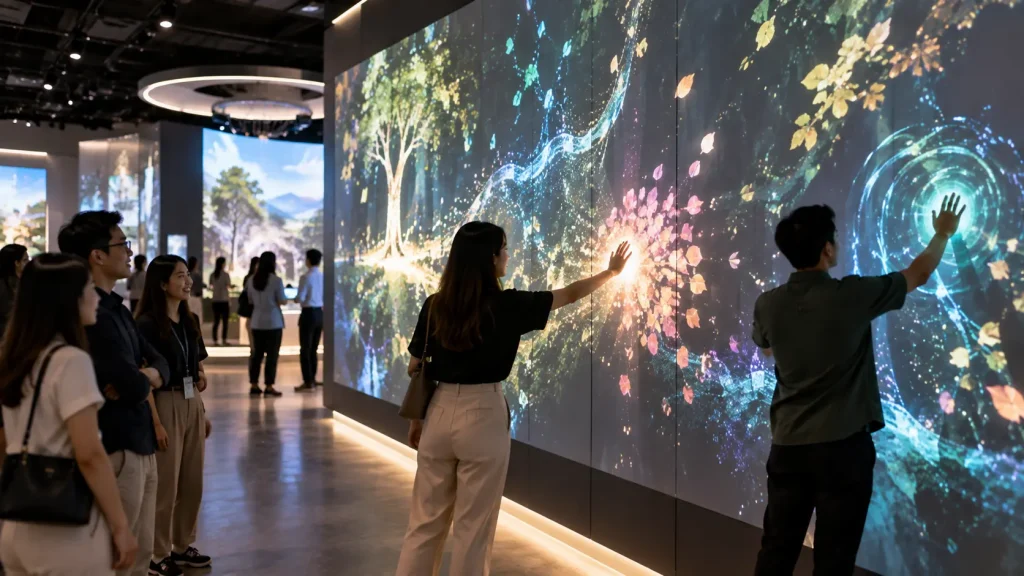
How Do You Plan the Visitor Journey?
An immersive experience should be planned around how visitors move through the space, not only around where technology can be installed.
A simple visitor journey may include:
- Attract – Give visitors a reason to approach or enter.
- Discover – Introduce the main story or experience.
- Interact – Allow visitors to touch, move, explore or make a choice.
- Respond – Provide immediate visual, physical or audio feedback.
- Explore – Reveal deeper information according to visitor interest.
- Complete – End with a clear takeaway, result or next action.
Not every project needs all six stages. A short brand activation may last only a few minutes, while a museum or visitor centre may contain several connected experience zones.
The important point is that each technology should have a clear role within the journey.
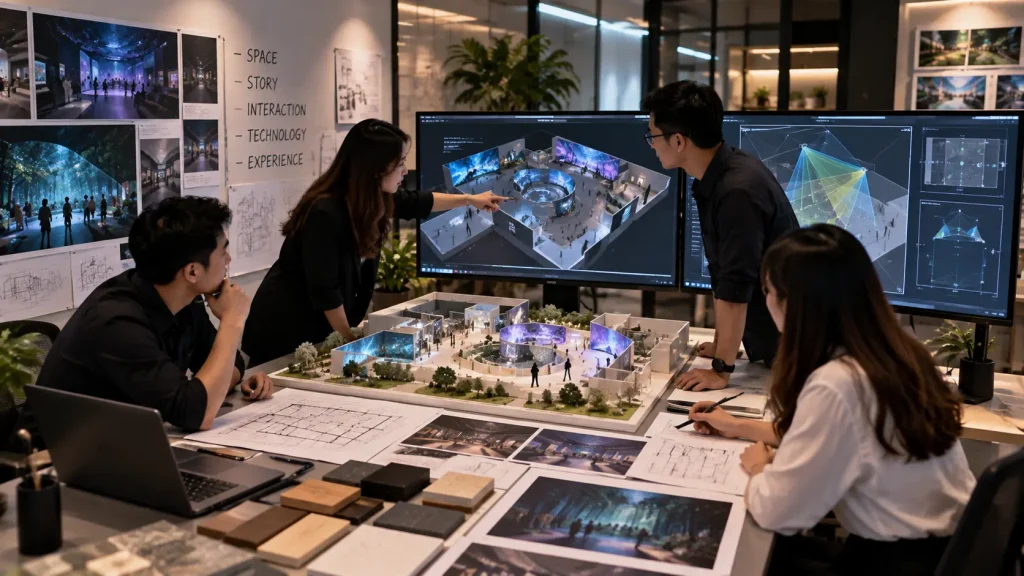
How Is an Immersive Experience Designed?
The design process normally begins with the objective rather than the equipment.
For example, a property visitor centre may need visitors to understand a large development quickly. Instead of immediately deciding to install several touchscreens, the experience can first be divided into key questions:
- What is the overall development?
- Where is it located?
- How are the different areas connected?
- What facilities or infrastructure are available?
- Which information should visitors explore individually?
The physical and digital experience can then be designed around those questions.
A large overview may use projection or a digital wall, a physical model may explain spatial relationships, and a touchscreen may allow visitors to explore individual locations in more detail.
This creates a connected system instead of several unrelated installations.
What Space Is Needed?
There is no fixed room size required for an immersive experience.
The space depends on the type of experience, number of visitors and technologies involved.
A site evaluation should consider:
- Available floor area
- Ceiling height
- Wall and floor surfaces
- Visitor entry and exit
- Expected visitor capacity
- Ambient lighting
- Power and network access
- Equipment installation positions
- Accessibility and safety
For projection-based experiences, projector throw distance and mounting positions also need to be evaluated. Interactive installations may require sufficient space for visitors to move without blocking other users.
The technology should adapt to the physical environment rather than forcing every project into the same standard layout.
How Important Is Content?
Content is one of the most important parts of an immersive experience.
Hardware determines how the experience is delivered, but content determines what visitors actually see, understand and remember.
Depending on the project, content may include:
- 2D motion graphics
- 3D animation
- Historical imagery
- Interactive maps
- Product visualisation
- Video
- Real-time graphics
- Data visualisation
- Games and interactive challenges
- Audio and environmental sound
The same content should not simply be duplicated across every screen. Each touchpoint should provide information that makes sense at that stage of the visitor journey.
Temporary vs Permanent Immersive Experiences
| Temporary Experience | Permanent Installation |
|---|---|
| Events, exhibitions and activations | Museums, visitor centres and experience centres |
| Designed for shorter operating periods | Designed for regular long-term operation |
| Fast installation and dismantling are important | Maintenance access and reliability are important |
| Often uses temporary scenic structures | Technology can be integrated into architecture |
| Operator support may be available on-site | Automatic daily operation may be required |
| Content usually supports one campaign or event | Content may need future updates |
A temporary exhibition experience and a permanent museum installation may use similar technologies, but they should not be designed in exactly the same way.
Permanent installations need additional planning for equipment access, system startup and shutdown, maintenance, content updates and long-term usability.
Can an Immersive Experience Be Updated Later?
Yes. Permanent systems can be designed so selected content can be updated without rebuilding the entire physical installation.
For example, a visitor centre may keep its physical model, projectors and touchscreens while introducing new developments, videos or interactive content over time.
Planning for future updates from the beginning can make the installation more useful as a long-term communication platform.
How Much Does an Immersive Experience Cost in Malaysia?
There is no standard price because an immersive experience can range from one interactive installation to an entire multi-zone visitor centre.
The main cost factors include:
- Size of the experience
- Number of experience zones
- Projection and display requirements
- Interactive hardware and sensors
- Software development
- 2D or 3D content production
- Physical fabrication
- Audio and lighting
- Installation and integration
- Temporary or permanent operation
A useful budget should therefore be based on the required visitor experience rather than only the number of screens or projectors.
For larger projects, the experience can also be divided into essential and optional zones so the concept can be developed around the available budget.
Our Immersive Experience Cost Malaysia guide explores these budget factors in more detail.
What Is the Project Process?
A typical immersive experience project can follow six main stages:
- Brief & Objectives – Understand the audience, message, venue and project goals.
- Experience Concept – Plan the visitor journey and key experience zones.
- Technical Planning – Select suitable projection, displays, sensors, software and physical systems.
- Content & Development – Produce visual content and develop interactive applications.
- Installation & Integration – Install and connect the physical and digital systems.
- Testing & Launch – Test the complete visitor journey before opening.
For permanent installations, training, documentation and ongoing support can also be considered as part of the project scope.
How Long Does an Immersive Experience Take to Develop?
The timeline depends on the scale and level of customisation.
A focused event installation with existing content can usually be developed more quickly than a permanent visitor centre containing custom fabrication, interactive software, projection and original content.
Projects involving construction or exhibition design should ideally include the immersive technology team early so equipment positions, surfaces, cable routes and maintenance access can be coordinated before fabrication is completed.
What Information Is Needed for a Proposal?
To prepare an initial immersive experience proposal, useful information includes:
- Project type and objective
- Venue or location
- Available space or floor plan
- Photos or videos of the site
- Target audience
- Expected visitor capacity
- Key messages or content
- Preferred interactive elements
- Temporary or permanent installation
- Project timeline
- Estimated budget range, if available
If the exact technology has not yet been selected, the experience can first be proposed based on the objective, visitor journey and available space.
Why Work with MyDigital Asia?
MyDigital Asia develops interactive and immersive experiences in Malaysia by combining creative content, software, projection, interactive technology and physical environments.
Depending on the project, our scope can include:
- Experience concept and visitor journey
- Interactive touchscreen applications
- Interactive maps and directories
- Projection mapping and immersive projection
- Interactive walls and floors
- Motion tracking and sensor integration
- RFID-triggered experiences
- 2D and 3D content production
- Physical exhibit integration
- System installation and testing
The objective is to design the different elements as one connected experience rather than treating each technology as a separate installation.
Frequently Asked Questions
Does an immersive experience always require projection?
No. Projection is one option. An immersive experience can also combine touchscreens, physical exhibits, interactive walls, sensors, RFID, lighting, sound and other digital systems.
Can an existing space be converted into an immersive experience?
Yes, depending on the available space, surfaces, lighting and technical conditions. A site evaluation can determine which parts of the existing environment can be retained or adapted.
Can visitors interact with the experience?
Yes. Interaction can use touch, movement, gestures, physical objects, RFID or other suitable inputs depending on the concept.
Can immersive experiences support multiple visitors?
Yes. The interaction design can be developed for individual users, small groups or larger visitor flows depending on the space and application.
Can the system operate without a technician?
Permanent installations can be designed for simplified daily operation or automated startup and shutdown, depending on the hardware and software configuration.
Is immersive technology suitable only for large projects?
No. A project can begin with one focused interactive experience and expand into multiple connected zones when the space and objective require it.
Create an Immersive Experience in Malaysia
An effective immersive experience is not defined by how many screens, projectors or sensors are installed.
It is defined by how well the physical space, content and interaction work together to guide the visitor through a meaningful experience.
Whether you are planning a museum, visitor centre, exhibition, brand activation, corporate space or event, MyDigital Asia can develop the project from experience concept through content, technology integration and installation.
Contact MyDigital Asia to discuss your space, audience and immersive experience requirements.
Related Immersive Experience Guides
- Immersive Room Malaysia
- Immersive Exhibition Malaysia
- Immersive Experience for Museums
- Interactive Experience Centre Malaysia
- Immersive Experience for Visitor Centres
- Immersive Brand Experience Malaysia
- Immersive Technology for Events
- Immersive Experience Cost Malaysia
- How to Design an Immersive Experience
Request a Free Consultation
Looking for Interactive Maps, Interactive Solutions or Event Technology?

LATEST POSTS