
Immersive Exhibition Malaysia
An immersive exhibition turns an exhibition space into an experience that visitors can enter, explore and interact with instead of simply walking past displays, posters and screens.
MyDigital Asia develops immersive and interactive exhibition experiences in Malaysia by combining physical exhibition design with digital content, projection, touchscreens, interactive installations, games and sensor-based technology.
The objective is not to fill an exhibition booth with more technology. It is to create a clear visitor journey that attracts attention, encourages participation and helps visitors understand the brand, product or message.
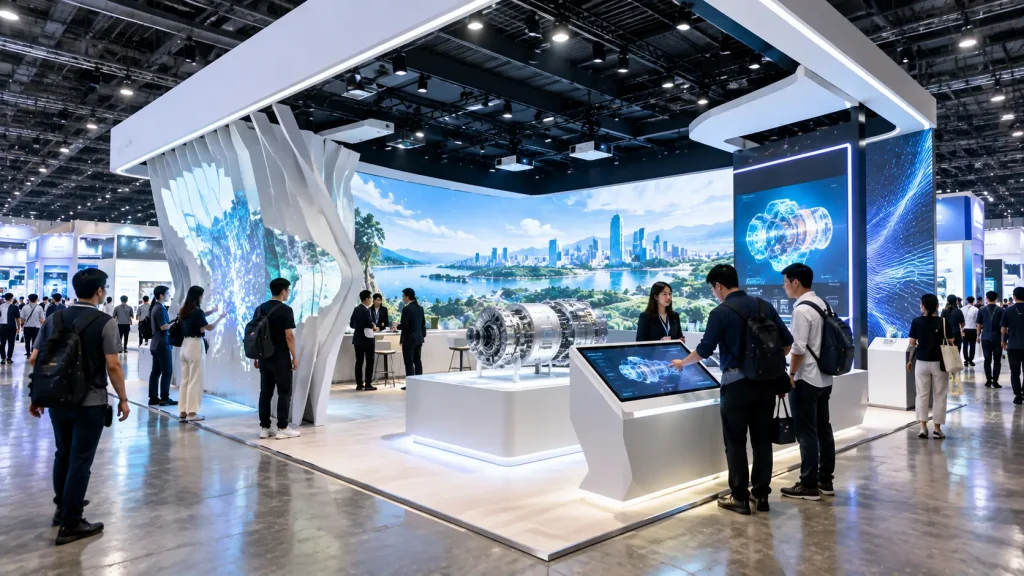
Immersive Exhibition at a Glance
| Visitor Stage | Objective | Possible Experience |
|---|---|---|
| Attract | Get attention from the aisle | Large digital visuals, projection, motion or interactive feature |
| Enter | Give visitors a reason to step inside | Entrance interaction, product feature or short challenge |
| Engage | Encourage active participation | Interactive wall, touchscreen, game or sensor experience |
| Discover | Communicate deeper information | Interactive product explorer, map, physical model or immersive room |
| Convert | Continue the conversation | Product demo, lead capture, consultation or call to action |
What Is an Immersive Exhibition?
An immersive exhibition is designed around what visitors experience as they move through the space.
Instead of treating the booth as a collection of separate elements, the physical environment, content and technology are planned to support one connected journey.
For example, a visitor may first notice a responsive digital installation from the aisle. After entering the booth, they interact with a physical product and explore its features through a nearby touchscreen. A larger digital environment then explains how the product is used before the visitor continues to a conversation with the brand team.
The technology changes according to the project, but the principle remains the same:
Attract Attention → Encourage Participation → Communicate the Story → Create a Next Step
Why Use Immersive Technology at an Exhibition?
Exhibition halls contain many brands competing for attention within the same environment.
A large screen may increase visibility, but visibility alone does not always create engagement.
Interactive and immersive technology gives visitors something to do rather than only something to watch.
This can help an exhibition space:
- Attract visitors from the aisle
- Create a stronger first impression
- Encourage visitors to spend more time in the booth
- Explain products visually
- Turn complex information into interactive content
- Create memorable participation moments
- Support conversations with the sales or brand team
The strongest solution depends on the objective. A technology exhibition, property showcase and consumer brand activation should not use the same visitor journey simply because they have similar booth sizes.
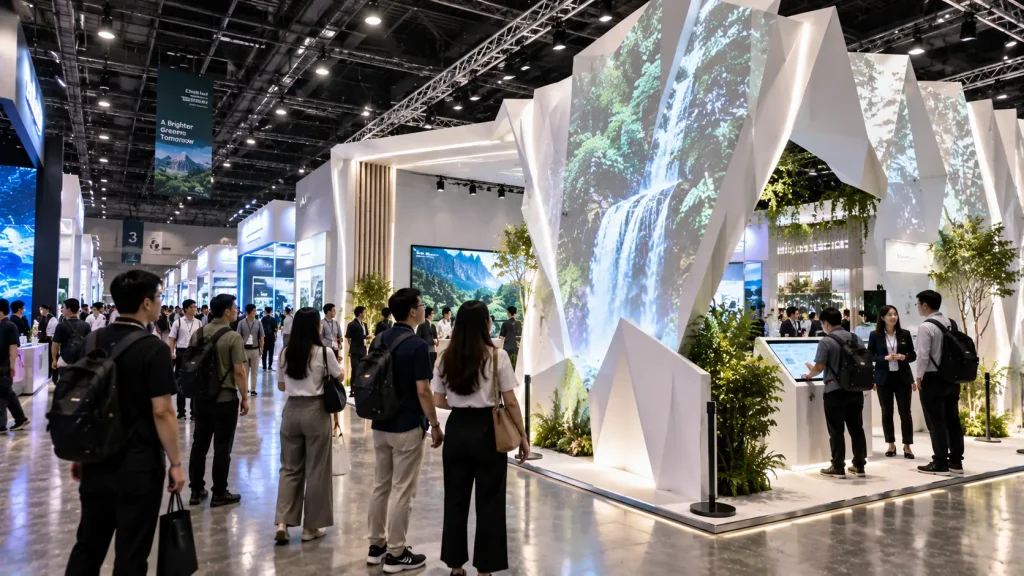
What Can Be Included in an Immersive Exhibition?
An immersive exhibition can combine physical and digital elements rather than relying on one technology.
Interactive Touchscreens
Touchscreens are useful when visitors need to explore information at their own pace.
They can present:
- Product ranges
- Specifications and features
- Interactive catalogues
- Maps and locations
- Timelines
- Videos and animation
- Before-and-after comparisons
- Product configuration
Instead of displaying every piece of information on the booth walls, a touchscreen allows deeper content to remain available without making the exhibition design visually crowded.
Interactive Walls
A large interactive wall can become both an attraction and an engagement point.
Visitors may use touch, movement or gestures to reveal content, trigger animation or participate in a branded experience.
Because the interaction can be visible from a distance, it can also encourage other visitors to approach and watch.
Projection Mapping
Projection mapping can transform physical exhibition structures, products or scenic surfaces using animated content.
Rather than adding another rectangular display, projection can make the physical booth itself become part of the visual experience.
It can be particularly useful for product storytelling, launch moments and unusual scenic structures. See our Projection Mapping for Product Launches guide for related applications.
Immersive Rooms
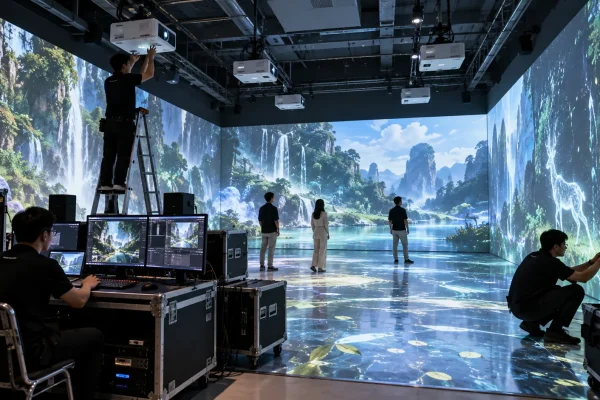
For larger exhibition spaces, a separate immersive room can create a short high-impact experience inside the booth.
Visitors can enter a controlled environment where multiple walls and selected floor areas become one continuous visual story.
This can work well for destination marketing, property development, infrastructure, technology and corporate storytelling.
Learn more about the technical and experience options in our Immersive Room Malaysia guide.
Interactive Games
Games can create a simple reason for visitors to participate.
Depending on the campaign, an exhibition game may use:
- Touch
- Reaction speed
- Body movement
- Gesture control
- Multiple-player competition
- Quiz mechanics
The game should still connect to the brand or exhibition objective where possible. Engagement is more valuable when visitors remember why they participated.
Physical Products with Digital Content
Real products can remain the centre of the experience while digital technology helps explain them.
A visitor might select a product on a touchscreen, place a physical item at an interactive station or approach a real product display.
The system can then reveal related features, animation, specifications or storytelling on another digital surface.
This creates a useful relationship:
Physical Product → Visitor Action → Digital Response
Immersive Exhibition for Product Showcases
Products are often displayed physically at exhibitions, but visitors may not immediately understand what makes them different.
Interactive technology can reveal information only when it becomes relevant.
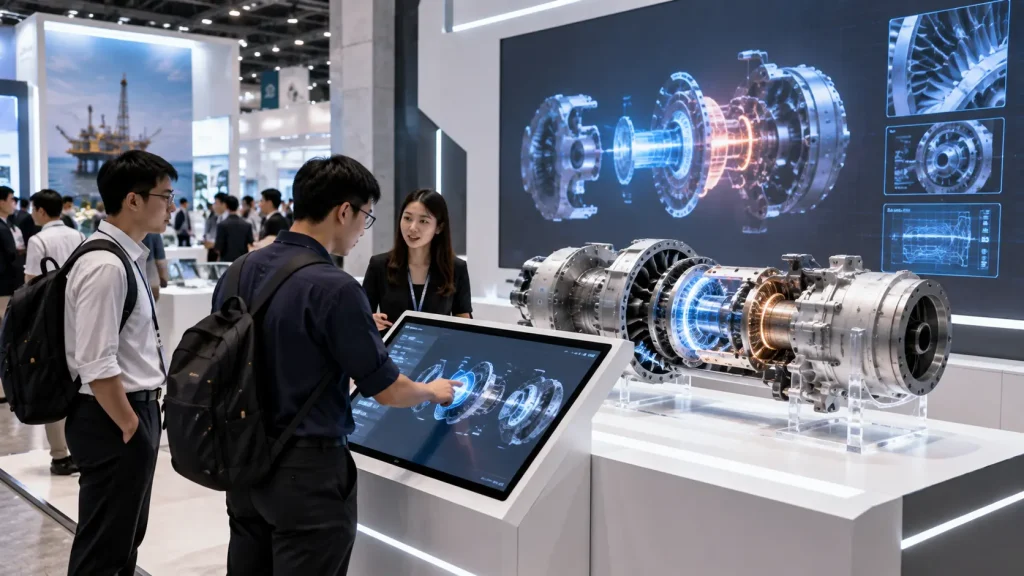
For example, an automotive or technology showcase could allow a visitor to select a feature on a touchscreen while related content appears around the physical product.
An industrial product may use animation to reveal internal components or demonstrate a process that cannot be shown physically at the exhibition.
This allows the physical product to remain the hero while digital content provides additional explanation.
Immersive Exhibition for Property and Infrastructure
Property, urban planning and infrastructure projects often involve information that is difficult to communicate through conventional posters.
An exhibition experience can combine:
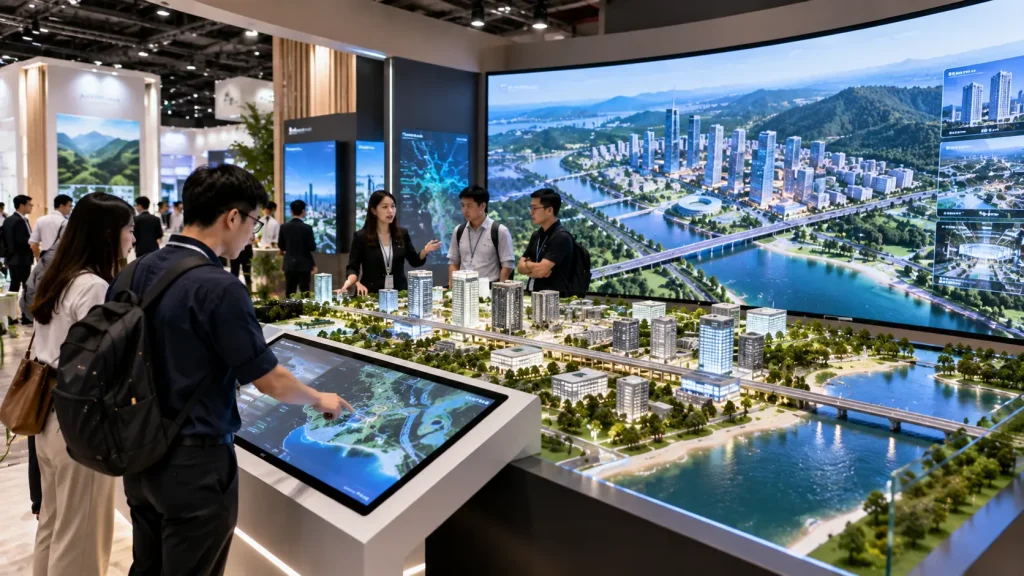
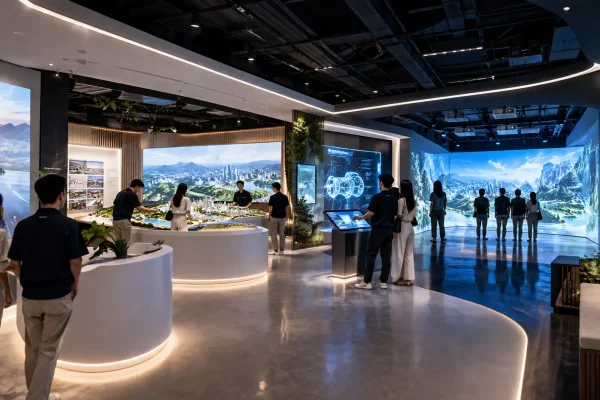
- A physical scale model
- Interactive map
- Touchscreen exploration
- Projection highlighting
- Development animation
- Large environmental visuals
A visitor could select a location or topic on a touchscreen, causing the relevant area of a physical model to highlight while supporting information appears on a larger display.
This creates a clearer relationship between location, physical development and detailed information.
Immersive Exhibition for Corporate and Technology Brands
Corporate and technology exhibitions often need to communicate services, systems or processes that are not physical products.
Instead of relying on presentation slides, the information can be divided into interactive experiences.
Visitors may explore a digital ecosystem, trigger a process visualisation, interact with a data-driven installation or move through different parts of the company’s story.
The objective is to turn abstract information into something visitors can see and experience.
Immersive Exhibition for Consumer Brands
Consumer activations usually require a faster experience.
The interaction should be easy to understand without lengthy instructions, especially in busy exhibition or mall environments.
Examples include:
- Short interactive challenges
- Motion-responsive visuals
- Digital photo experiences
- Product-triggered content
- Personalised visual results
- Interactive product discovery
Visitors should be able to understand the basic interaction within seconds.
How Should the Visitor Journey Be Planned?
An immersive exhibition should consider the visitor journey before individual technologies are selected.
A practical structure is:
1. Attract
What can visitors see from outside the booth?
The first experience should communicate movement, activity or visual interest from the aisle without requiring visitors to read detailed information.
2. Enter
Once visitors approach, there should be a clear reason to step into the space rather than watch everything from outside.
3. Engage
The visitor performs an action such as touching, moving, selecting, scanning or playing.
4. Discover
After the initial interaction, deeper product or brand information can be introduced.
5. Convert
The journey should eventually connect visitors with the next useful action, whether that is a product demonstration, registration, lead capture or conversation with the team.
Technology should support this journey instead of becoming an obstacle between the visitor and the brand.
How Much Technology Should an Exhibition Use?
More technology does not automatically create a better immersive exhibition.
A booth containing five unrelated interactive systems can feel less coherent than a booth containing two carefully connected experiences.
For example, a focused exhibition journey might use:
Large Attraction Visual → Interactive Product Station → Physical Product Demo
Another may use:
Interactive Game → Personalised Result → Brand Conversation
The technology should be selected according to what the visitor should do next.
Immersive Exhibition vs Conventional Exhibition Booth
| Conventional Exhibition | Immersive Exhibition |
|---|---|
| Visitors mainly look and read | Visitors participate and explore |
| Information is displayed simultaneously | Content can appear according to visitor actions |
| Screens often operate independently | Physical and digital elements can work together |
| Visitor path may be informal | Experience is planned around a visitor journey |
| Brand team explains most information | Interactive systems can support explanation |
This does not mean every conventional exhibition should become fully immersive. The right approach depends on the objective, audience, available space and budget.
How Much Space Is Needed for an Immersive Exhibition?
There is no fixed minimum size for an immersive exhibition.
A smaller booth may focus on one strong interactive feature, while a larger exhibition space can divide the visitor journey into several connected zones.
| Space Type | Possible Approach |
|---|---|
| Small Booth | One hero interaction supported by product display or touchscreen content |
| Medium Booth | Attraction feature, interactive zone and product exploration |
| Large Exhibition Space | Multiple connected zones, immersive room, physical exhibits and interactive experiences |
| Experience Pavilion | Structured visitor journey with several physical and digital touchpoints |
The objective is not to fit as many technologies as possible into the available floor area.
Visitors still need sufficient space to enter, interact, observe and move to the next part of the experience without creating unnecessary congestion.
Open Booth or Enclosed Immersive Experience?
Both approaches can work, but they serve different purposes.
Open Exhibition Booth
An open booth allows activity to remain visible from the exhibition aisle.
This is useful for interactive walls, games, product displays and other experiences where seeing another person participate can encourage new visitors to approach.
It also supports higher visitor turnover because people can enter and leave from multiple directions.
Enclosed Experience
An enclosed or partially enclosed space provides greater control over lighting, sound and visual attention.
This can be useful for immersive projection, cinematic storytelling or experiences where visitors should temporarily disconnect from the surrounding exhibition hall.
A temporary immersive room can therefore be built inside a larger exhibition booth when the concept requires a controlled environment.
The disadvantage is that the experience may be less visible from the aisle and visitor capacity needs to be managed more carefully.
How Many Visitors Can Use the Experience?
Visitor capacity depends on both the physical space and the interaction design.
A large visual installation may be experienced by many visitors simultaneously, while a touchscreen or individual game may support only one or several users at a time.
For busy exhibitions, the experience should consider:
- Number of simultaneous users
- Average interaction duration
- Queue space
- Entry and exit points
- Viewing space for spectators
- Movement between experience zones
An experience that takes several minutes per visitor may work well for a targeted B2B exhibition but create long queues at a high-traffic consumer event.
Visitor throughput should therefore be considered during concept development rather than after the system has already been built.
Can the Exhibition Capture Leads?
Yes. Where appropriate, registration or lead capture can be integrated into the visitor journey.
For example, visitors may register before starting an experience, scan a QR code to receive a personalised result, or submit selected information after completing an interaction.
However, lead capture should not create unnecessary friction at the beginning of every experience.
For a busy exhibition, allowing visitors to experience the attraction first and introducing registration at a meaningful stage can sometimes create a smoother journey.
The exact approach should consider the campaign objective, required data and applicable privacy requirements.
Can Multiple Interactive Systems Work Together?
Yes. Different systems can be connected when there is a clear reason for them to exchange information.
For example:
Visitor Selection → Physical Model Highlight → Large Display Content
or:
Registration → Interactive Challenge → Personalised Result
This creates a more connected experience than asking visitors to use several independent kiosks with no relationship between them.
For larger projects, the overall immersive experience can be designed around multiple connected physical and digital touchpoints.
What Content Is Needed?
Exhibition content should be designed for short attention spans and a busy environment.
Visitors should not need to watch a long corporate video before understanding the experience.
Depending on the project, content may include:
- 2D motion graphics
- 3D product animation
- Interactive product information
- Maps and data visualisation
- Real-time interactive graphics
- Game content
- Product demonstrations
- Personalised results
- Short-form branded storytelling
Existing brand assets, product videos and 3D models may also be incorporated when they are suitable for the required system.
Can the Experience Be Reused for Future Exhibitions?
Yes, particularly when reuse is considered from the beginning.
Software, interactive content and selected hardware may be reused at future exhibitions, although the physical setup may need to adapt to different booth dimensions and venue conditions.
A reusable system may also allow selected content, products or campaign visuals to be updated without developing the entire experience again.
This can be useful for brands participating in multiple exhibitions throughout the year.
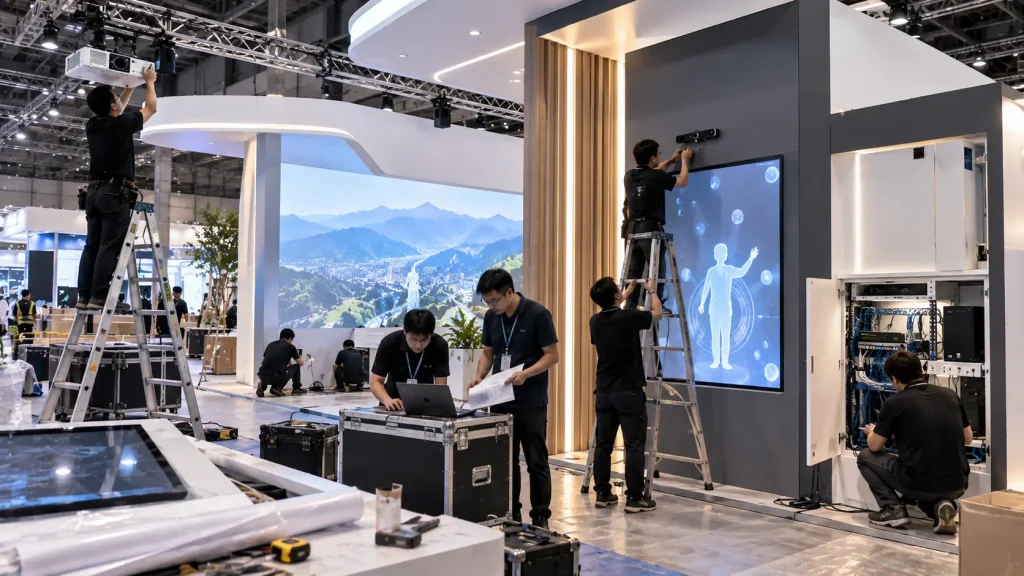
Temporary Exhibition Installation
Most exhibition installations are temporary, so the technical system needs to work within limited setup and dismantling periods.
The installation may involve:
- Temporary scenic structures
- Touchscreens and kiosks
- Projectors and mounting systems
- Sensors and tracking equipment
- Computers and media servers
- Network equipment
- Audio systems
- Power and signal cabling
The technical design should also coordinate with the booth contractor so mounting points, equipment compartments, ventilation, cable routes and access panels are planned before fabrication.
What Venue Requirements Should Be Checked?
Before finalising the experience, the venue and booth conditions should be reviewed.
Important considerations include:
- Booth dimensions and height restrictions
- Available electrical power
- Rigging restrictions
- Internet or local network requirements
- Ambient lighting
- Projection distances
- Equipment ventilation
- Visitor circulation
- Installation schedule
- Venue safety requirements
For projection-based experiences, uncontrolled exhibition lighting can affect image visibility, so the projection surface and surrounding lighting should be planned carefully.
For motion-tracking experiences, the sensor position and active interaction area also need to remain clear of unnecessary obstructions.
How Much Does an Immersive Exhibition Cost in Malaysia?
The cost depends on the scale and complexity of the experience rather than the exhibition booth size alone.
Major cost factors can include:
- Number of interactive experience zones
- Touchscreens and displays
- Projection equipment
- Sensors and tracking systems
- Custom software development
- Interactive game development
- 2D and 3D content production
- Physical fabrication
- System integration
- Installation and testing
- On-site technical support
A focused booth with one strong interactive installation can therefore require a very different budget from a large pavilion containing an immersive room, physical model, multiple touchscreens and custom interactive systems.
For more detailed budgeting considerations, see our Immersive Experience Cost Malaysia guide.
How Can the Budget Be Used More Effectively?
Instead of spreading the budget across many small technologies, it can be more effective to create one or two strong visitor experiences.
For example, a product exhibition may prioritise:
Hero Interactive Product Experience + Physical Product Display
while a property exhibition may prioritise:
Physical Model + Interactive Map + Coordinated Digital Content
The remaining booth design can support these key experiences rather than competing with them.
Immersive Exhibition Project Process
A typical project can follow these stages:
- Brief & Objective – Understand the brand, audience, exhibition and desired outcome.
- Visitor Journey – Plan how visitors attract, enter, engage, discover and continue.
- Experience Concept – Select the strongest physical and digital touchpoints.
- Technical Planning – Coordinate hardware, software, booth design and venue requirements.
- Content & Development – Produce visual content and develop interactive applications.
- Integration & Testing – Test the complete experience before or during installation.
- On-Site Setup – Install, calibrate and prepare the system for exhibition opening.
Where multiple suppliers are involved, early coordination between the experience team, event agency, booth contractor and AV team can reduce changes during installation.
What Information Is Needed for a Proposal?
For an initial proposal, useful information includes:
- Exhibition name and date
- Venue
- Booth dimensions
- Booth layout or design, if available
- Brand or product being presented
- Target audience
- Expected visitor volume
- Key message or campaign objective
- Preferred interactive ideas or references
- Available content and assets
- Required lead capture, if any
- Estimated budget range
If the booth design has not yet been developed, the experience concept can be planned first so the physical booth is designed around the required technology rather than trying to fit the technology into a completed structure later.
Why MyDigital Asia?
MyDigital Asia develops immersive and interactive exhibition experiences by combining creative content, software, interactive technology and physical environments.
Depending on the project, our scope can include:
- Visitor journey and experience concept
- Interactive touchscreen applications
- Interactive walls and floors
- Projection mapping
- Immersive rooms
- Interactive games
- Motion tracking and sensors
- Physical product integration
- Interactive maps and models
- 2D and 3D content production
- System integration and testing
- On-site technical support
The objective is to make the technology part of the exhibition experience rather than a collection of disconnected devices.
Frequently Asked Questions
Does an immersive exhibition need a large booth?
No. A smaller booth can focus on one strong interactive experience. Larger spaces allow more connected zones, but the concept should still match the available visitor flow and budget.
Can you work with our existing booth contractor?
Yes. Interactive and immersive technology can be coordinated with the booth contractor so equipment positions, structures, cabling and access requirements are considered during fabrication.
Can the experience work without internet access?
Many interactive exhibition systems can be designed to operate locally without continuous internet access. Internet connectivity may still be required for functions such as cloud data, online registration or external integrations.
Can we collect visitor information from an interactive experience?
Yes. Registration and lead capture can be integrated when required, subject to the project workflow and applicable privacy requirements.
Can the system be reused at another exhibition?
Software, content and selected equipment can often be reused or adapted, especially when future reuse is considered during the initial development.
Do we need technicians during the exhibition?
It depends on the complexity of the installation. Some systems can operate with simplified controls, while larger immersive or multi-system installations may benefit from on-site technical support.
Create an Immersive Exhibition in Malaysia
An immersive exhibition should do more than make a booth look technologically impressive.
It should give visitors a reason to approach, participate, understand the product or story and continue the conversation with the brand.
MyDigital Asia can develop the experience from visitor journey and concept through interactive software, digital content, technical integration and on-site installation.
Contact MyDigital Asia with your exhibition date, venue, booth size and objective to discuss a suitable immersive exhibition concept.
Related Immersive Experience Guides
- Immersive Experience Malaysia
- Immersive Room Malaysia
- Immersive Experience for Museums
- Interactive Experience Centre Malaysia
- Immersive Experience for Visitor Centres
- Immersive Brand Experience Malaysia
- Immersive Technology for Events
- Immersive Experience Cost Malaysia
- How to Design an Immersive Experience
Request a Free Consultation
Looking for Interactive Maps, Interactive Solutions or Event Technology?

LATEST POSTS