
Immersive Experience Cost Malaysia
How much does an immersive experience cost in Malaysia?
There is no single standard price because an immersive experience can range from one interactive installation to a complete room using multiple projectors, sensors, custom software, physical exhibits and specially produced content.
Two projects occupying a similar amount of space can also have very different budgets depending on what visitors are expected to experience.
MyDigital Asia develops immersive experiences in Malaysia for events, exhibitions, museums, visitor centres, experience centres and brand activations.
This guide explains the main factors that affect project cost and how to plan a realistic budget without paying for technology that does not improve the experience.
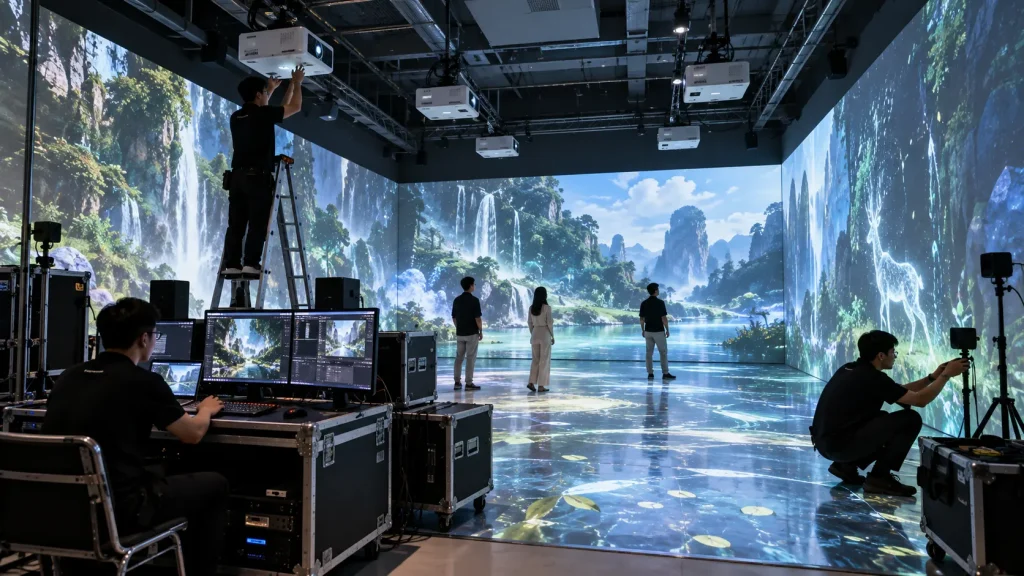
What Determines the Cost of an Immersive Experience?
The total cost is usually a combination of several components:
| Cost Component | What Can Affect It? |
|---|---|
| Experience Design | Visitor journey, concept complexity and number of experience zones |
| Hardware | Projectors, displays, computers, sensors, audio and control equipment |
| Content | 2D animation, 3D animation, filming, interactive visuals and sound |
| Software | Interaction logic, interface, real-time graphics and system integration |
| Physical Environment | Scenic structures, surfaces, furniture and equipment integration |
| Installation | Site access, mounting, cabling, calibration and commissioning |
| Operation | Event operators, maintenance, support and future content updates |
The budget should therefore be developed around the complete experience rather than multiplying the number of screens or projectors by a fixed rate.
Start with the Experience, Not the Equipment
One of the most useful ways to control cost is to define what visitors should actually experience before choosing the technology.
For example, consider two projects using the same room.
Project A may require visitors to watch a five-minute panoramic story.
Project B may require visitors to walk through the room, interact with the floor, trigger different content with body movement and receive personalised results.
Although the physical space is identical, Project B requires additional sensors, software development, real-time processing, testing and interactive content.
The correct starting point is therefore:
Visitor Experience → Required Functions → Technical System → Budget
not:
Buy Equipment → Decide What to Do with It
How Does Space Size Affect the Budget?
Space size matters, particularly for projection-based experiences, but it is only one factor.
A larger environment may require:
- More projectors
- Higher output projectors
- Additional playback outputs
- More mounting structures
- More cabling
- Larger content canvases
- Additional calibration
However, a smaller interactive installation with custom tracking and software can sometimes require more development than a large passive projection wall.
Floor area alone is therefore not enough to estimate an immersive project accurately.
How Much Do Projectors Affect Immersive Experience Cost?
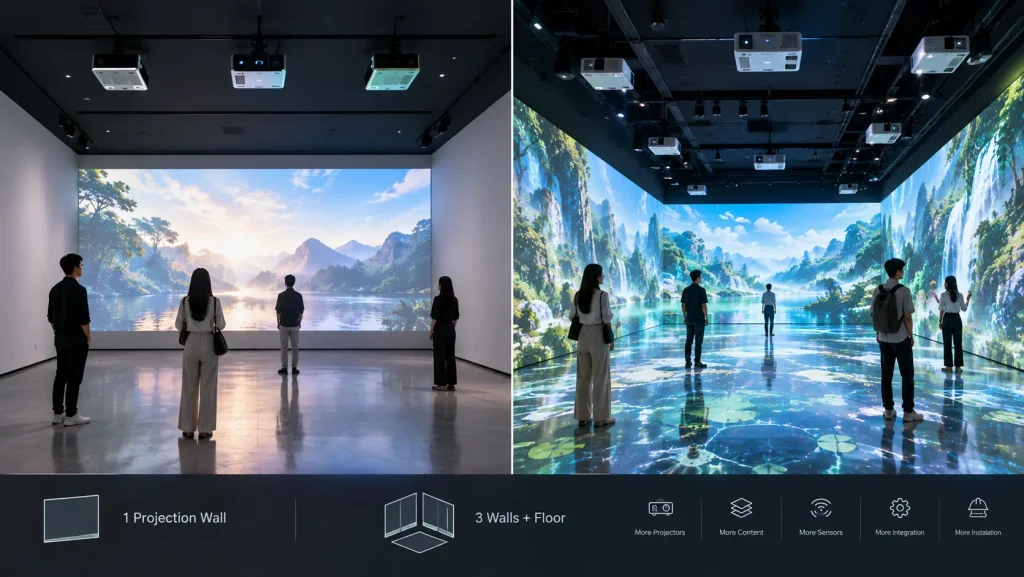
Projection hardware can represent a significant part of the budget for multi-wall or large-scale immersive environments.
The required projector configuration depends on factors such as:
- Projection surface size
- Throw distance
- Ambient light
- Required brightness
- Viewing distance
- Projector mounting position
- Required resolution
- Number of projection surfaces
A single-wall experience may use a very different configuration from a room where three walls and the floor need to appear visually continuous.
Projector quantity should therefore be determined from the actual geometry and visual requirement rather than from room size alone.
For more information about projection environments, see Immersive Room Malaysia.
Does Higher Brightness Always Mean Higher Cost?
Higher-output projection equipment generally increases hardware cost, but selecting the brightest projector available is not automatically the best approach.
Brightness should be considered together with:
- Room lighting
- Surface colour
- Image size
- Projection distance
- Content style
- Visitor environment
Improving light control or projection surfaces can sometimes be more efficient than compensating for poor conditions with significantly higher projector output.
Projector Rental vs Permanent Purchase
Temporary and permanent immersive experiences have different cost structures.
| Temporary Experience | Permanent Installation |
|---|---|
| Equipment may be rented | Equipment is commonly purchased for dedicated operation |
| Short installation period | Permanent mounting and infrastructure required |
| Live technical crew may operate the system | Daily operation should be simplified |
| Dismantling and logistics are part of the scope | Maintenance access and lifecycle matter |
| Campaign-specific content | Future content updates may be required |
A temporary event may have lower hardware ownership requirements but additional rental, logistics, setup and crew costs.
A permanent installation requires greater consideration of equipment life, ventilation, mounting, maintenance and future replacement.
Can Existing Projectors Reduce the Cost?
Potentially, yes.
If a venue already owns suitable projectors, displays, speakers or computers, those systems may be reused after their specifications and installation positions are reviewed.
Existing equipment should be checked for:
- Brightness
- Resolution
- Lens compatibility
- Throw distance
- Input and output requirements
- Operating condition
- Required coverage
Using existing hardware only saves money when it can perform the required function reliably.
Designing an entire experience around unsuitable equipment can create additional compromises or integration costs later.
How Much Does Immersive Content Affect the Budget?
Content can be one of the largest variables in an immersive experience quotation.
A simple loop using existing brand assets requires a different production scope from a custom ten-minute visual journey containing original 3D environments, animation, sound design and multiple interactive states.
Content cost can be affected by:
- Experience duration
- Number of scenes
- 2D or 3D production
- Level of visual detail
- Number of projection surfaces
- Interactive states
- Existing usable assets
- Filming requirements
- Sound design
- Number of revision stages
For immersive projection, content also needs to be designed according to the physical environment rather than simply stretched across several walls.
Does Immersive Content Need to Be 3D?
No.
3D animation can be valuable when the experience needs spatial environments, products, architecture, simulations or visual transformation.
However, photography, video, motion graphics, illustration and 2D animation can also create effective immersive experiences.
The production method should follow the story and visual objective.
Using 3D for every scene may increase production time without necessarily improving the visitor experience.
Can Existing Videos Be Reused?
Yes, but they may need adaptation.
Existing corporate videos, campaign films, archive footage or product animations can sometimes become part of an immersive experience.
However, a conventional 16:9 video was designed for a rectangular screen.
For multi-wall projection, the content may need to be reformatted, extended, recomposed or combined with additional visual material so it works across the physical space.
Reusing suitable assets can reduce production requirements, but the amount of saving depends on how closely the existing material matches the new experience.
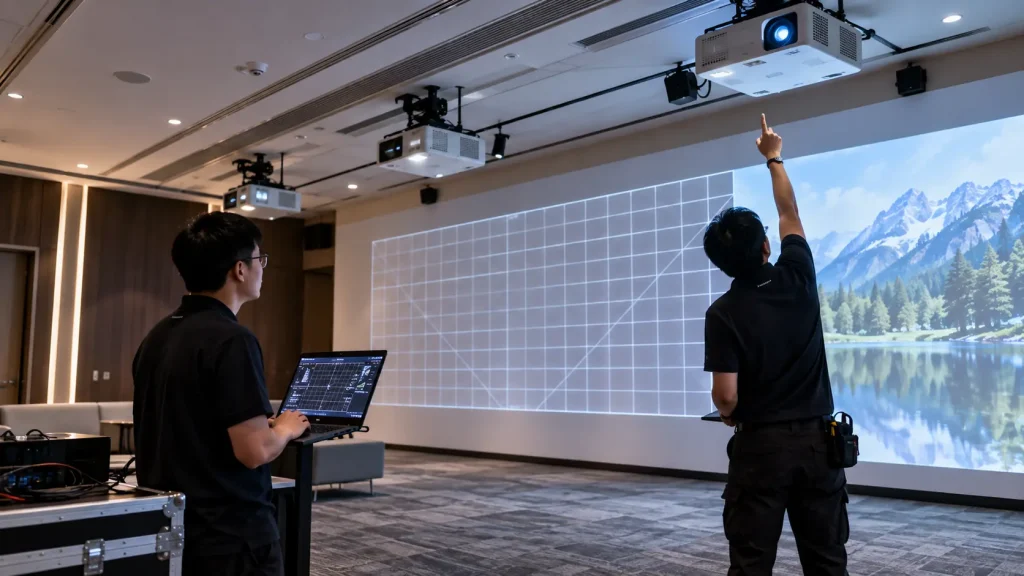
How Does Interactivity Affect the Cost?
Adding interaction introduces more than the cost of a sensor.
An interactive experience usually requires:
Detection → Software Logic → Real-Time Response → Interactive Content → Testing
For example, an interactive floor may require a tracking sensor, but the project also needs software to interpret visitor positions and visual content that responds correctly to those positions.
More advanced interactions may need to manage:
- Multiple visitors
- Gesture recognition
- Object detection
- Touch input
- Real-time physics
- Game logic
- Personalised output
- External data
The complexity of the interaction logic can therefore affect the budget more than the physical sensor itself.
Touchscreen vs Motion Tracking Cost
A touchscreen interaction is generally more contained because the input surface and user position are clearly defined.
Motion-based interaction may require a larger detection area, sensor positioning, calibration and additional testing for different visitor positions and movements.
This does not mean motion tracking is always the more appropriate or more valuable solution.
If visitors simply need to browse detailed product information, a touchscreen may provide a clearer and more cost-efficient experience.
If body movement is central to the concept, motion tracking may justify the additional development.
Does AI Increase the Cost?
AI can introduce additional requirements depending on how it is used.
Possible cost considerations include:
- AI service or processing fees
- Cloud infrastructure
- Internet connectivity
- Custom workflow development
- Processing hardware
- Output generation time
- Data handling
AI should therefore be used where personalised generation, recognition or another AI-specific capability improves the experience.
It should not be treated as a requirement for every immersive project.
Physical Fabrication and Scenic Cost
Immersive technology often needs a physical environment to work effectively.
The project may require:
- Projection surfaces
- Custom walls
- Scenic structures
- Interactive furniture
- Equipment enclosures
- Physical models
- Product displays
- Protective finishes
For temporary events, these elements may need to be designed for transport and dismantling.
For permanent installations, durability, maintenance access and integration with the interior architecture become more important.
Does a Media Server Increase the Cost?
Some multi-display or multi-projector experiences require a dedicated playback or media server system.
The requirement depends on factors such as:
- Number of outputs
- Content resolution
- Synchronisation
- Real-time rendering
- Interactive processing
- Show control requirements
A simple installation should not automatically be given a complex server architecture.
At the same time, reducing the playback system too aggressively can create reliability or performance limitations for larger immersive environments.
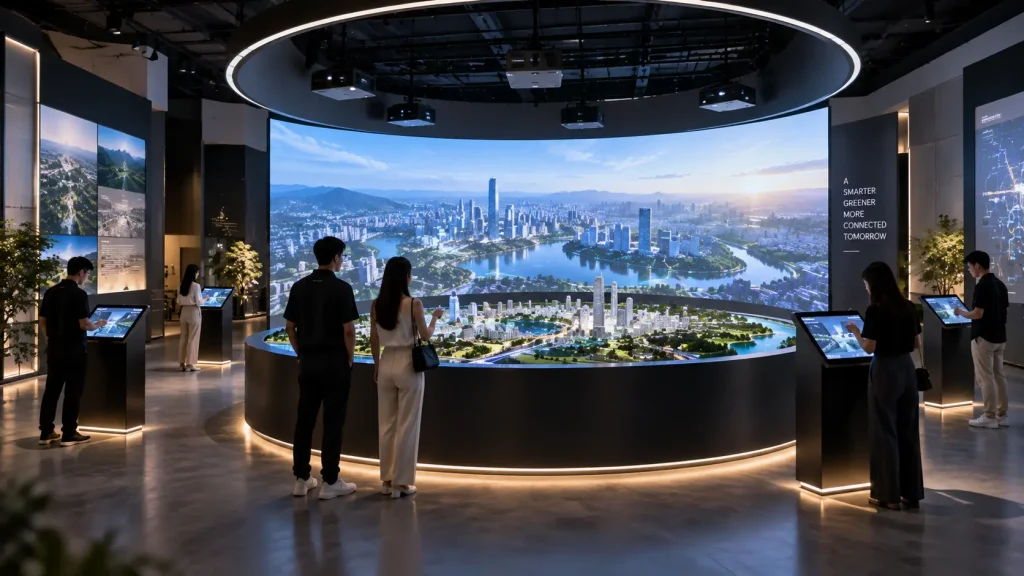
Why Site Conditions Affect the Quotation
The same experience can cost differently at two venues because installation conditions are different.
A site survey may identify factors such as:
- Ceiling height
- Projector mounting points
- Available throw distance
- Power locations
- Network infrastructure
- Ambient light
- Wall and floor surfaces
- Visitor circulation
- Equipment access
- Installation working hours
For this reason, early quotations for complex projects may be budgetary until the physical site and final technical requirements are confirmed.
What Information Helps Produce a More Accurate Budget?
Providing a few practical details can significantly improve an initial cost estimate.
- Project type and objective
- Venue or location
- Room dimensions or floor plan
- Photos or videos of the space
- Temporary or permanent installation
- Expected number of visitors
- Required interaction
- Available hardware
- Existing content or 3D assets
- Required operating period
- Project timeline
- Estimated budget range
Even when the final concept has not been decided, this information helps determine which experience approaches are technically and commercially realistic.
How Can You Reduce the Cost of an Immersive Experience?
Reducing the budget does not necessarily mean reducing the quality of the entire experience.
A better approach is to identify which elements create the most value for visitors and simplify the parts that are less important.
Common ways to control the budget include:
- Focus on one strong hero experience
- Reuse suitable existing hardware
- Reuse and adapt existing content
- Reduce unnecessary interactive functions
- Control ambient light instead of relying only on higher projector brightness
- Use simpler physical structures where possible
- Design reusable systems for multiple events
- Implement permanent projects in phases
The objective should be to simplify the system without weakening the main visitor experience.
One Hero Experience vs Multiple Interactive Zones
One of the easiest ways for a project budget to increase is to divide the space into too many technology-heavy zones.
For example, a proposal may include an immersive room, interactive wall, interactive floor, touchscreen, AI photo experience and motion game.
Each element may be interesting individually, but every additional system introduces hardware, content, software, integration and testing requirements.
For many projects, a stronger approach is:
One Hero Experience + Supporting Digital Experiences
A visitor centre, for example, might invest more heavily in one immersive storytelling room while using simpler interactive maps and touchscreens for supporting information.
A brand activation might focus on one memorable physical-digital product interaction rather than several unrelated games.
Where Is It Worth Spending More?
The most valuable part of the budget depends on the objective of the project.
| Project Objective | Possible Budget Priority |
|---|---|
| Large Visual Impact | Projection coverage, brightness and content quality |
| Interactive Engagement | Software, tracking and responsive content |
| Product Explanation | Product visualisation and intuitive interface |
| Museum Storytelling | Content research, storytelling and physical-digital integration |
| Permanent Visitor Experience | Reliable hardware, maintainability and content management |
| Corporate Event | Key audience moments, reliable operation and live integration |
The most expensive technology is not automatically the most important component.
A reliable interaction with strong content can create more value than a technically complex installation that visitors do not understand.
Where Should You Avoid Cutting the Budget Too Aggressively?
Some reductions can create larger problems later.
Areas that should be reviewed carefully before reducing scope include:
- Projector brightness required for the actual environment
- Computer performance for real-time content
- Tracking coverage for interactive experiences
- Structural and mounting safety
- Essential cabling and signal infrastructure
- Testing and calibration
- Permanent equipment ventilation
- Maintenance access
- Critical event backup planning
For example, reducing projector quantity without considering the required coverage may create visible gaps or insufficient image quality.
Similarly, reducing testing time on a custom interactive installation can increase operational risk when real visitors begin using the system.
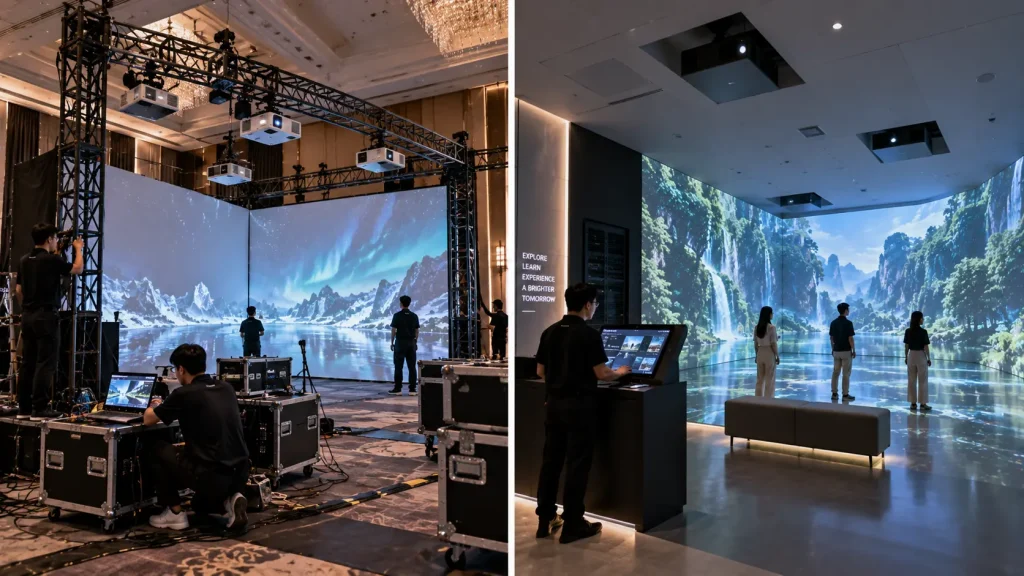
Can Existing Hardware Be Reused?
Yes, and this can be one of the most practical ways to control the project budget.
A venue may already have:
- Projectors
- LED screens
- Commercial displays
- Touchscreens
- Computers
- Speakers
- Network infrastructure
The existing equipment should first be checked against the new experience requirements.
If it is suitable, the budget can be redirected toward content, software or other parts of the installation.
If it is not suitable, forcing the system to use it may introduce additional limitations that reduce the quality of the final experience.
Can Existing Content Reduce Production Cost?
Yes. Existing content can be useful when the original assets are available at suitable quality.
Reusable assets may include:
- Corporate videos
- Product 3D models
- Architectural models
- Photography
- Archive material
- Brand motion graphics
- Existing animation
However, the amount of saving depends on how much adaptation is required.
A high-quality 3D product model, for example, may significantly reduce modelling work if it can be used directly.
A compressed promotional video designed only for social media may offer much less production value for a large immersive environment.
Can Content Be Designed for Future Reuse?
Yes. If future reuse is planned from the beginning, selected content and software can be structured so they are easier to update or redeploy.
This may be useful for:
- Annual exhibitions
- Multi-location roadshows
- Permanent experience centres
- Visitor centres
- Museums with changing programmes
- Recurring corporate events
Reusable content does not mean every future deployment will have no additional cost.
Different venues may still require changes to resolution, layout, projection geometry, branding or system configuration.
Can an Immersive Project Be Built in Phases?
Yes. Phased implementation can be useful for larger permanent projects where the complete vision exceeds the initial budget.
For example:
Phase 1: Core immersive presentation and infrastructure
Phase 2: Interactive exhibits and additional content
Phase 3: Personalisation, data integration or additional experience zones
The important point is to plan the long-term system architecture during the earlier phase.
This can help avoid rebuilding infrastructure when new experiences are added later.
Temporary Immersive Experience Budget
Temporary projects such as exhibitions, product launches and corporate events typically concentrate the budget around a short operating period.
Typical scope may include:
- Equipment rental
- Custom content
- Temporary structures
- Transport
- Installation
- Calibration
- Rehearsal
- On-site operation
- Dismantling
Rental can reduce the need to purchase equipment, but logistics and event labour become an important part of the overall cost.
For event-specific applications, see Immersive Event Technology Malaysia.
Permanent Immersive Installation Budget
Permanent projects should be evaluated over a longer operating period.
In addition to the initial experience, planning should consider:
- Hardware purchase
- Permanent mounting
- Equipment ventilation
- Daily startup and shutdown
- Maintenance access
- Software recovery
- Replacement components
- Content updates
- Long-term technical support
A permanent installation may require a larger initial investment but should be designed so normal daily operation does not depend on a specialist technical crew.
Event Rental vs Permanent Installation
| Cost Area | Temporary Event | Permanent Installation |
|---|---|---|
| Hardware | Often rental-based | Usually purchased |
| Installation | Fast temporary setup | Integrated permanent installation |
| Operation | Technical crew may operate live | Designed for routine staff operation |
| Content | Campaign or event-specific | Longer lifecycle and update planning |
| Maintenance | Limited operating period | Long-term support required |
Comparing only the equipment price between these two project types can therefore be misleading.
How Should a Limited Budget Be Allocated?
If the available budget is limited, start by identifying the one experience visitors should remember most.
A practical priority sequence can be:
Core Experience → Reliable Hardware → Essential Content → Required Interaction → Supporting Features
Optional features can then be added if the remaining budget allows.
This approach protects the main experience instead of reducing the quality of every component equally.
Should You Tell the Supplier Your Budget?
Providing an approximate budget range can help the experience designer recommend a technically realistic approach.
Without any budget guidance, several very different solutions may all appear suitable during the concept stage.
For example, the same storytelling objective might be approached through:
- One large projection wall
- A multi-wall immersive room
- An interactive touchscreen installation
- A physical model with projection
- A combination of several technologies
Knowing the approximate budget helps prioritise which approach is realistic before significant concept and technical development begins.
Why Can Two Quotations Be Very Different?
Two immersive experience quotations may appear to describe the same project while containing very different scopes.
When comparing quotations, check whether they include the same items.
Important differences may include:
- Projector specifications and quantity
- Rental versus purchase
- Content production
- Custom software development
- Sensor and tracking systems
- Media server or playback hardware
- Physical fabrication
- Installation structures
- Audio
- Testing and calibration
- On-site technical support
- Warranty or maintenance
A lower quotation may simply exclude components that another supplier has included.
Comparing the scope line by line is more useful than comparing only the final total.
What Should an Immersive Experience Quotation Include?
Depending on the project, a quotation may be divided into several sections:
- Experience & Technical Scope – The proposed experience and system configuration.
- Hardware – Projectors, displays, computers, sensors, audio and related equipment.
- Software – Interactive applications, real-time systems and integrations.
- Content Production – 2D, 3D, video, animation and sound requirements.
- Physical Integration – Structures, surfaces, furniture or exhibit integration.
- Installation – Mounting, cabling, setup and calibration.
- Operation – Event crew, training or daily operating requirements.
- Support – Warranty, maintenance or future support where applicable.
A clear quotation makes it easier to understand which parts of the budget can be adjusted if the project scope changes.
Budgetary Quotation vs Final Quotation
At the early concept stage, an immersive project may receive a budgetary quotation.
This provides an estimated project direction based on the information currently available.
A more accurate quotation may require:
- Confirmed dimensions
- Site survey
- Final experience scope
- Confirmed content duration
- Hardware specifications
- Installation requirements
- Final operating requirements
This is particularly important for projection and permanent installations where physical site conditions directly affect the technical configuration.
Immersive Experience Cost Planning Process
A practical budgeting process can follow these steps:
- Define the Objective – What should visitors experience or understand?
- Define the Space – Confirm the venue, dimensions and installation conditions.
- Prioritise the Experience – Identify the hero experience and supporting elements.
- Review Existing Assets – Check usable hardware, content and physical infrastructure.
- Develop the Technical Approach – Determine the appropriate projection, display, interaction and playback systems.
- Estimate Content & Software – Define the production and development scope.
- Review the Budget – Simplify or phase lower-priority elements where required.
- Confirm the Site – Conduct technical verification before final implementation.
Why MyDigital Asia?
MyDigital Asia approaches immersive experience budgeting from both the creative and technical sides of the project.
Depending on the project, our scope can include:
- Immersive experience concept
- Projection mapping
- Immersive rooms
- Interactive walls and floors
- Touchscreen applications
- Motion tracking and sensors
- Interactive games
- Physical-digital installations
- 2D and 3D animation
- Interactive software development
- Hardware integration
- Installation and calibration
- Temporary event operation
- Permanent system commissioning
The objective is to allocate the project budget toward the elements that contribute most directly to the visitor experience.
Frequently Asked Questions
How much does an immersive experience cost in Malaysia?
The cost depends on the size of the experience, hardware, content production, software, interaction, physical fabrication and installation requirements. A focused interactive installation and a complete multi-projector immersive room therefore require very different budgets.
Can I get a quotation before a site survey?
Yes. A budgetary quotation can often be prepared from dimensions, floor plans, photographs, project objectives and available technical information. Complex installations may require a site survey before the final configuration and price are confirmed.
Can we use our existing projectors or screens?
Potentially. Existing equipment can be reviewed to determine whether its specifications, condition and installation position are suitable for the proposed experience.
Can we reduce the budget by using existing videos?
Yes, where the existing material is suitable. Some videos can be reused directly, while others may require adaptation for different aspect ratios, projection surfaces or interactive environments.
Is projection always the most expensive part?
No. In some projects, custom software, interactive development, content production or physical fabrication can represent a significant part of the overall budget.
Can a permanent immersive experience be developed in phases?
Yes. Larger projects can be implemented in phases if the technical infrastructure and future expansion requirements are considered during the initial planning stage.
Plan an Immersive Experience Budget in Malaysia
An immersive experience budget should be based on what visitors need to experience rather than how many technologies can be placed inside the space.
By defining the objective, reviewing the site, prioritising the strongest experience and identifying reusable assets, it is possible to develop a solution that balances impact, reliability and budget.
MyDigital Asia can support the process from early concept and budgetary planning through content production, interactive development, hardware integration, installation and operation.
Contact MyDigital Asia with your project objective, location, dimensions, reference images, operating period and estimated budget range to discuss an immersive experience solution in Malaysia.
Related Immersive Experience Guides
- Immersive Experience Malaysia
- Immersive Room Malaysia
- Immersive Exhibition Malaysia
- Immersive Museum Malaysia
- Interactive Experience Centre Malaysia
- Immersive Visitor Centre Malaysia
- Immersive Brand Experience Malaysia
- Immersive Event Technology Malaysia
- How to Design an Immersive Experience
Request a Free Consultation
Looking for Interactive Maps, Interactive Solutions or Event Technology?

LATEST POSTS