
Immersive Room Malaysia
An immersive room transforms an ordinary physical room into a digital environment where walls, floors, sound and interactive technology work together as one experience.
Instead of watching content on a conventional screen, visitors enter the experience and become surrounded by the visual environment.
MyDigital Asia designs and develops immersive rooms in Malaysia for museums, visitor centres, exhibitions, corporate experience centres, brand activations and selected events.
An immersive room does not always need four projected walls or a complete 360-degree setup. The right configuration depends on the room, content, audience and experience objective.
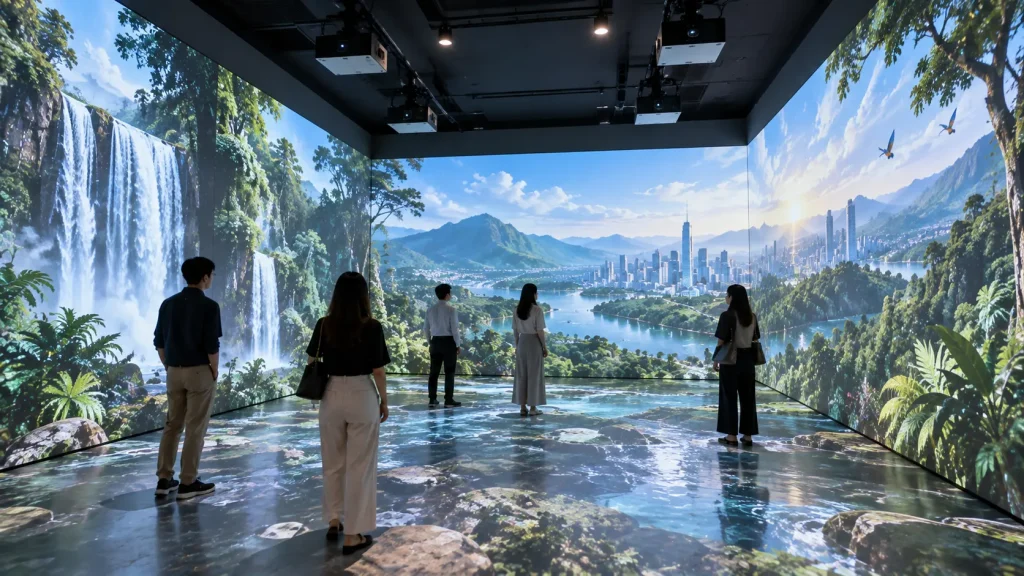
Immersive Room at a Glance
| Element | Possible Approach |
|---|---|
| Walls | One panoramic wall, multiple walls or surrounding projection |
| Floor | Static, projected or interactive floor |
| Interaction | Touch, movement, gestures or sensors |
| Audio | Environmental or spatial sound |
| Content | 2D, 3D, video, animation or real-time visuals |
| Installation | Temporary or permanent |
What Is an Immersive Room?
An immersive room is a physical space designed so digital content extends beyond a single conventional display.
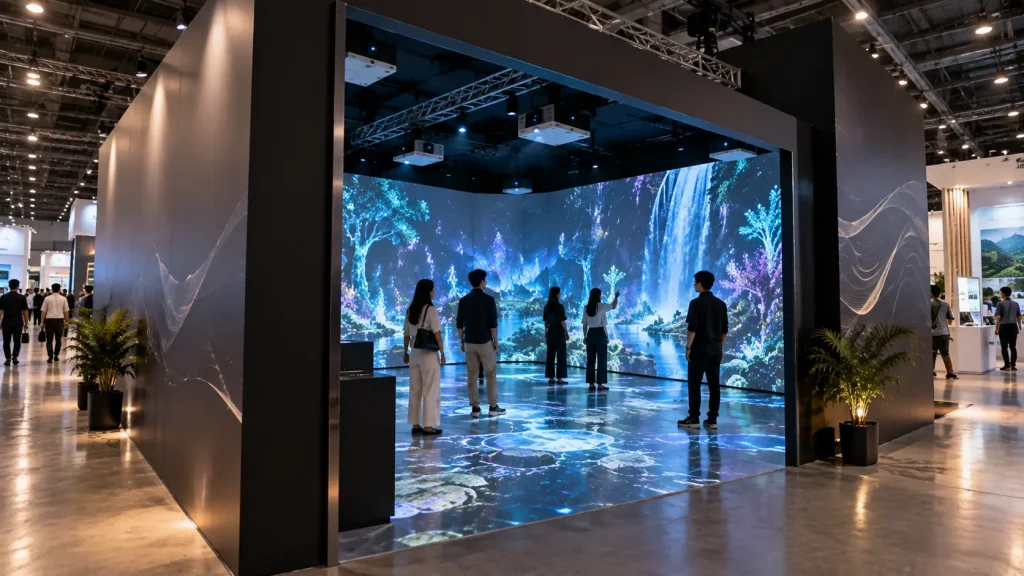
For example, three walls can display one continuous environment while the floor visually extends the scene beneath the visitors.
A city could grow around the room, historical environments could appear across the walls, or visitors could walk through an animated natural landscape.
The objective is to make the room itself part of the content.
This is different from installing several large screens around a room. In a properly designed immersive environment, the individual surfaces are visually coordinated to create one connected experience.
Does an Immersive Room Need 360° Projection?
No. A complete 360-degree room is only one possible configuration.
Depending on the venue and budget, an immersive room can use:
- One large panoramic wall
- Two connected walls
- Three surrounding walls
- Three walls plus floor
- Four walls
- Multiple walls, floor and selected ceiling elements
More projection surfaces do not automatically create a better experience.
For many projects, three walls or two walls plus a floor can create sufficient visual immersion while keeping entrances, equipment access and visitor circulation practical.
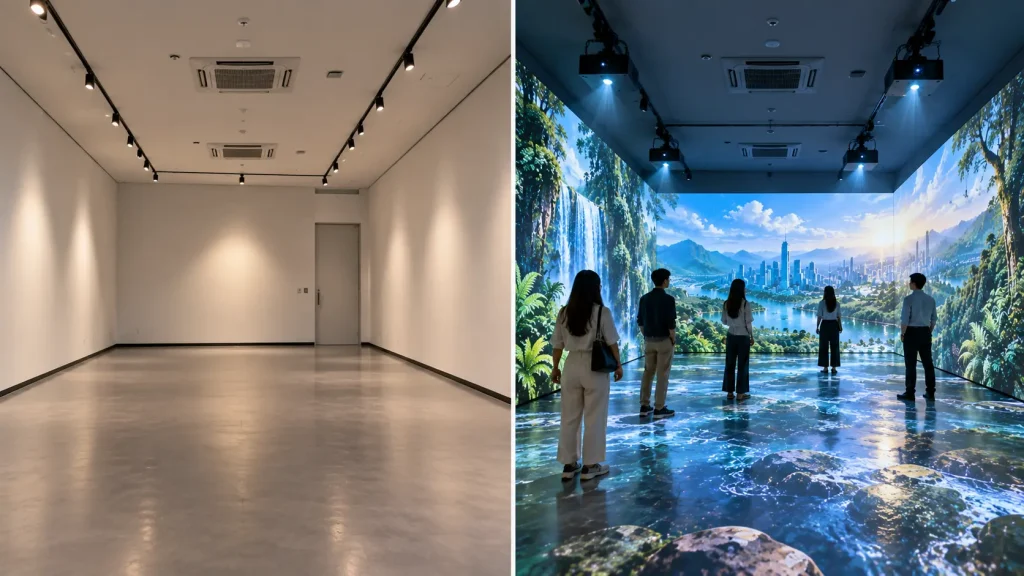
What Can an Immersive Room Be Used For?
The same room technology can support very different applications depending on the content and visitor journey.
Museums and Cultural Experiences
An immersive room can recreate environments that cannot physically exist inside a gallery.
Visitors might enter a historical city, explore an ecosystem, experience a cultural story or see archival material expanded across the surrounding environment.
Physical artefacts can also remain inside the room while digital visuals provide context around them.
For a wider experience strategy beyond a single room, see our Immersive Experience for Museums guide.
Visitor Centres
Immersive rooms can help explain large or complex subjects such as infrastructure, property development, urban planning, tourism destinations and future projects.
A visitor may first explore a physical model or interactive map before entering an immersive room for a larger visual presentation of the project.
This makes the room one stage within the complete immersive visitor centre journey.
Corporate Experience Centres
Companies can use immersive rooms to communicate their history, capabilities, technology, sustainability initiatives or future vision.
Instead of presenting the information through a conventional corporate video on one screen, the room can turn the story into a spatial experience.
Exhibitions
A temporary immersive room can become a destination within a larger exhibition booth.
Visitors can enter for a short branded experience before continuing to product displays, demonstrations or conversations with the exhibition team.
Because exhibition visitors usually have limited time, these experiences should be visually clear and relatively short.
Events and Product Launches
Immersive rooms can also be installed as separate experience zones at selected events.
For example, guests may enter a pre-function experience before a product launch, annual dinner or corporate programme.
Unlike main-stage projection mapping, the immersive room creates a smaller environment where visitors are physically surrounded by the content.
Can an Existing Room Become an Immersive Room?
Yes. Many projects can begin with an existing meeting room, gallery, exhibition space or enclosed area.
The first step is to evaluate whether the room can support the required visual and technical setup.
Important factors include:
- Room dimensions
- Ceiling height
- Wall condition and colour
- Available projector positions
- Doors and windows
- Ambient lighting
- Power and network access
- Visitor entry and exit
- Equipment access
Some existing architectural features can be incorporated into the experience rather than completely hidden.
If the room has unsuitable surfaces or too much uncontrolled light, temporary projection surfaces, blackout treatment or scenic structures may be considered.
How Does an Immersive Room Work?
A projection-based immersive room typically combines several systems:
Content → Media Server → Multiple Projectors → Physical Surfaces → Visitor Experience
The media server distributes synchronised content across the required projectors.
Where projection areas overlap, edge blending and geometric correction are used so the final image appears as one continuous visual environment rather than several separate projector images.
For more technical detail about multi-surface projection, see Immersive Projection Malaysia.
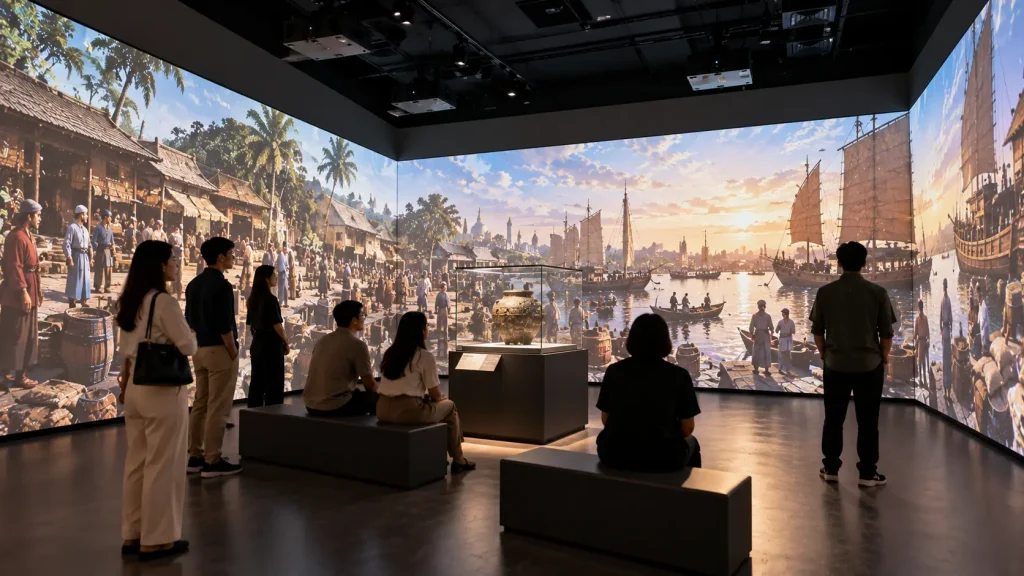
Can the Floor Be Part of the Experience?
Yes. Floor projection can visually extend the environment from the walls into the space around visitors.
For example, projected water may appear to continue from a wall across the floor, or a digital map may extend beneath the audience.
The floor can remain purely visual or become interactive.
With tracking technology, projected elements can respond to footsteps and visitor position. This approach is covered in more detail in our Interactive Floor Projection Malaysia guide.
Can an Immersive Room Be Interactive?
Yes, but interaction should be added only when it improves the experience.
An interactive immersive room may respond to:
- Visitor movement
- Position within the room
- Hand gestures
- Touch
- Physical objects
- Interactive control stations
For example, walking into a specific area could reveal additional visual content, while a touchscreen could allow visitors to select which environment or topic appears around the room.
This creates a different experience from a purely cinematic immersive room, where everyone watches the same programmed sequence.
Projects requiring more advanced responsive environments can also combine the room with interactive projection mapping.
Cinematic vs Interactive Immersive Room
| Cinematic Room | Interactive Room |
|---|---|
| Content follows a programmed sequence | Content responds to visitors |
| Suitable for storytelling and presentations | Suitable for exploration and participation |
| Everyone experiences similar content | Experience can change according to user actions |
| Simpler visitor flow | Requires interaction and tracking design |
| Strong for group experiences | Strong for engagement and repeat exploration |
Neither approach is automatically better. The correct choice depends on what visitors should do inside the room.
For storytelling, a well-produced cinematic sequence may be more effective than adding unnecessary interaction. For exhibitions or experience centres, interactive elements may encourage visitors to explore for longer.
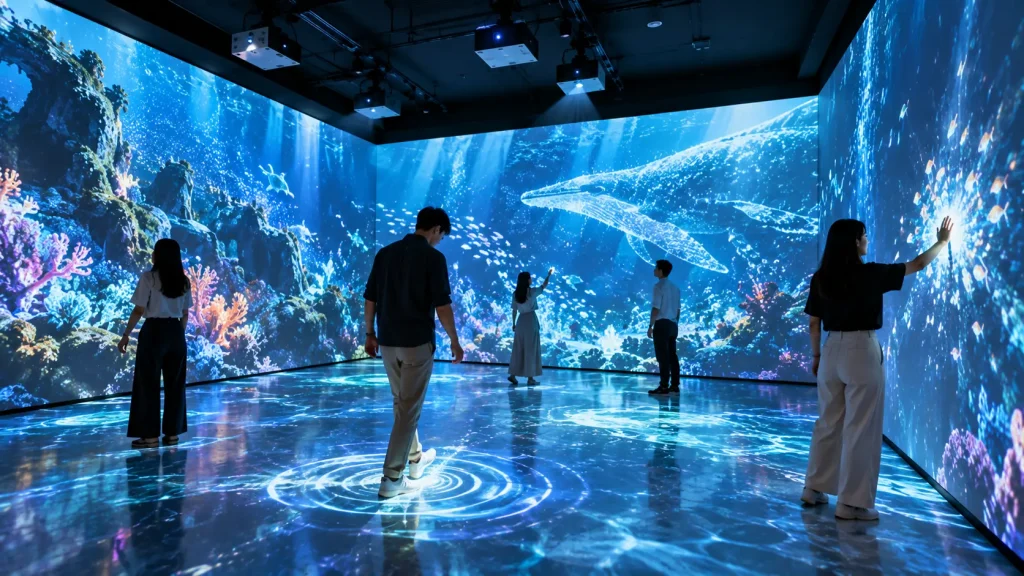
How Long Should an Immersive Room Experience Be?
The ideal duration depends on where the room sits within the visitor journey.
A temporary exhibition experience may only need a short sequence that visitors can enter and understand quickly.
A museum or visitor centre may use a longer programmed presentation or allow visitors to explore content at their own pace.
The experience should also consider visitor turnover. If every session is too long, queues can develop outside the room and reduce overall capacity.
For this reason, content duration, room capacity and visitor flow should be planned together rather than treated as separate decisions.
What Content Works Best in an Immersive Room?
Content for an immersive room should be designed for the physical space rather than treated as a conventional video stretched across several walls.
Because visitors are surrounded by the visuals, composition, scale, movement and transitions need to consider where people are standing and which surfaces they can see at the same time.
Immersive room content may include:
- 2D motion graphics
- 3D environments and animation
- Historical or cultural storytelling
- Data visualisation
- Future city and infrastructure visualisation
- Product and technology storytelling
- Nature and environmental scenes
- Interactive real-time graphics
Not every project requires complex 3D production. Existing photographs, archive materials, corporate videos and 2D graphics can also be adapted into an immersive format when the creative direction supports them.
Does an Immersive Room Need Spatial Audio?
Audio can significantly improve immersion because the experience is not only visual.
Depending on the concept, the room may use narration, music, environmental sound or sound effects that correspond with events happening around the space.
For example, an environmental experience may combine surrounding visuals with water, wind or nature sounds, while a corporate experience may use narration and cinematic music to guide visitors through a structured story.
Advanced spatial audio is not essential for every project. The audio system should match the scale of the room and the storytelling requirement.
Will Visitors See the Projectors?
Projector visibility depends on the room architecture and installation method.
For permanent installations, projectors can often be positioned above the visitor sightline or integrated into ceiling and architectural structures.
Temporary immersive rooms may use overhead mounting, truss or other suitable structures depending on the venue.
The objective is to keep equipment as visually discreet as practical while maintaining the correct projection geometry and service access.
How Are Shadows Controlled?
Shadows are an important consideration whenever visitors can move between a projector and its projection surface.
They can be reduced through:
- Suitable projector positioning
- Higher mounting positions
- Shorter projection distances where appropriate
- Multiple-projector coverage
- Careful visitor circulation planning
- Keeping interactive zones away from critical projection paths
The correct approach depends on the dimensions and layout of the room.
This is one reason projector positions should be planned together with the visitor journey rather than added after the interior design has already been completed.
How Many People Can Enter an Immersive Room?
Capacity depends on the room size, viewing arrangement and type of interaction.
A cinematic room can usually accommodate groups more efficiently because visitors experience the same programmed content together.
An interactive room may require more personal space if visitors need to move, gesture or interact with specific areas.
For high-traffic exhibitions, capacity should be considered together with experience duration.
| Experience Type | Visitor Flow Consideration |
|---|---|
| Cinematic Experience | Groups can enter and watch together |
| Interactive Room | Requires sufficient movement and interaction space |
| Exhibition Installation | Shorter experiences can improve visitor turnover |
| Museum Installation | May support longer viewing and exploration |
Temporary vs Permanent Immersive Room
An immersive room can be developed as a temporary installation or as part of a permanent space.
Temporary Immersive Room
Temporary installations are suitable for exhibitions, events, product launches and brand activations.
The system should prioritise efficient installation, venue compatibility and dismantling after the project.
Temporary scenic walls or projection surfaces can also be constructed when the existing venue is unsuitable.
Permanent Immersive Room
Permanent installations require additional consideration for long-term operation.
This may include:
- Integrated projector mounting
- Equipment ventilation
- Maintenance access
- Automatic system startup and shutdown
- Content management
- Operator controls
- Future content updates
Museums, galleries and visitor centres should consider these requirements during the architectural or exhibition design stage whenever possible.
Can the Content Be Changed Later?
Yes. An immersive room can be designed so the physical installation remains in place while digital content is updated over time.
This is particularly useful for visitor centres, corporate experience centres and permanent exhibitions where information may change after the initial launch.
For example, the same room could present different development phases, campaigns, educational topics or seasonal content without rebuilding the entire space.
How Much Does an Immersive Room Cost in Malaysia?
The cost of an immersive room depends on the room and experience rather than a fixed package price.
Major cost factors include:
- Room dimensions
- Number of projection surfaces
- Number and specification of projectors
- Media server and playback system
- Projection surfaces or scenic construction
- Interactive sensors and tracking
- Audio system
- 2D or 3D content production
- Software development
- Installation and calibration
- Temporary or permanent requirements
A three-wall cinematic room using relatively simple content will have a different budget from a permanent multi-surface interactive room with custom software, sensors and original 3D content.
For this reason, the most useful quotation starts with the room dimensions, required experience and project objective.
For broader budgeting considerations across different immersive installations, see our Immersive Experience Cost Malaysia guide.
How Can the Budget Be Controlled?
An immersive room does not need to use every available technology.
Budget can often be controlled by prioritising the elements that create the strongest experience.
For example:
- Use three important surfaces instead of projecting every wall.
- Keep the floor non-interactive if interaction does not add meaningful value.
- Use strong 2D motion design where full 3D production is unnecessary.
- Reuse suitable existing media as part of the content.
- Concentrate interactive technology in one important experience zone.
The objective should be to create a convincing experience within the available budget rather than maximise the equipment count.
Immersive Room Project Process
A typical project can follow these stages:
- Site & Brief Review – Understand the room, audience and objective.
- Experience Concept – Define what visitors should see, feel and do.
- Spatial Planning – Determine projection surfaces, visitor flow and equipment positions.
- Technical Design – Plan projectors, playback, audio and interaction systems.
- Content Production – Develop the visual and audio experience for the room.
- Installation & Calibration – Install equipment and align the projected environment.
- Testing – Test content, interaction and the complete visitor journey.
For permanent installations, system documentation, training and support can also be included according to the project scope.
What Do We Need to Prepare a Proposal?
For an initial immersive room proposal, it is useful to provide:
- Room dimensions
- Floor plan, if available
- Photos or videos of the space
- Ceiling height
- Project type
- Target audience
- Expected number of visitors
- Temporary or permanent requirement
- Preferred experience or reference
- Project timeline
- Estimated budget range, if available
If the room has not yet been constructed, architectural drawings or preliminary layouts can be used for early planning.
Why MyDigital Asia?
MyDigital Asia develops immersive rooms as part of a complete interactive and digital experience rather than treating projection as a standalone equipment rental.
Depending on the project, our scope can include:
- Immersive experience concept
- Visitor journey planning
- Projection system design
- Multi-projector mapping and calibration
- Interactive tracking and sensors
- Touchscreen and control applications
- 2D and 3D content production
- Audio integration
- Physical environment integration
- Installation and testing
An immersive room can also form one part of a larger Immersive Experience Malaysia project containing multiple physical and digital touchpoints.
Frequently Asked Questions
Do I need a completely dark room?
Not necessarily, but controlled lighting generally improves projected image quality. The required level of light control depends on the projector system, room surfaces and visual content.
Does every wall need projection?
No. One panoramic wall, two connected walls or three walls plus a floor may already create an effective immersive environment. The configuration should be selected according to the experience rather than the number of available walls.
Can an immersive room use LED screens instead of projectors?
Yes. Some immersive environments can combine LED displays, projection and other digital surfaces. Projection is particularly useful when large connected surfaces or room-scale visual environments are required.
Can visitors control what appears in the room?
Yes. A touchscreen, sensor or other interactive system can allow visitors to select content or trigger changes within the environment.
Can we use our existing corporate videos?
Existing videos may be incorporated, but conventional 16:9 content may need to be reformatted or redesigned so it works effectively across multiple surfaces.
Can an immersive room be installed for only a few days?
Yes. Temporary immersive rooms can be developed for exhibitions, events and activations, provided the venue has sufficient installation time, space and technical access.
Create an Immersive Room in Malaysia
An effective immersive room is not simply a room containing multiple projectors.
The strongest results come from designing the physical space, content, projection, sound and interaction as one connected experience.
Whether you are planning a museum, visitor centre, exhibition, corporate experience centre or temporary event installation, MyDigital Asia can develop the immersive room from concept and technical planning through content production, integration and installation.
Contact MyDigital Asia to discuss your room dimensions, project objective and immersive experience requirements.
Related Immersive Experience Guides
- Immersive Experience Malaysia
- Immersive Exhibition Malaysia
- Immersive Experience for Museums
- Interactive Experience Centre Malaysia
- Immersive Experience for Visitor Centres
- Immersive Brand Experience Malaysia
- Immersive Technology for Events
- Immersive Experience Cost Malaysia
- How to Design an Immersive Experience
Request a Free Consultation
Looking for Interactive Maps, Interactive Solutions or Event Technology?

LATEST POSTS