
Interactive Floor Projection Malaysia
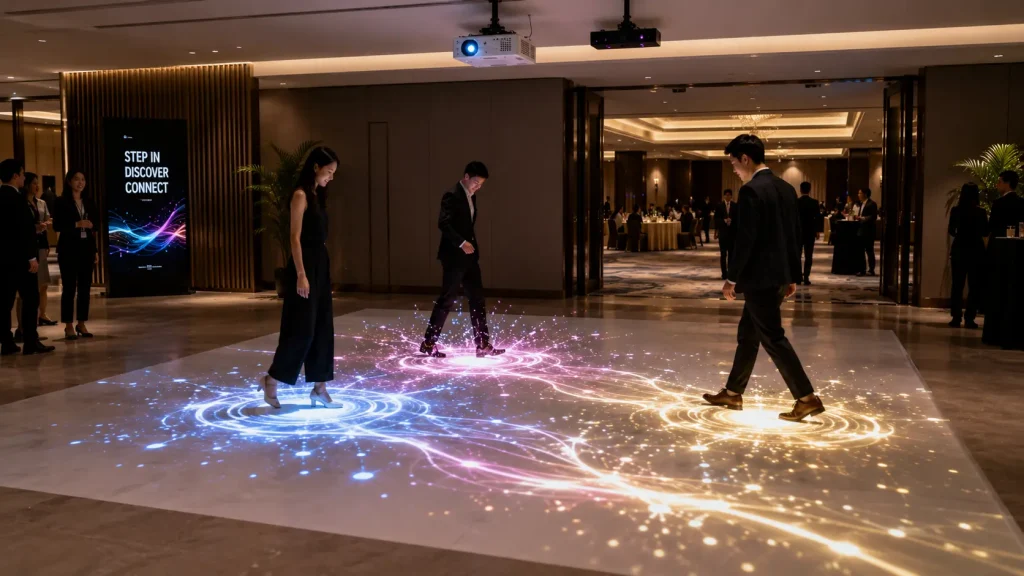
Interactive floor projection transforms an ordinary physical floor into a responsive digital experience that reacts when visitors walk, step or move across it.
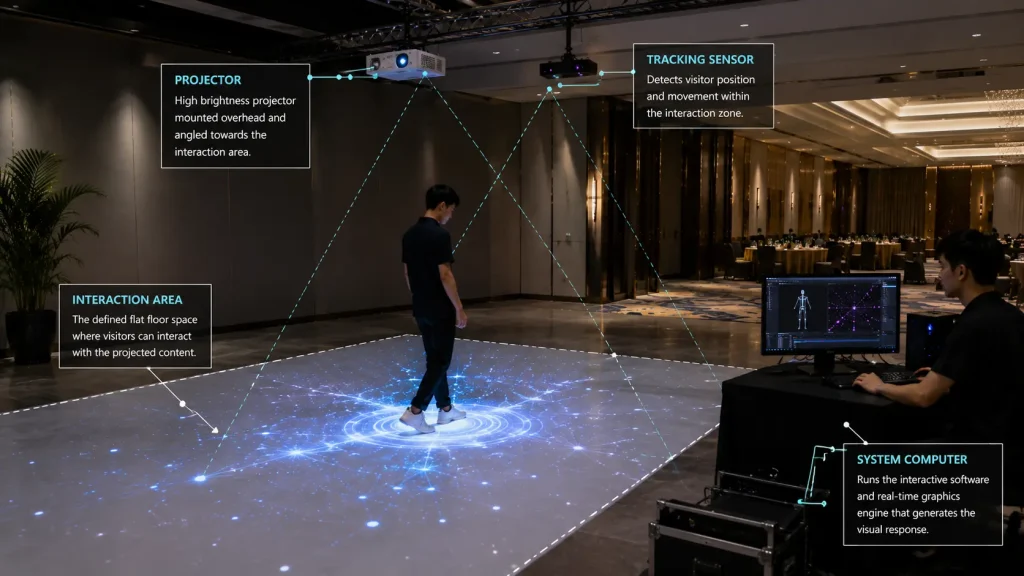
Instead of installing an LED floor or asking visitors to use a touchscreen, projected visuals are displayed directly onto a suitable flat floor surface. A tracking system detects visitor movement and interactive software changes the visuals in real time.
A guest may step onto the floor and create water ripples beneath their feet, scatter digital particles, reveal a pathway, activate branded graphics or participate in an interactive floor game.
In Malaysia, interactive floor projection can be used for corporate events, exhibitions, shopping malls, museums, visitor centres, brand activations and permanent interactive installations.
Key Takeaways
- Interactive floor projection uses projectors, tracking technology and real-time software to create a responsive floor experience.
- The physical floor remains flat; the visual effects are created through projection.
- Visitors can normally participate simply by walking or stepping into the interaction area.
- The experience can range from ambient visual effects to multiplayer interactive games.
- Projector position, floor material, ambient lighting and visitor flow are important technical considerations.
- The content can be customised for corporate branding, campaigns, exhibitions and educational experiences.
What Is Interactive Floor Projection?
Interactive floor projection is a form of interactive projection mapping designed specifically for horizontal floor surfaces.
One or more projectors display digital content onto the physical floor while a tracking system detects people moving within the interaction area.
When the system detects a visitor’s position or movement, the software generates an immediate visual response.
For example:
- A visitor steps onto projected water and ripples appear beneath their feet.
- Digital leaves move away as someone walks through them.
- Projected particles follow a visitor across the floor.
- A pathway illuminates as guests move toward an entrance.
- Players step on projected targets to score points.
The result is a digital experience that appears to respond directly to the visitor.
Is Interactive Floor Projection the Same as an LED Floor?
No. Although both can display digital content beneath visitors, the technologies are fundamentally different.
An LED floor uses physical LED display panels installed on the ground. Visitors walk directly on top of the display modules.
Interactive floor projection uses a conventional physical floor or prepared projection surface. Visual content is projected onto that surface from a suitable projector position.
The floor itself does not produce the image.
This difference can make projection particularly useful when a project requires:
- A temporary interactive area
- Custom-shaped projection coverage
- Visual effects that blend into the surrounding environment
- A large responsive surface without installing LED panels across the entire floor
- Integration with wall or immersive projection
However, projection and LED each have different advantages. The correct solution depends on the venue, lighting conditions, required brightness, installation method and experience concept.
How Does an Interactive Floor Detect Visitors?
A tracking device monitors a defined interaction area and provides visitor-position information to the interactive software.
The software then determines where the visual response should appear.
For example, if a visitor moves from the left side of the floor toward the centre, the system can continuously update the person’s position and generate effects around the corresponding area.
This tracking process happens repeatedly in real time, allowing the projected visuals to appear connected to the visitor’s movement.
Different tracking technologies may be used depending on the installation. The correct approach depends on the interaction area, number of users, ceiling conditions and type of experience.
For a broader explanation of sensors and real-time projection systems, see our Interactive Projection Mapping Malaysia guide.
Does the Floor Need to Be Special?
The floor does not necessarily need to contain electronic components, but its physical properties affect projection quality.
A suitable surface should generally provide enough visual contrast for the projected content while remaining safe for visitors to walk across.
Factors to consider include:
- Floor colour
- Surface reflectivity
- Texture
- Existing patterns
- Levelness
- Walking safety
- Ambient lighting
A very dark, reflective or heavily patterned floor may reduce visual clarity depending on the projector and content design.
Where necessary, a temporary projection-friendly surface can be introduced over the existing venue floor, provided that the installation remains suitable for visitor traffic and event safety requirements.
Where Is the Projector Installed?
For many interactive floor installations, the projector is positioned above the interaction area and aimed downward toward the floor.
This can help reduce the amount of space occupied by equipment at visitor level while allowing guests to move naturally through the experience.
However, projector placement must be planned carefully.
The required position depends on:
- Floor coverage size
- Ceiling height
- Projector lens
- Available mounting or rigging positions
- Visitor movement
- Nearby structures
A projector should not simply be mounted directly above the centre of the floor without checking its required image geometry and throw distance.
For larger interactive areas, more than one projector may be required.
How Large Can an Interactive Floor Be?
The interactive area can vary from a compact activation to a much larger floor experience.
There is no single standard size because the coverage depends on projector specifications, installation height, tracking range, venue conditions and intended visitor capacity.
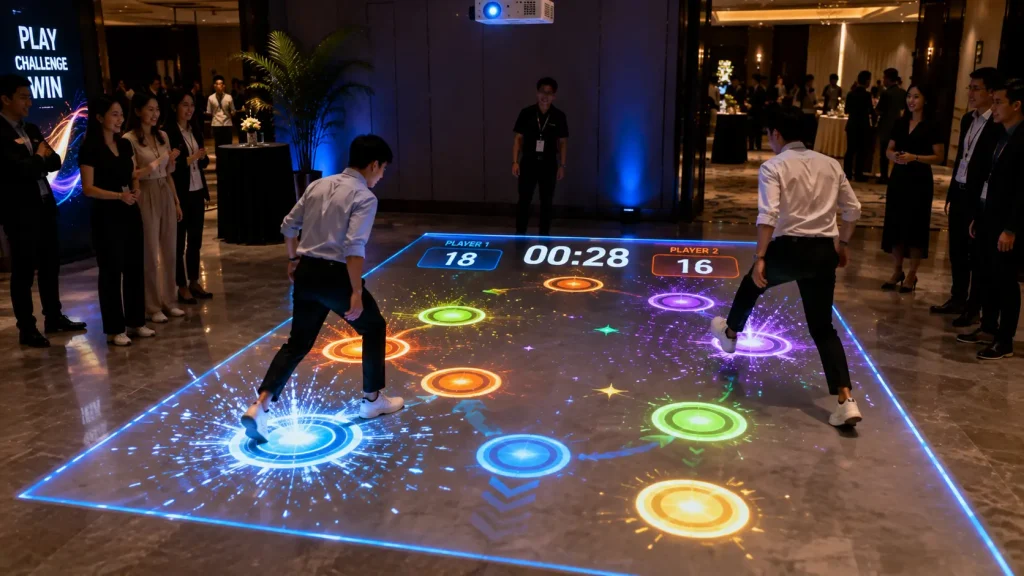
A small experience may be designed for one or two participants at a time.
A larger installation may allow several visitors to move through different areas simultaneously.
When the floor becomes larger, multiple projectors can be combined to create a continuous visual canvas. Tracking coverage may also need to be expanded accordingly.
Can Several People Use the Interactive Floor at the Same Time?
Yes. Interactive floor experiences can be designed for multiple visitors.
The system may track several positions and generate separate visual responses around different participants.
For example, four visitors walking through a projected water environment could each create their own ripples.
For games, several players may also compete within different zones or interact with the same projected objects.
However, the experience should be designed around the expected number of participants.
If too many people enter a small interaction area, the visual response can become difficult to understand even if the tracking system is technically capable of detecting them.
What Types of Interactive Floor Effects Are Possible?
Interactive floor projection does not need to follow one particular visual style.
The response can be designed according to the environment, brand or communication objective.
Water and Ripple Effects
Projected water can react beneath visitors’ feet, creating ripples and movement as they walk.
This is one of the easiest interaction concepts for visitors to understand because the visual response closely resembles a familiar physical behaviour.
Particles and Light Trails
Digital particles can follow visitors, move away from their footsteps or form trails behind them.
This works well for technology-themed events, futuristic experiences and visually driven brand activations.
Nature Effects
Projected flowers can bloom, leaves can move and digital environments can change as visitors walk through the space.
These interactions can support sustainability, environmental and educational themes.
Interactive Pathways
Projection can create a pathway that responds as visitors move through an entrance, corridor or exhibition environment.
This can be used to guide attention while creating a more memorable arrival experience.
Reveal Experiences
Visitors can uncover hidden graphics, images or information by walking across particular areas of the floor.
Instead of displaying everything at once, content is discovered through physical movement.
Can Interactive Floor Projection Become a Game?
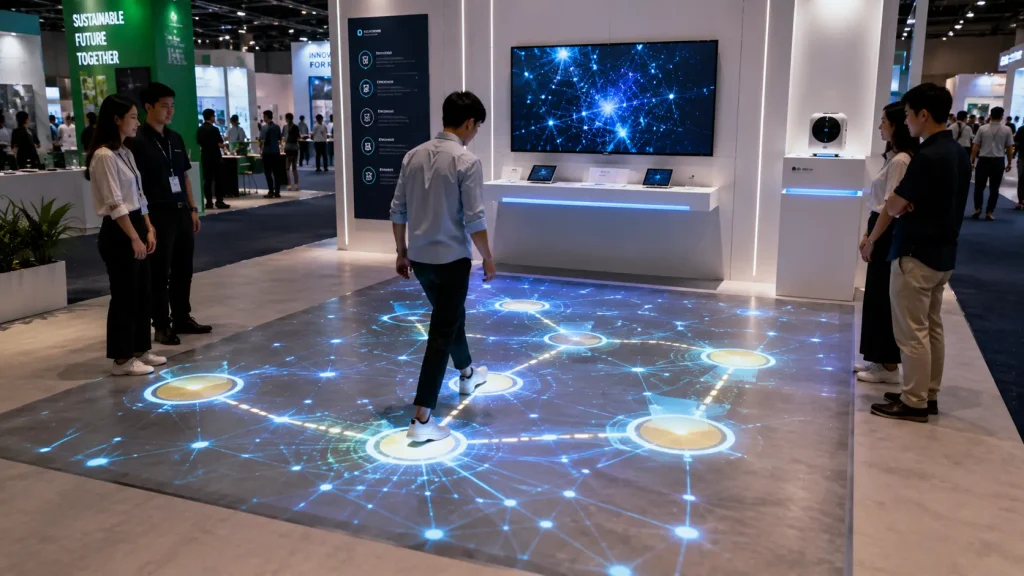
Yes. The same tracking and projection system can be developed into an interactive floor game.
Instead of simply generating visual effects, the software can introduce objectives, scores, timers and challenges.
Examples include:
- Step-on-target reaction games
- Collect-the-object games
- Avoid-the-obstacle challenges
- Team-based floor competitions
- Educational matching games
- Timed branded challenges
A corporate activation could ask participants to step on specific projected targets before time runs out, while an educational exhibition could ask children to match projected objects with the correct categories.
The game mechanics should remain simple enough that visitors can understand them quickly, particularly in high-traffic event and exhibition environments.
Interactive Floor Projection for Corporate Events
Corporate events can use interactive floors as part of the guest experience rather than limiting digital technology to the main stage.
An interactive floor can be positioned at:
- Event entrances
- Registration areas
- Pre-function foyers
- Brand activation zones
- Photo experience areas
- Networking spaces
For example, guests entering an annual dinner could walk across a projected pathway where particles or themed graphics respond around their footsteps.
This can complement stage-based projection mapping for annual dinners and extend the visual theme beyond the ballroom stage.
Interactive Floor Projection for Exhibitions
At exhibitions, the floor is often an underused part of the booth or visitor environment.
Interactive projection can turn this area into an attraction that is visible when people approach the booth.
Visitors may walk through a branded visual environment, participate in a short game or trigger different content zones through movement.
Because the interaction is physical and visually noticeable, other visitors can often understand the experience simply by watching somebody else use it.
This can help create natural curiosity around an exhibition space.
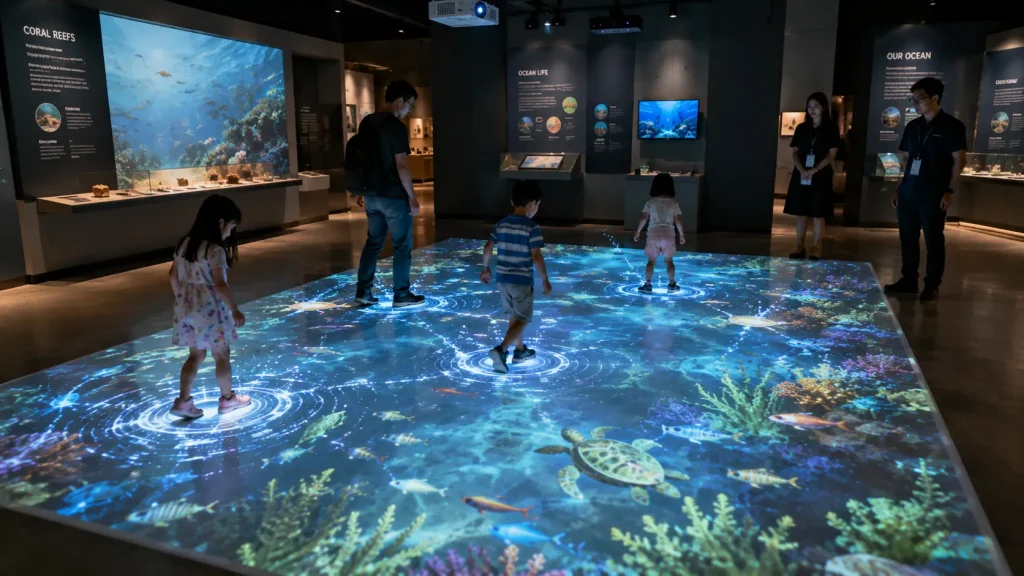
Interactive Floor Projection for Museums
Museums and educational environments can use interactive floors to transform learning into a physical experience.
Instead of only reading or watching content, visitors can move through it.
For example:
- Children could walk across a projected ecosystem and discover different species.
- A historical map could reveal information as visitors move between locations.
- An ocean environment could react as visitors explore different zones.
- A science exhibition could visualise forces, particles or movement around the visitor.
The interaction can make abstract information easier to understand by connecting digital content with physical movement.
Interactive Floor Projection for Shopping Malls and Brand Activations
Shopping malls and public activation spaces often require experiences that can attract attention without requiring lengthy instructions.
An interactive floor can respond immediately when someone walks into the area.
This lowers the participation barrier because visitors do not necessarily need to scan a QR code, download an application or hold a controller.
Brand graphics, campaign visuals and interactive game mechanics can be incorporated into the projected content while maintaining a natural walk-up experience.
Can an Interactive Floor Connect to a Wall Projection?
Yes. The floor does not need to operate as an isolated rectangular projection.
Floor content can visually continue onto surrounding walls to create a larger environment.
For example, projected water could cover the floor while an underwater environment continues across the walls. Visitor movement on the floor could then trigger changes elsewhere in the projected environment.
This approach begins to move from a standalone interactive floor toward a complete immersive projection experience.
The advantage is that visitors are no longer interacting with a single digital surface. They are participating inside a responsive environment.
Will People Create Shadows on an Interactive Floor?
Yes. Because interactive floor projection uses light projected onto a physical surface, a person can create a shadow if their body moves between the projector and the projected area.
This is a normal technical consideration and should be addressed during system planning rather than after installation.
For many floor projection installations, the projector is mounted overhead and positioned at an angle that reduces the amount of important content blocked by visitors.
The content can also be designed with visitor movement in mind. Important game elements, instructions or targets should not depend on areas that are frequently obstructed.
Can Shadows Be Completely Eliminated?
Not always, and complete shadow elimination is not necessarily required for a successful interactive floor experience.
The objective is to make sure shadows do not interfere with the interaction.
Depending on the installation, this may involve:
- Positioning projectors higher above the interaction area
- Using an appropriate projection angle
- Reducing unnecessary crossing of the projection path
- Using more than one projector where appropriate
- Designing the interaction around expected visitor positions
- Keeping important visual elements away from frequently obstructed areas
The projector layout and interaction design should therefore be developed together.
What Ceiling Height Is Required for Interactive Floor Projection?
There is no universal minimum ceiling height because the required installation height depends on the size of the floor area, projector lens, throw ratio and mounting position.
A higher ceiling can provide more flexibility for covering a larger floor area from above, but height alone does not determine whether the installation will work.
For example, a venue may have a high ceiling but unsuitable rigging positions. Another venue may have a lower ceiling but allow a compact interactive area using an appropriate projector and lens configuration.
The practical approach is to evaluate the required floor coverage together with the available projector position.
Can Interactive Floor Projection Work Without Ceiling Rigging?
Potentially. Ceiling mounting is common, but it is not the only possible installation method.
If venue rigging is unavailable, alternative structures may be considered depending on the site conditions. These could include suitable overhead support structures or other secure projector positions outside the main visitor circulation area.
Any temporary structure must be planned with equipment safety, visitor clearance and the required projection geometry in mind.
The projector should not simply be placed at floor level where visitors can easily block the image or come into contact with the equipment.
How Does Ambient Light Affect Interactive Floor Projection?
Ambient lighting has a significant effect on projected image visibility.
Projection does not create a self-emitting surface in the same way as an LED display. Strong venue lighting falling directly onto the floor can reduce contrast and make interactive effects less visible.
Interactive floor projection therefore performs best when lighting around the projection zone can be controlled.
This does not mean the entire venue needs to be dark.
At an event or exhibition, lighting can often be designed so the surrounding environment remains comfortable while direct light on the interactive floor is reduced.
Can Interactive Floor Projection Be Used in a Bright Exhibition Hall?
Yes, depending on the environment and expectations.
A bright exhibition hall requires more careful planning than a dark immersive room.
Important considerations include:
- Projector brightness
- Size of the projected area
- Floor colour
- Nearby exhibition lighting
- Direct spotlights
- Required visual style
High-contrast graphics can often perform better than subtle dark visuals in brighter environments.
For example, bold particles, targets, pathways and colourful game elements may remain easier to understand than a cinematic scene containing many dark details.
What Happens When Several People Enter the Tracking Area?
A multi-user interactive floor can be designed to track several visitors simultaneously.
The software can assign individual interaction positions and create separate responses around each participant.
However, the practical number of users should be determined by both tracking capability and physical space.
A system that technically detects several people may still provide a poor experience if too many visitors are crowded into a small floor area.
For public installations, it is therefore important to consider:
- Interaction area size
- Expected visitor volume
- Entry and exit direction
- Game duration
- Number of simultaneous participants
- Spectator space
How Accurate Does Floor Tracking Need to Be?
The required tracking accuracy depends on the interaction.
An ambient particle experience may only need to understand the approximate position of each visitor.
A reaction game where players must step on small projected targets requires more precise positioning.
This is why the interaction concept should be defined before the tracking system is selected.
Using unnecessarily complex tracking for a simple visual effect can increase cost without improving the visitor experience.
Is There Any Delay Between Movement and Projection?
An interactive floor should respond quickly enough that visitors naturally connect their movement with the visual reaction.
Several parts of the system influence response time, including:
- Tracking hardware
- Interactive software
- Real-time graphics
- Computer performance
- Projection system
The complete system should therefore be tested as one experience rather than evaluating each component separately.
For fast reaction games, response performance becomes particularly important because even a noticeable delay can affect gameplay.
How Are Interactive Floor Games Developed?
An interactive floor game normally combines game design, tracking input and real-time visual content.
The first step is to define what the player is expected to do.
A simple game flow might be:
Enter Game Zone → Countdown → Step on Targets → Score Points → Final Result
The software detects where the player steps and determines whether the correct projected object has been activated.
Additional features can be developed depending on the project, such as:
- Countdown timers
- Scores
- Multiple difficulty levels
- Team competition
- Player rankings
- Custom branded graphics
- Sound effects
- Different game rounds
For event activations, shorter and simpler game mechanics are often more effective because new participants need to understand the experience quickly.
Can the Interactive Floor Be Branded?
Yes. The visual content and interaction can be customised according to a campaign, corporate identity or event theme.
However, effective branding involves more than placing a logo in the corner of the projection.
The interaction itself can support the campaign concept.
For example, an automotive activation could ask visitors to collect different performance-related elements. A sustainability campaign could allow plants to grow as visitors move across the floor. A technology event could use footsteps to activate connected data points across a digital network.
This creates a stronger relationship between the interaction and the brand message.
Can Interactive Floor Projection Be Used for an Entrance Experience?
Yes. One of the most natural applications is to transform an event or exhibition entrance into a responsive pathway.
Instead of asking guests to stop and learn how to use an installation, the experience reacts automatically as they walk through it.
Projected graphics could follow footsteps, open a visual pathway, create themed effects or gradually reveal a campaign environment.
This can work particularly well for corporate events where the interactive floor continues the visual language of the main event.
Can It Be Used for a Product Launch?
Yes. Interactive floor projection can support a larger product launch projection mapping experience.
For example, an interactive pathway could guide guests toward the product reveal area, or floor graphics could react as visitors approach a physical product display after the launch.
The floor can also become part of a post-reveal engagement area where visitors explore different features through movement.
Can Interactive Floor Projection Run for the Entire Event?
Yes, provided the system is designed for the required operating duration.
However, continuous operation does not mean the same animation needs to repeat unchanged throughout the event.
The experience can include different states such as:
- Idle mode when nobody is present
- Attract mode when a visitor approaches
- Interactive mode when tracking begins
- Game mode for active participants
- Result or celebration mode after an interaction
These states can make the installation feel more intentional and reduce unnecessary visual activity when the interaction area is empty.
Is Interactive Floor Projection Safe to Walk On?
The projected image itself does not create a physical obstacle because the visuals are displayed onto the floor using light.
However, the physical installation still needs to be designed for safe visitor movement.
If a temporary projection surface is added, it should be installed securely and should not create unnecessary raised edges or trip hazards.
Cables, computers, sensors and projection equipment should also be positioned away from normal visitor circulation wherever possible.
For game-based experiences, the interaction should avoid encouraging unsafe movements such as uncontrolled running, jumping or collisions in a limited space.
Temporary vs Permanent Interactive Floor Installation
Interactive floor projection can be developed for both temporary events and permanent environments.
Temporary Event Installation
For an event, exhibition or roadshow, the system is typically installed for a defined period and dismantled after the activation.
The design should consider fast installation, venue restrictions and practical equipment placement.
Permanent Installation
Museums, visitor centres, galleries and experience centres may require the system to operate regularly over a much longer period.
Permanent installations require additional planning for:
- Equipment access
- Projector maintenance
- Sensor protection
- Computer ventilation
- Automatic system startup and shutdown
- Content management
- Long-term calibration
- Technical support
The installation should be designed so routine maintenance can be performed without unnecessarily dismantling the surrounding environment.
Why Is a Site Survey Important?
A site survey helps determine whether the proposed floor experience can be installed reliably in the actual venue.
We typically need to understand factors such as:
- Floor dimensions
- Ceiling height
- Available mounting positions
- Floor material and colour
- Ambient lighting
- Visitor circulation
- Power availability
- Rigging restrictions
- Installation access
- Operating hours
Photos, videos, floor plans and ceiling information can also help during the initial planning stage before an on-site survey is arranged.
What Is the Project Workflow?
A typical interactive floor projection project may follow these stages:
- Project Brief – Define the event, audience, objective and venue.
- Interaction Concept – Decide what visitors will do and how the floor should respond.
- Site and Technical Planning – Determine floor coverage, projector positions and tracking requirements.
- Visual and Game Design – Develop the projected environment and interaction mechanics.
- Software Development – Build the real-time interactive application.
- Testing – Test tracking, response speed and gameplay before deployment.
- On-Site Installation – Install the projection, tracking and computer systems.
- Calibration – Align the projected image and tracking area with the physical floor.
- User Testing – Test the experience using realistic visitor movement.
- Event or Installation Operation – Run the completed interactive floor experience.
How Much Does Interactive Floor Projection Cost in Malaysia?
The cost of an interactive floor projection system depends on the scale and complexity of the project rather than one standard package price.
Important cost factors include:
- Size of the interactive floor
- Number and brightness of projectors
- Projector lens requirements
- Tracking technology
- Number of simultaneous users
- Complexity of the interactive content
- Custom game development
- Computer requirements
- Temporary projection surface, if required
- Rigging or support structures
- Installation location
- Operating duration
- Temporary or permanent installation
A compact single-user floor effect will therefore have very different requirements from a large multi-user interactive environment.
For broader projection budgeting considerations, see our Projection Mapping Cost Malaysia guide.
How Can the Budget Be Controlled?
A focused interaction is usually the most effective starting point.
Instead of making the floor unnecessarily large or developing many different game modes, the project can concentrate on one clear experience that visitors immediately understand.
Budget can also be managed by:
- Keeping the interaction area appropriately sized
- Using one strong game or interaction concept
- Matching tracking accuracy to the actual experience
- Using suitable 2D real-time graphics where 3D is unnecessary
- Controlling ambient lighting around the installation
- Using existing suitable venue infrastructure where technically possible
What Information Is Needed for a Quotation?
For an initial interactive floor projection quotation, it is useful to provide:
- Event or project type
- Venue and location
- Event dates and operating duration
- Approximate floor area
- Ceiling height
- Photos or videos of the venue
- Expected visitor volume
- Preferred interaction or game concept
- Branding requirements
- Available venue equipment, if any
- Temporary or permanent installation requirement
- Estimated budget range, if available
If the interaction concept has not yet been decided, the experience can be proposed based on the project objective, audience and available space.
How Early Should Interactive Floor Projection Be Planned?
Interactive floor projects should ideally be planned early enough to allow time for technical evaluation, content development, software testing and on-site calibration.
A simple existing interaction can require less preparation than a fully customised game or large multi-user installation.
Projects involving specialised structures, multiple projectors or permanent installation should allow additional time for technical coordination and testing.
Why Work with MyDigital Asia?
MyDigital Asia develops interactive projection experiences for events, exhibitions, museums, visitor centres and brand activations in Malaysia.
Our interactive floor projects can combine:
- Experience and game concept development
- Interactive software development
- Motion and visitor tracking
- Real-time visual content
- Projection system planning
- Projector and sensor integration
- On-site installation
- Projection and tracking calibration
- Testing and event operation
By planning the projection, tracking, software and content as one system, the experience can be designed around the actual venue and visitor behaviour rather than treating each technical component separately.
Frequently Asked Questions
Is an interactive floor an LED screen?
No. Interactive floor projection displays visuals onto a physical floor using projectors. The floor itself does not contain LED display modules.
Do visitors need to wear or hold a sensor?
Not necessarily. Many installations use external tracking technology that detects visitors within the interaction area without requiring them to wear a device or hold a controller.
Can children use an interactive floor?
Yes. Interactive floors can be designed for children, particularly for museums, educational environments and family activations. The content and interaction should be designed appropriately for the intended age group and physical environment.
Can several people play together?
Yes. Multi-user experiences and games can be developed depending on the size of the interaction area, tracking system and game design.
Can it be installed in a hotel ballroom?
Yes, subject to suitable ceiling or support positions, projection coverage, ambient lighting and venue installation restrictions.
Can it be installed at an exhibition booth?
Yes. Interactive floor projection can be incorporated into exhibition spaces when the booth provides sufficient floor area, suitable equipment positions and manageable lighting conditions.
Can existing projectors be used?
Potentially. Existing projectors should be evaluated based on brightness, resolution, lens, throw distance and available mounting position before confirming that they are suitable.
Can the game show scores and winners?
Yes. Custom interactive floor games can include scores, countdown timers, player results and other game mechanics according to the project requirements.
Can the floor interaction connect with wall projection?
Yes. Interactive floor content can be integrated with surrounding projection surfaces to create a larger immersive projection environment.
Create an Interactive Floor Experience in Malaysia
Interactive floor projection can transform an ordinary floor into a responsive environment where visitors participate through natural movement.
From event entrances and exhibition games to museums and immersive environments, the technology can be adapted to different audiences and project objectives.
The strongest installations combine a simple interaction idea with suitable projection coverage, reliable tracking, responsive software and content designed specifically for the physical space.
If you are planning an interactive floor projection project in Malaysia, MyDigital Asia can support the project from concept and technical planning through interactive software, content development, installation and on-site calibration.
Contact MyDigital Asia to discuss your venue, interactive floor concept and project requirements.
Related Projection Mapping Guides
- Projection Mapping Malaysia
- Projection Mapping Cost Malaysia
- Projection Mapping for Corporate Events
- Building Projection Mapping Malaysia
- Projection Mapping for Product Launches
- Projection Mapping for Annual Dinners
- Interactive Projection Mapping Malaysia
- Immersive Projection Malaysia
- Projection Mapping vs LED Screen
Request a Free Consultation
Looking for Interactive Maps, Interactive Solutions or Event Technology?

LATEST POSTS