
Projection Mapping Cost Malaysia
How much does projection mapping cost in Malaysia?
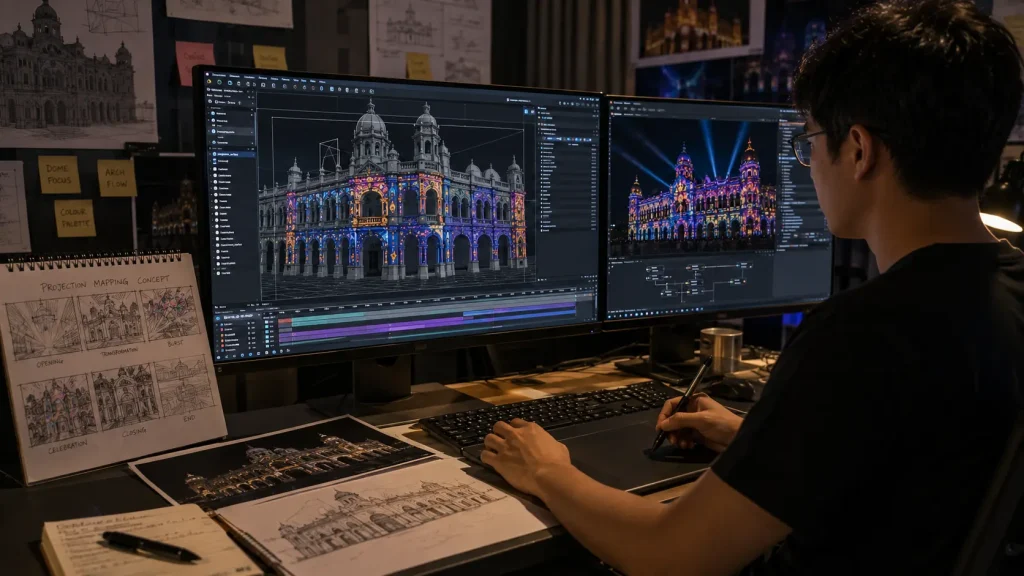
The answer can vary significantly because Projection Mapping Cost Malaysia is determined by much more than the number of projectors used.
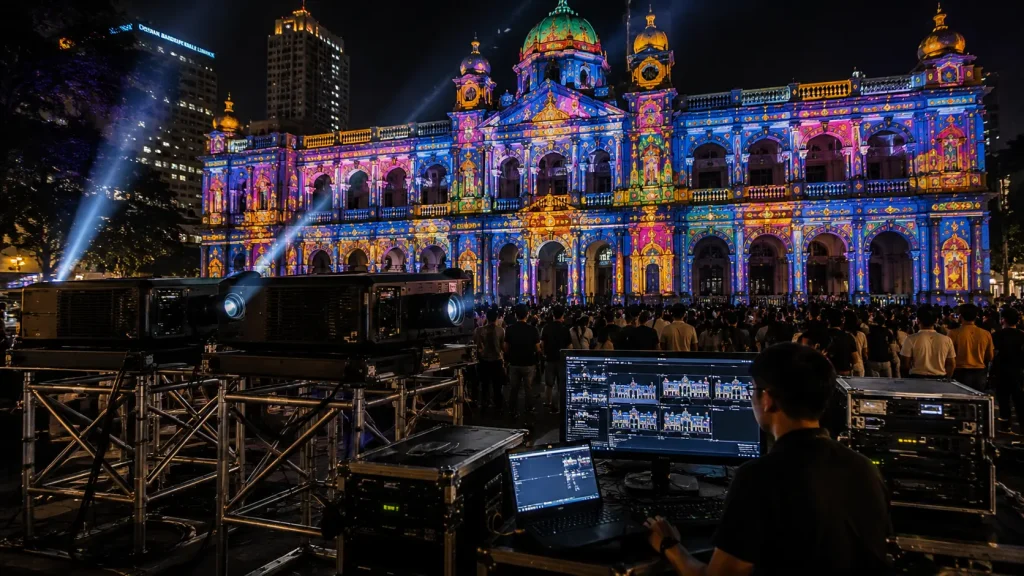
A small indoor projection mapping installation for a product display may have very different technical requirements from a large outdoor projection covering an entire building façade.
The final budget can be affected by projection surface size, projector brightness, projection distance, content complexity, installation structures, media server requirements, technical crew and the duration of the event.
This guide explains the major factors that affect projection mapping pricing in Malaysia and what information you should prepare before requesting a quotation.
Key Takeaways
- There is no single fixed price for projection mapping because every projection surface and venue is different.
- Projector quantity and brightness are major factors affecting the technical budget.
- Custom 2D or 3D projection mapping content is normally calculated separately from equipment requirements.
- Large outdoor building projection requires significantly more technical planning than small indoor installations.
- Projection distance and lens selection can affect the equipment configuration.
- A site survey may be required before an accurate quotation can be prepared.
- Providing the surface dimensions, venue, event date and reference concept can speed up the quotation process.
Why Does Projection Mapping Pricing Vary So Much?
Projection mapping is not a standard screen rental where the price can be calculated only according to screen size.
The physical environment becomes part of the projection system.
This means two projects with similar projection dimensions can still require very different technical setups.
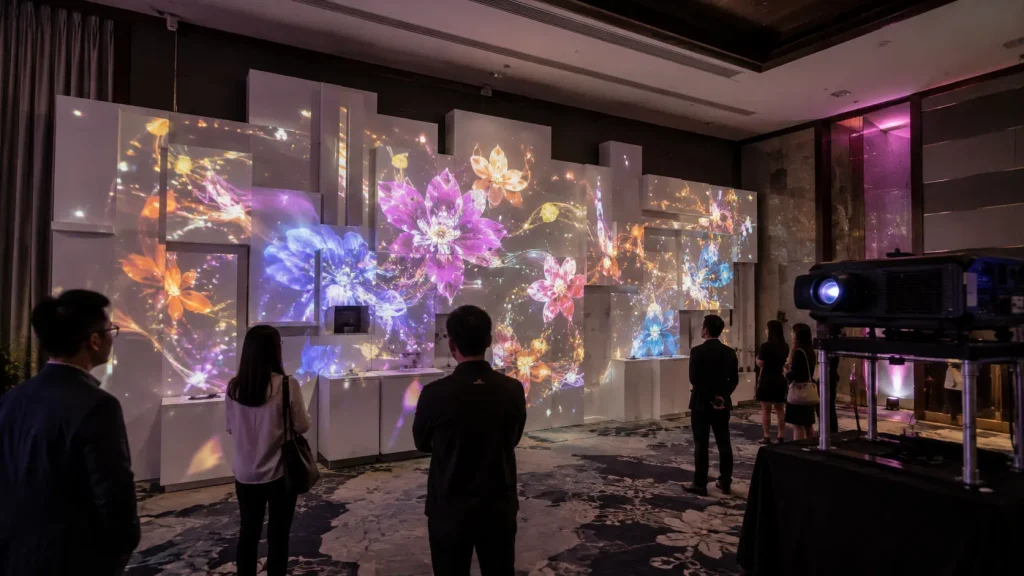
For example, a 10-metre-wide projection inside a dark ballroom may require a relatively straightforward configuration.
A similar-sized projection outdoors may need considerably more brightness because of surrounding street lights, longer projection distances and environmental conditions.
The content requirements can also be completely different.
A simple branded motion graphic sequence requires less production than a customised 3D architectural animation designed to make a building appear to transform.
For this reason, professional projection mapping quotations are normally based on both:
- Technical Production
- Creative Content Production
Main Factors Affecting Projection Mapping Cost
When preparing a projection mapping quotation, several technical and creative factors need to be evaluated.
1. Projection Surface Size
The width and height of the projection surface are among the first pieces of information required.
A larger surface normally requires either a wider projected image, additional projectors or higher-output equipment.
Typical projection surfaces may include:
- Event Stage Structures
- Indoor Walls
- Building Façades
- Vehicles
- Products
- Exhibition Structures
- Floors
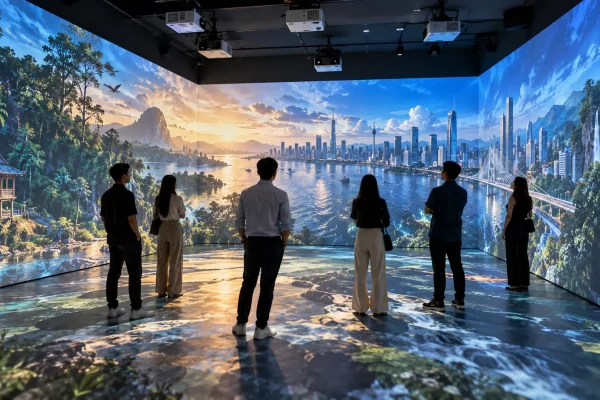
- Immersive Rooms
Surface dimensions also help determine the required content resolution and projector layout.
2. Projector Brightness
Projector brightness is commonly measured in lumens.
The brightness required depends on the environment, projection area and surrounding light conditions.
A controlled indoor environment can generally operate with lower brightness than a large outdoor building projection.
Outdoor projection mapping may require high-brightness professional projectors to ensure the content remains visible against ambient lighting.
Higher-output projection equipment generally represents a larger portion of the technical budget.
3. Number of Projectors
Some projection mapping installations require only one projector.
Others may require several projectors working together.
Multiple projectors may be required when:
- The Projection Surface Is Very Wide
- The Surface Is Very Large
- Several Walls Need to Be Covered
- Additional Brightness Is Required
- Different Projection Angles Are Needed
- An Immersive Environment Is Being Created
For wide projection surfaces, several images may be blended together to create one seamless canvas.
In other situations, multiple projectors may be stacked onto the same area to increase brightness.
4. Projection Distance & Lens Selection
The distance between the projector and projection surface affects the type of lens and equipment configuration required.
Not every venue allows projectors to be positioned at the ideal distance.
There may be:
- Audience Seating
- Existing Stage Structures
- Venue Restrictions
- Roads
- Trees
- Lighting Structures
- Architectural Obstacles
Different projector lenses may therefore be required to achieve the necessary image size from the available position.
For large outdoor projects, projector placement should be studied carefully before the equipment list is confirmed.
5. Indoor vs Outdoor Projection Mapping
Indoor and outdoor projection mapping can have very different cost structures.
Indoor Projection Mapping
Indoor venues generally provide greater control over lighting and equipment placement.
Typical indoor applications include:
- Corporate Events
- Annual Dinners
- Product Launches
- Exhibitions
- Museums
- Immersive Rooms
The controlled environment can simplify some technical requirements, although large or complex installations may still require multiple projectors and specialised equipment.
Outdoor Projection Mapping
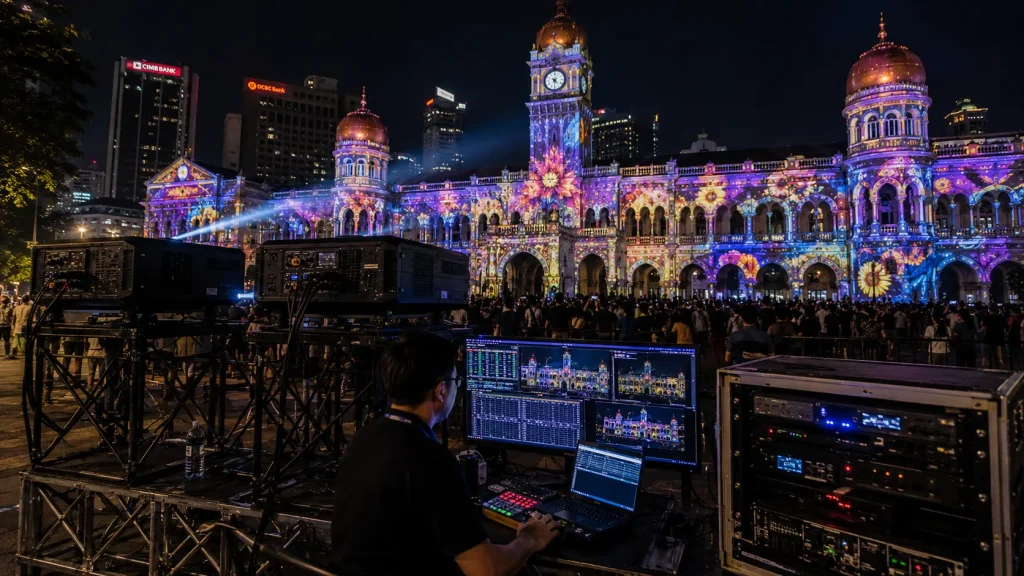
Outdoor projection mapping often requires additional planning for brightness, weather protection, equipment structures, power supply and projection distance.
Large building façades may also require multiple high-brightness projectors and professional media server systems.
These additional requirements can make outdoor architectural projection considerably more complex than a small indoor installation.
6. Projection Mapping Content
Projection equipment is only one part of the project.
The visual content itself can represent a significant portion of the overall production.
Projection mapping content may include:
- Graphic Design
- 2D Motion Graphics
- 2.5D Animation
- 3D Animation
- Architectural Animation
- Product Animation
- Particle Effects
- Sound Design
- Music Synchronisation
A simple looping visual sequence will normally require less production than a fully customised cinematic projection mapping show.
For building projection mapping, the animation may also need to be designed according to windows, columns, arches and other architectural features.
7. Duration of Projection Mapping Content
The length of the projection mapping sequence can affect the creative production budget.
A short opening sequence may only need to run for several minutes, while an exhibition or public installation may require longer content or multiple visual scenes.
However, content duration alone does not determine the cost.
A 60-second highly detailed 3D architectural animation can require more production work than a longer sequence made from relatively simple motion graphics.
8. Media Server & Playback System
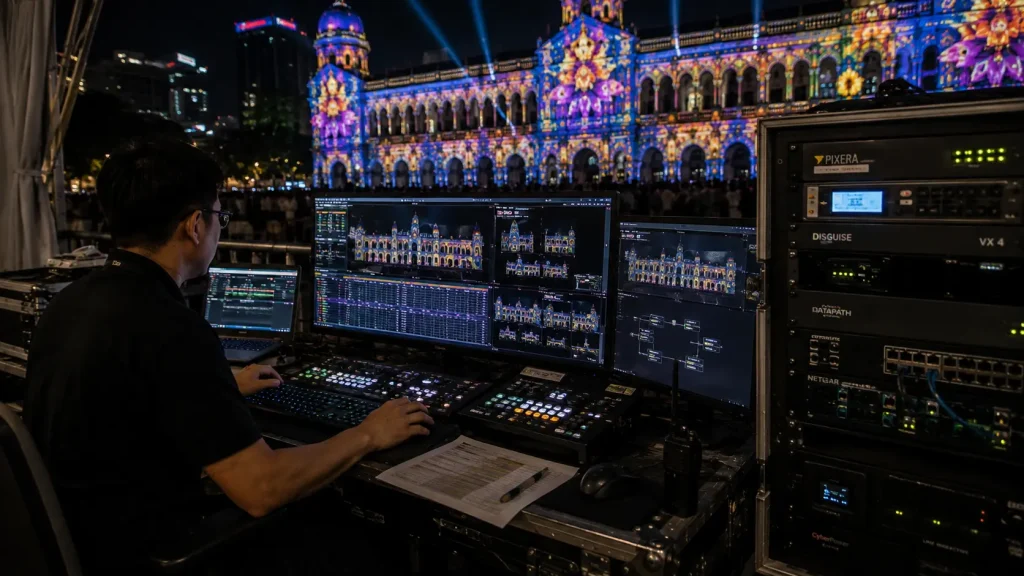
Complex projection mapping installations may require a dedicated media server or high-performance playback system.
The system manages the content outputs and ensures that visuals are correctly distributed across the projectors.
Media server requirements become more important when the installation involves:
- Multiple Projectors
- High-resolution Content
- Wide Panoramic Projection
- Multi-wall Projection
- Immersive Environments
- Interactive Content
- Precisely Synchronised Playback
The required hardware and software configuration therefore depends on the complexity of the installation.
9. Installation Structure & Rigging
Projectors need stable and safe positions throughout the event.
Depending on the venue, projectors may be installed on:
- Projector Stands
- Truss Structures
- Raised Platforms
- Existing Venue Rigging
- Custom Outdoor Structures
Large outdoor projectors may require weather protection and secure structures designed for the equipment and environment.
These requirements should be included when evaluating the complete projection mapping budget.
10. Interactive Technology
Adding interaction can change both the hardware and software requirements.
An Interactive Projection Mapping installation may use:
- Motion Tracking Cameras
- Depth Sensors
- Interactive Software
- Computer Vision
- Touch or Pressure Sensors
- Custom Real-time Graphics
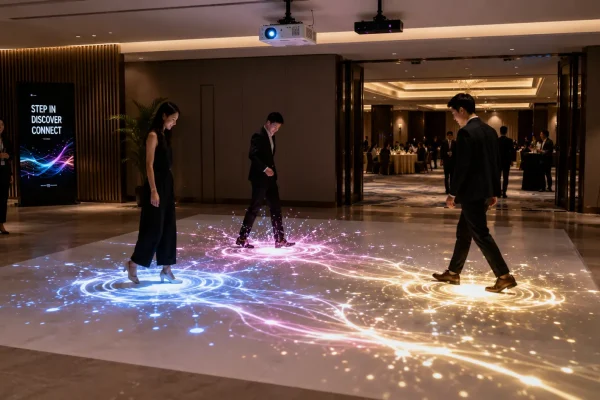
For example, an interactive floor projection that responds to visitor movement requires more than a projector and video file.
The system must continuously detect participants and generate the appropriate visual response in real time.
What Types of Projection Mapping Projects Have Different Budgets?
Rather than looking for one universal projection mapping price, it is more useful to understand how the technical requirements change between different project types.
Small Indoor Projection Mapping
This may involve a relatively compact wall, product, stage feature or exhibition structure.
The environment is usually easier to control and the projection distance may be relatively short.
These projects can be suitable for:
- Exhibition Displays
- Corporate Presentations
- Product Displays
- Small Launch Experiences
- Interactive Installations
Corporate Event Projection Mapping
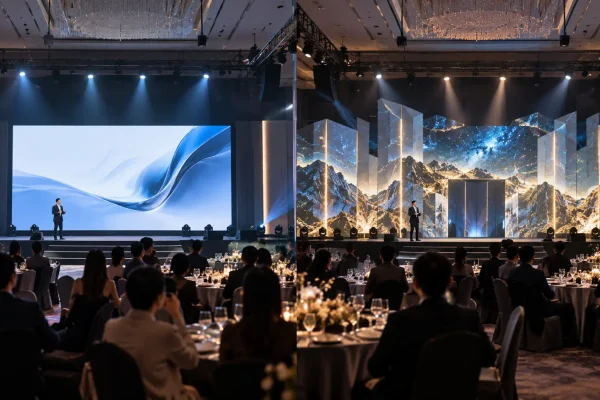
Corporate event projection mapping may cover a larger stage or custom scenic structure.
The projection sequence can also be synchronised with:
- Event Lighting
- Sound Effects
- Opening Performances
- Product Reveals
- Physical Stage Actions
The overall budget therefore depends on both the projection system and the complexity of the show content.
Building Projection Mapping
Building projection mapping is typically one of the more technically demanding formats because the projection area can be very large.
A building project may require:
- Multiple High-brightness Projectors
- Specialised Projection Lenses
- Outdoor Projector Structures
- Media Servers
- Architectural Mapping
- Custom 3D Content
- Technical Crew
- Testing & Rehearsal
The size and shape of the building can significantly affect the final equipment configuration.
For this reason, building projection mapping quotations are normally prepared after reviewing the actual façade and potential projector positions.
Projection Mapping Budget Structure
A projection mapping quotation is usually easier to understand when the project is separated into technical production and creative production.
Depending on the project, the quotation may include several different components rather than one single equipment rental fee.
A typical budget structure may include:
- Projection Equipment
- Projection Lenses
- Media Server & Playback System
- Projection Mapping Setup
- Edge Blending & Alignment
- 2D or 3D Content Production
- Interactive Sensors & Software
- Projector Structures or Rigging
- Technical Crew
- Installation & Testing
- Rehearsal
- Transportation & Logistics
- Dismantling
Not every project requires every item.
A simple indoor installation may use a relatively compact technical setup, while a large outdoor architectural projection can involve several specialised production components.
Projection Equipment Cost vs Content Production Cost
One of the most important things to understand when budgeting for projection mapping is that the equipment and the visual content are two different parts of the project.
Projection Equipment & Technical Production
This covers the physical system required to display and operate the experience.
It may include:
- Projectors
- Projection Lenses
- Media Server
- Playback Computers
- Signal Distribution
- Projector Structures
- Cabling
- Mapping & Alignment
- Technical Operators
Creative Content Production
This covers the visuals that audiences actually experience.
Depending on the concept, content production may include:
- Creative Direction
- Storyboard Development
- Styleframes
- Graphic Design
- 2D Motion Graphics
- 3D Animation
- Architectural Animation
- Product Animation
- Sound Design
- Final Rendering
A client who already has suitable projection mapping content may therefore require mainly technical production.
However, conventional videos may still need to be reformatted or adapted before they can work correctly across a mapped surface.
Does Projection Mapping Cost More Than an LED Screen?
Projection mapping and LED screens solve different creative and technical requirements, so comparing them only by rental price can be misleading.
An LED screen provides a defined rectangular digital display and can be highly effective for presentations, videos, live camera feeds and event information.
Projection mapping is more suitable when the objective is to integrate digital visuals with the physical environment.
For example, projection mapping can transform:
- An Entire Building Façade
- A Custom Stage Structure
- A Physical Product
- A Vehicle
- An Exhibition Installation
- A Floor
- Multiple Walls of a Room
For some events, the most effective solution may be to combine projection mapping with an LED screen rather than choosing only one technology.
One-Night vs Multi-Day Projection Mapping
Event duration can affect the total project cost, but the relationship is not always proportional.
A significant portion of projection mapping work may happen before the event begins.
This can include:
- Site Survey
- Technical Planning
- Content Production
- Equipment Preparation
- Installation
- Mapping
- Testing
- Rehearsal
Once the complete system has been installed and calibrated, operating it for an additional event day may not require repeating all of these processes.
However, additional rental days, technical crew, security, venue access, equipment protection and operational requirements may still affect the multi-day budget.
For public installations or exhibitions running for extended periods, the system should also be planned around reliability and daily operation.
Does a Longer Projection Show Cost More?
Longer content can increase production requirements, but animation duration should not be used as the only way to calculate creative cost.
Content complexity is equally important.
For example, a short cinematic sequence containing detailed 3D architectural transformations may require substantial modelling, animation, simulation and rendering.
A longer ambient projection loop using graphic patterns and relatively simple motion may require less production work.
The creative budget should therefore consider:
- Content Duration
- Animation Style
- Number of Scenes
- 3D Complexity
- Surface Complexity
- Visual Effects
- Number of Revisions
- Audio Requirements
How to Reduce Projection Mapping Cost
Projection mapping can often be optimised without removing the main visual impact of the experience.
The key is to identify which elements are most important to the audience and allocate the budget accordingly.
1. Reduce the Projection Area
Instead of covering an entire building or stage, selected architectural areas can become the main projection canvas.
A smaller projection area may reduce projector quantity while still creating a strong focal point.
2. Use the Architecture Strategically
Projection does not always need to cover every surface.
Columns, entrances, central façades or distinctive architectural features can be selected according to the creative concept.
This can create a more focused show while simplifying the technical configuration.
3. Control Ambient Lighting
For indoor projects, reducing unnecessary lighting around the projection surface can improve perceived image brightness.
This may allow the projection system to perform more effectively without relying entirely on additional projector output.
4. Simplify Content Where Appropriate
Not every scene needs complex 3D animation.
A production can combine selected high-impact 3D moments with:
- 2D Motion Graphics
- Typography
- Brand Graphics
- Particle Effects
- Video Content
This can help concentrate the creative budget on the moments that matter most.
5. Confirm the Venue Early
Early access to venue information can prevent unnecessary technical assumptions.
Knowing the actual projection distance, surface dimensions and available installation positions allows the equipment configuration to be planned more accurately.
Can Existing Projectors Be Used?
In some venues, clients may already have access to professional projectors.
Existing equipment can potentially be incorporated into the projection mapping system if it meets the technical requirements.
The projectors should be evaluated based on:
- Brightness
- Resolution
- Lens Compatibility
- Projection Distance
- Signal Inputs
- Installation Position
- Operating Condition
Using existing projectors can reduce equipment rental requirements, but the equipment should first be checked to ensure that it is suitable for the intended projection area.
Can Existing Content Be Used?
Existing brand videos, corporate animations and visual assets can often be incorporated into a projection mapping production.
However, a standard 16:9 video is not automatically projection mapping content.
The material may need to be adapted according to:
- Projection Surface Dimensions
- Surface Geometry
- Content Resolution
- Mapped Zones
- Architectural Features
- Creative Sequence
Existing logos, product renders, brand guidelines, photographs and videos can also help reduce the amount of new asset creation required.
Why Is a Site Survey Important for Pricing?
For larger projects, a site survey can significantly improve the accuracy of the technical proposal and quotation.
Photographs alone may not reveal all of the physical restrictions affecting projector placement.
A site survey can help identify:
- Actual Projection Dimensions
- Available Throw Distance
- Potential Projector Positions
- Ambient Lighting
- Power Locations
- Audience Sightlines
- Existing Structures
- Access Restrictions
- Weather Exposure
- Installation & Dismantling Access
For complex outdoor projection mapping, these factors can significantly change the required equipment configuration.
What Information Is Needed for a Projection Mapping Quotation?
If you are requesting a Projection Mapping Price Malaysia quotation, providing the right information from the beginning can make the initial technical assessment much faster.
Useful information includes:
- Event Date
- Venue & Location
- Indoor or Outdoor
- Projection Surface Width & Height
- Photographs of the Projection Surface
- Approximate Projection Distance
- Event Duration
- Number of Event Days
- Expected Audience Size
- Required Content Duration
- Reference Videos or Visual Concepts
- Whether Existing Content Is Available
- Whether Interaction Is Required
- Estimated Project Budget
For building projection mapping, architectural drawings, façade elevations or accurate measurements can be especially useful.
Common Projection Mapping Budget Mistakes
Several common assumptions can lead to inaccurate initial budgets.
Choosing Projectors Based Only on Lumens
Brightness is important, but projector selection also depends on lens options, resolution, projection distance, surface coverage and installation conditions.
Ignoring the Content Budget
High-end projection equipment cannot compensate for content that has not been designed for the physical surface.
Technical production and creative production should therefore be considered together.
Planning the Projector Position Too Late
Projector placement affects throw distance, lens selection and audience sightlines.
For outdoor installations, the required projector position may also affect structures, road access or venue planning.
Treating Projection Mapping Like Normal Video Playback
Projection mapping requires alignment, masking, warping and sometimes edge blending before the content can accurately match the physical surface.
Time should be allocated for technical setup and testing.
How Early Should You Plan a Projection Mapping Project?
Planning should ideally begin once the venue, projection surface and event date are reasonably confirmed.
Projects involving customised 3D content, large buildings or complex technical installations generally benefit from a longer preparation period.
Early planning gives the creative and technical teams enough time to:
- Study the Projection Surface
- Develop the Creative Concept
- Confirm Equipment Availability
- Produce Custom Content
- Coordinate with the Venue
- Prepare Installation Structures
- Conduct Testing & Rehearsals
How MyDigital Asia Plans Projection Mapping Projects
MyDigital Asia approaches projection mapping as a combination of creative content and technical deployment rather than treating the projector as a standalone rental item.
Depending on the project requirements, our scope can include:
- Projection Mapping Concept Development
- Technical Planning
- Site Assessment
- Projector & Lens Planning
- 2D & 3D Content Production
- Architectural Mapping
- Media Server Setup
- Interactive Integration
- Installation & Calibration
- Edge Blending
- Testing & Rehearsal
- On-site Technical Operation
This allows the projection system and the visual content to be planned together according to the actual event environment.
Frequently Asked Questions About Projection Mapping Cost
How much does projection mapping cost in Malaysia?
There is no universal fixed price because the cost depends on the projection surface, projector requirements, content complexity, venue, installation and project duration. A technical assessment is normally required before an accurate quotation can be prepared.
Is building projection mapping expensive?
Building projection mapping can require a larger budget than small indoor installations because large façades may need multiple high-brightness projectors, specialised lenses, outdoor structures, media servers and customised architectural content.
Does projection mapping pricing include animation?
This depends on the quotation. Projection equipment and creative content production can be separate scopes, so clients should confirm whether 2D or 3D animation is included.
Can I rent only the projection mapping equipment?
Technical equipment can potentially be provided separately when suitable mapping content and production requirements have already been prepared. The final setup should still be reviewed to ensure compatibility with the projection surface.
Can projection mapping be used for only one night?
Yes. Projection mapping can be deployed for a single event night, although installation, alignment, testing and rehearsal may take place before the actual show.
Can the same projection mapping content be reused?
Content can potentially be reused when the projection surface and technical configuration remain compatible. If the surface dimensions or geometry change, the content may need to be adapted or remapped.
Do I need a site survey before getting a quotation?
Not always. An initial estimate may be possible using accurate dimensions, photographs, venue plans and reference materials. For larger or technically complex projects, a site survey may be recommended before finalising the setup.
Get a Projection Mapping Quotation in Malaysia
If you are planning projection mapping for a corporate event, product launch, building, exhibition, interactive installation or immersive experience, the first step is to identify the physical surface and project objective.
Send MyDigital Asia your event date, venue, projection dimensions, site photographs and reference concept so that the technical and creative requirements can be evaluated.
We can then recommend a suitable projection approach based on the available space, audience experience and project requirements.
Planning a projection mapping project in Malaysia?
Contact MyDigital Asia to discuss the projection surface, technical setup, content production and estimated project budget.
Related Projection Mapping Guides
- Projection Mapping Malaysia: Complete Guide for Events, Buildings & Experiences
- Projection Mapping for Corporate Events
- Building Projection Mapping Malaysia
- Projection Mapping for Product Launches
- Projection Mapping for Annual Dinners
- Interactive Projection Mapping Malaysia
- Interactive Floor Projection Malaysia
- Immersive Projection Malaysia
- Projection Mapping vs LED Screen
Request a Free Consultation
Looking for Interactive Maps, Interactive Solutions or Event Technology?

LATEST POSTS