
Projection Mapping for Corporate Events
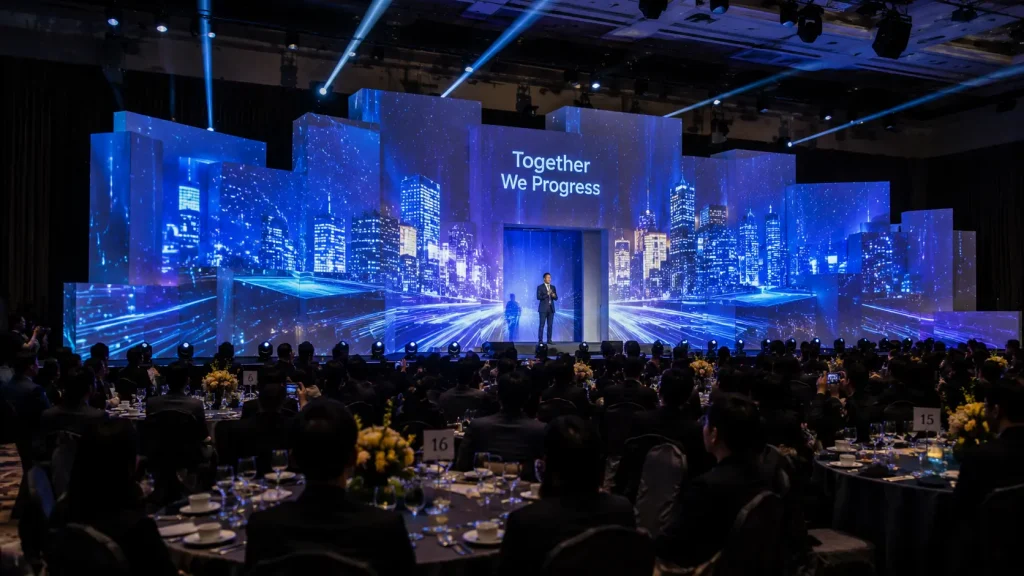
Projection Mapping for Corporate Events can transform an ordinary event venue into a dynamic visual environment by combining customised digital content with physical stages, walls, structures and event spaces.
Instead of limiting visual content to a conventional rectangular screen, projection mapping allows animations to follow the shape and dimensions of physical surfaces.
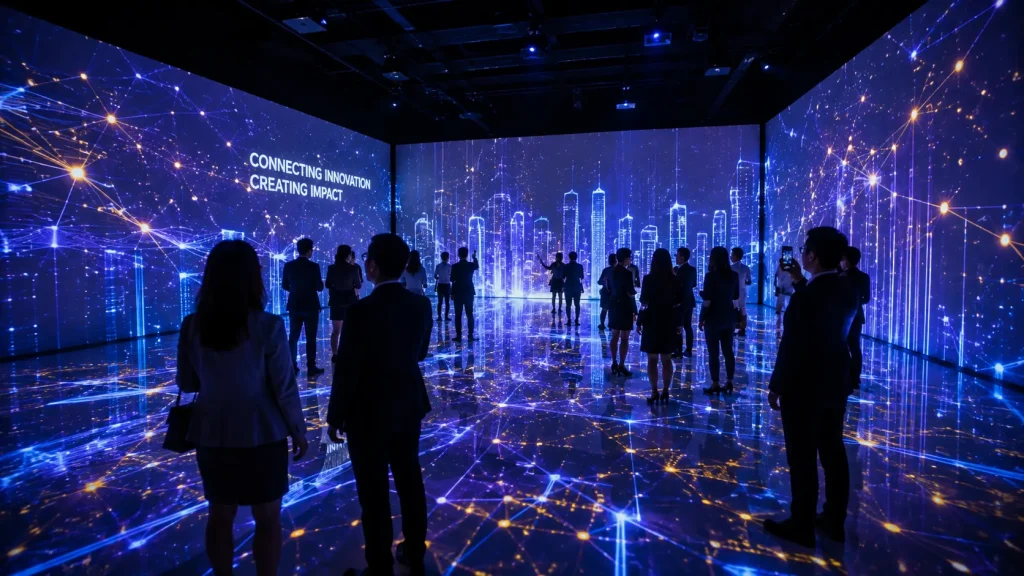
A stage can appear to transform during an opening ceremony. Brand stories can move across multiple scenic panels. A physical product can become part of a launch sequence. Walls and floors can even be incorporated into an immersive or interactive experience.
For corporate events in Malaysia, projection mapping can be used as part of opening shows, conferences, product launches, annual dinners, award ceremonies, exhibitions and experiential brand activations.
Key Takeaways
- Projection mapping can transform physical event surfaces into customised digital experiences.
- It can be used for opening shows, stage content, product reveals, awards and brand storytelling.
- Projection mapping does not always require an entire building or extremely large venue.
- Indoor corporate events can use stages, walls, scenic panels, products and custom structures as projection surfaces.
- Projection content can be synchronised with lighting, sound and physical event actions.
- Interactive technology can be added to create audience participation experiences.
- The projection system should be planned together with the event stage and content from an early stage.
What Is Corporate Event Projection Mapping?
Corporate event projection mapping uses projectors, mapping software and customised visual content to display animations precisely across physical surfaces within an event environment.
Unlike standard projection where a video is displayed inside a rectangular frame, projection mapping content is designed according to the geometry of the selected surface.
Possible projection surfaces at a corporate event include:
- Stage Backdrops
- Scenic Panels
- Event Walls
- Custom Structures
- Product Displays
- Vehicles
- Floors
- Entrance Features
- Architectural Surfaces
The physical structure therefore becomes part of the visual content rather than simply supporting a screen.
For a broader introduction to the technology, see our Projection Mapping Malaysia guide.
Why Use Projection Mapping for Corporate Events?
Corporate events often contain important moments that need stronger visual impact than a standard presentation.
This may be the opening of the event, the introduction of a new product, a company milestone or an award presentation.
Projection mapping gives event organisers another creative tool for designing these moments.
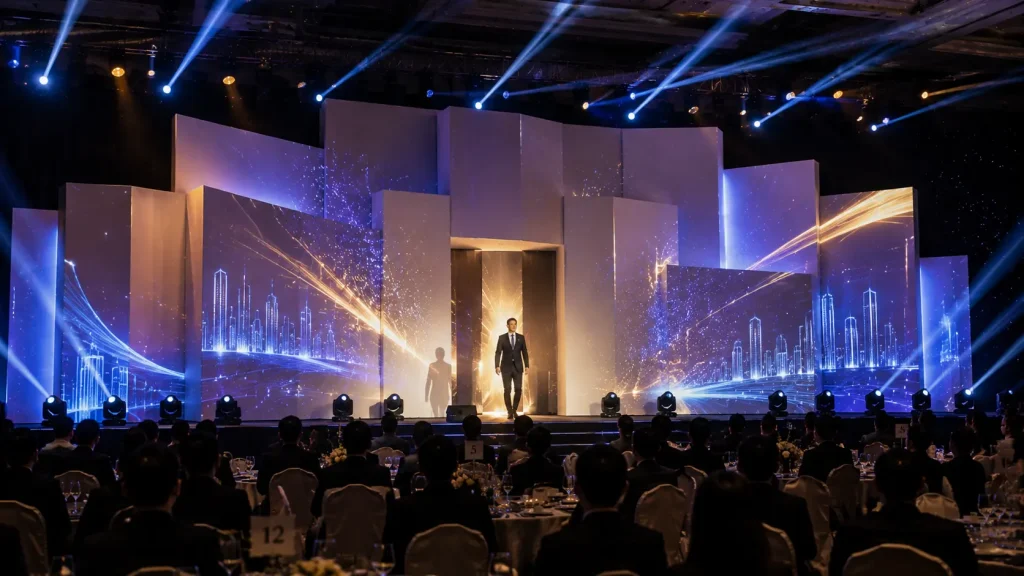
Create a Stronger Opening Moment
The first few minutes of a corporate event can establish the atmosphere for the entire programme.
Instead of beginning immediately with a speech or conventional corporate video, the event can open with a projection mapping sequence combining animation, music and lighting.
Physical stage elements can gradually illuminate, transform or reveal different parts of the visual story.
Integrate Content with the Physical Stage
Projection mapping can make scenic structures part of the content itself.
For example, several physical panels can be treated as individual visual zones before combining into one larger animation.
This gives designers greater freedom to create a stage that does not need to behave like one large rectangular display.
Create Event-specific Visual Experiences
The visual sequence can be designed around the company’s brand, event theme, anniversary, campaign or product.
This allows the projection experience to become part of the event narrative rather than functioning only as background decoration.
Where Can Projection Mapping Be Used During a Corporate Event?
Projection mapping can be integrated into different stages of the event programme.
It does not have to be limited to one opening show.
Event Opening Show
An opening projection mapping sequence can combine:
- Corporate Brand Elements
- Event Theme Graphics
- Company Milestones
- Cinematic Animation
- Music
- Sound Effects
- Stage Lighting
- Physical Performances
The sequence can conclude by revealing the event title, introducing the speaker or transitioning directly into the next programme segment.
Corporate Brand Storytelling
Projection mapping can turn a conventional corporate history presentation into a more visual experience.
Instead of showing every milestone as a slide, different parts of the physical stage can represent different periods, achievements or business areas.
Animation can move between these areas while connecting the story into one continuous sequence.
This approach can be suitable for:
- Company Anniversaries
- Corporate Milestones
- Brand Launches
- Transformation Stories
- Corporate Rebranding
- Opening Ceremonies
Projection Mapping for Product Reveals
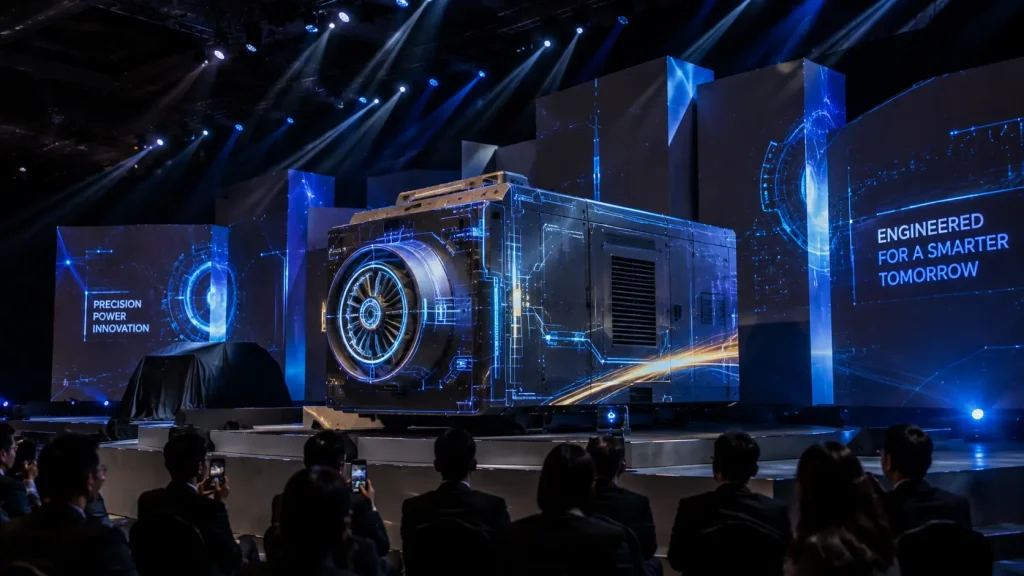
A physical product can become part of the projection mapping show rather than being revealed only after a video ends.
Visual effects can build around the product, highlight its shape or introduce key design elements before the final reveal.
For example, automotive projection mapping can use animated lines and light effects to emphasise the contours of a vehicle before transitioning into the physical launch moment.
The projection sequence can also be combined with lighting, sound and other event technology.
For projects specifically focused on launches, see our upcoming Projection Mapping for Product Launches guide.
Projection Mapping for Award Ceremonies
Award presentations can use projection mapping to create visual transitions between award categories and winners.
Instead of maintaining one static stage appearance throughout the ceremony, the mapped environment can change according to each segment.
Projection content can support:
- Award Category Introductions
- Winner Reveals
- Achievement Visuals
- Long Service Awards
- Corporate Milestones
- Closing Celebrations
This can be particularly useful when the same physical stage needs to support several different programme moments.
Projection Mapping for Annual Dinners
Annual dinners can use projection mapping to strengthen the event theme and create memorable programme moments without relying entirely on conventional screen content.
A themed physical stage can change visually throughout the night using customised mapped animation.
Projection mapping can be incorporated into:
- Opening Shows
- Management Entrances
- Award Presentations
- Theme Reveals
- Entertainment Segments
- Lucky Draw Moments
- Closing Sequences
For a more focused guide, see Projection Mapping for Annual Dinners.
Stage Projection Mapping for Corporate Events
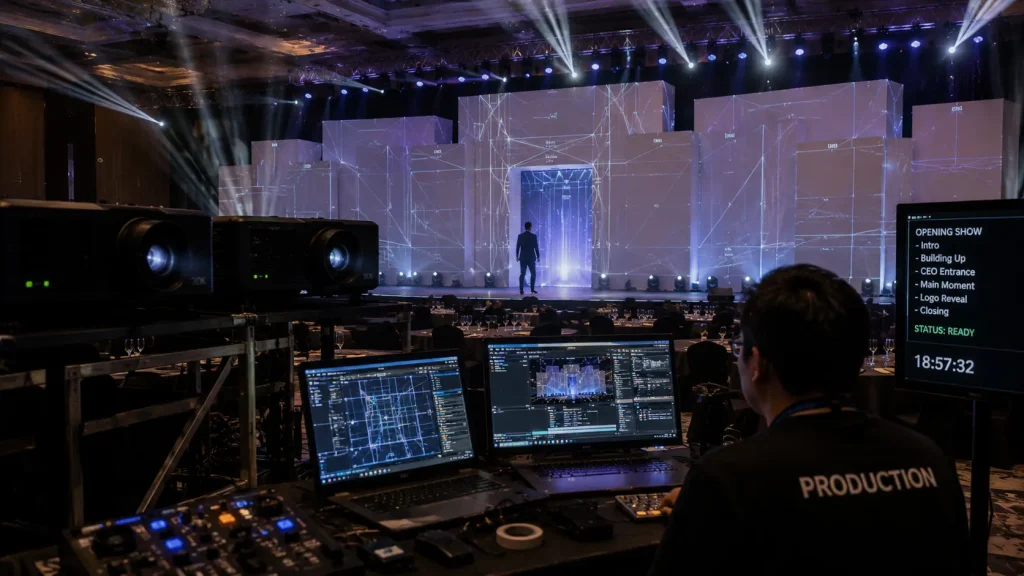
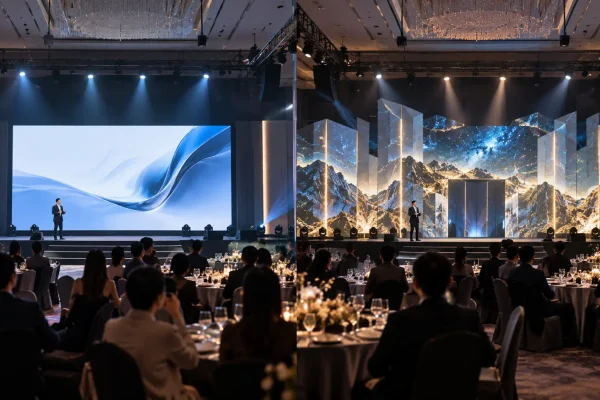
Stage projection mapping is one of the most practical ways to introduce projection mapping into an indoor corporate event.
The stage can be designed with physical surfaces that provide depth and different visual levels for the projection content.
These surfaces may include:
- Flat Scenic Panels
- Layered Walls
- Geometric Structures
- Columns
- Product Platforms
- Custom Fabricated Features
The content can then be mapped individually onto these surfaces.
During one sequence, the entire stage may appear as one continuous environment.
During another sequence, individual sections can illuminate or animate independently.
Does Projection Mapping Replace the LED Screen?
Not necessarily.
Projection mapping and LED screens can perform different roles within the same corporate event.
An LED screen remains highly effective for:
- Presentation Slides
- Speaker Content
- Live Camera Feed
- Videos
- Event Information
Projection mapping can then be used for selected high-impact moments or to extend visuals beyond the main screen.
For example, an LED screen may remain in the centre of the stage while surrounding scenic structures are projection mapped.
During presentations, the LED screen provides clear information.
During the opening or launch sequence, the entire stage environment can become part of the visual show.
This hybrid approach can provide both practical event functionality and stronger creative impact.
Projection Mapping for Opening Ceremonies
Opening ceremonies are one of the strongest applications for corporate event projection mapping because the technology can be synchronised with the complete show sequence.
A typical opening can be planned around several stages.
Build-up
The room darkens and subtle projection content begins appearing across the physical stage.
Story Development
The visual sequence introduces the brand, event theme or corporate message while gradually increasing in intensity.
Transformation
The mapped stage appears to change through animated architectural effects, motion graphics or 3D visual sequences.
Climax
Projection, lighting and sound reach the main launch or opening moment together.
Transition
The projection sequence ends in a controlled way and transitions into the CEO entrance, speech, product reveal or next programme segment.
Planning these transitions in advance is important because projection mapping works best when it is integrated with the event flow rather than treated as an isolated video.
Synchronising Projection Mapping with Lighting and Audio
Projection mapping can become significantly more effective when the visual content is coordinated with other event production elements.
Depending on the show concept, this may include:
- Moving Head Lighting
- Stage Wash Lighting
- Followspots
- Sound Effects
- Music
- Smoke or Haze
- Laser Effects
- Performer Cues
- Physical Product Reveals
The objective is not simply to add more effects.
Each element should support the same visual moment.
For example, when an animated line travels across a mapped stage, lighting can follow the movement before the sequence reaches a physical product at the centre.
This creates a more connected experience than operating projection, lighting and audio as separate elements.
Can Corporate Projection Mapping Be Interactive?
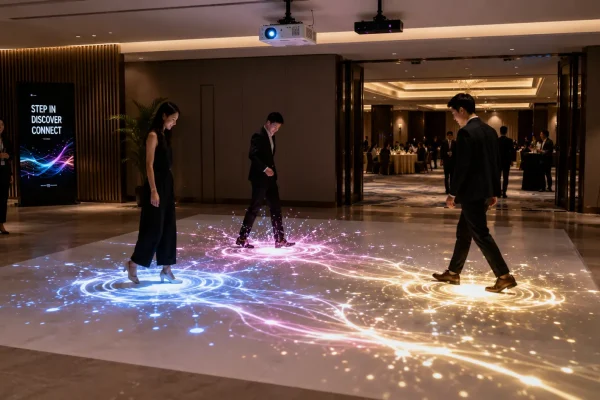
Yes. Projection mapping can be combined with sensors and real-time software to allow participants to influence the projected content.
Interactive applications may include:
- Motion-responsive Walls
- Interactive Floors
- Gesture-controlled Visuals
- Interactive Brand Experiences
- Audience Games
- Exhibition Installations
For example, guests walking across a projected floor can trigger ripples, particles, brand elements or other visual reactions around their movement.
An interactive wall can respond as participants move in front of the installation.
This changes projection mapping from a passive visual show into an audience engagement experience.
Learn more in our Interactive Projection Mapping Malaysia guide and Interactive Floor Projection Malaysia guide.
Indoor vs Outdoor Projection Mapping for Corporate Events
Corporate projection mapping can be deployed in both indoor and outdoor environments, but the technical requirements can be very different.
Indoor Projection Mapping
Indoor corporate events usually provide greater control over ambient lighting, projector positions and audience viewing conditions.
Common indoor applications include:
- Ballroom Events
- Corporate Conferences
- Annual Dinners
- Product Launches
- Award Ceremonies
- Exhibitions
- Brand Activations
Because the lighting environment can be controlled, indoor projection mapping can often achieve strong visual results without the same brightness requirements as a large outdoor installation.
Outdoor Projection Mapping
Outdoor corporate events may use buildings, architectural structures or temporary event surfaces as projection canvases.
Outdoor installations require additional consideration for:
- Ambient Lighting
- Projection Distance
- Projector Brightness
- Weather Protection
- Power Supply
- Projector Structures
- Public Safety
- Installation Access
For large architectural applications, see our Building Projection Mapping Malaysia guide.
What Projectors Are Used for Corporate Event Projection Mapping?
The projector configuration depends on the projection surface, venue and required visual brightness.
Important factors include:
- Projection Surface Width & Height
- Throw Distance
- Ambient Lighting
- Projector Brightness
- Projector Resolution
- Lens Selection
- Available Installation Positions
A smaller indoor installation may require only one professional projector.
A wider stage may require several projectors working together to create one continuous visual canvas.
Large outdoor façades can require multiple high-brightness projectors depending on the size and environmental conditions.
Projector quantity should therefore be determined by the actual site rather than selected using a standard package.
How Many Projectors Are Needed?
There is no fixed number of projectors required for a corporate projection mapping project.
The number depends primarily on the size and shape of the projection surface.
Additional projectors may be required when:
- The Stage Is Very Wide
- Several Physical Surfaces Need to Be Covered
- The Projection Area Requires Higher Brightness
- Different Projection Angles Are Needed
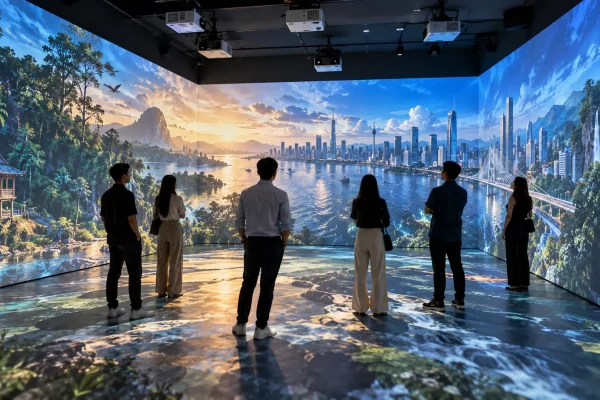
- Multiple Walls Are Being Used
- An Immersive Environment Is Being Created
When several projectors are used across one large surface, edge blending can combine the individual outputs into a continuous image.
For some applications, projectors can also be stacked onto the same projection area to increase brightness.
Planning the Projection Surface
The projection surface is one of the most important elements of a successful corporate event projection mapping setup.
Projection mapping works best when the creative and technical teams understand the surface before content production begins.
The surface should be evaluated based on:
- Physical Dimensions
- Shape
- Colour
- Material
- Architectural Features
- Viewing Angle
- Projector Position
- Ambient Lighting
Light-coloured matte surfaces generally provide a more predictable projection result than highly reflective or extremely dark materials.
However, the final surface treatment should also support the overall event design when the projection is not operating.
Should the Stage Be Designed for Projection Mapping?
For events where projection mapping is a major part of the experience, it is beneficial to consider projection requirements while the stage is still being designed.
This allows the stage designer and projection team to coordinate:
- Projection Surfaces
- Stage Dimensions
- Physical Depth
- Projector Sightlines
- Speaker Positions
- Lighting Positions
- LED Screen Placement
- Audience Viewing Angles
A stage designed without considering projector sightlines may later create unnecessary technical restrictions.
For example, hanging decorations, lighting structures or scenic elements may block the projection path.
Early coordination can reduce these conflicts before installation begins.
Projection Mapping Content for Corporate Events
Projection mapping content should be designed according to both the physical surface and the purpose of the event.
Simply stretching a standard corporate video across a mapped stage usually does not take full advantage of the technology.
Custom content can use different sections of the stage to create visual movement, depth and transformation.
Depending on the project, content production may include:
- Creative Concept Development
- Storyboard
- Styleframes
- 2D Motion Graphics
- 3D Animation
- Corporate Brand Elements
- Product Visualisation
- Architectural Animation
- Particle Effects
- Sound Design
Do Corporate Events Need 3D Projection Mapping Content?
Not every corporate projection mapping project requires complex 3D animation.
The appropriate content style depends on the creative concept and available production budget.
A projection mapping sequence can combine:
- 2D Graphics
- Typography
- Photography
- Video Footage
- Motion Graphics
- 3D Animation
- Visual Effects
3D animation becomes particularly useful when the objective is to create architectural illusions or make physical surfaces appear to move, open, collapse or transform.
For many corporate events, a combination of 2D motion graphics and selected high-impact 3D sequences can provide a good balance between visual impact and production requirements.
Can Existing Corporate Videos Be Used?
Existing corporate videos and brand assets can often be incorporated into projection mapping content.
However, a conventional 16:9 corporate video is normally designed for a rectangular screen.
If the projection surface has several panels, layers or unusual dimensions, the existing material may need to be reformatted or redesigned.
Useful existing assets may include:
- Corporate Videos
- Brand Guidelines
- Company Logos
- Product Renders
- 3D Models
- Photography
- Campaign Graphics
- Previous Animation Assets
These materials can become part of the new mapped visual sequence rather than having to recreate every asset from the beginning.
Projection Mapping Project Workflow
A corporate event projection mapping project typically moves through several creative and technical stages.
1. Project Brief
The process begins by understanding the event objective, venue, audience, programme and desired visual experience.
2. Site & Surface Assessment
The projection surface, available projector positions, venue lighting and physical restrictions are reviewed.
3. Creative Concept
The visual direction and key show moments are developed according to the event theme and projection surface.
4. Technical Planning
The projector quantity, brightness, lenses, playback system and installation positions are planned.
5. Content Production
2D motion graphics, 3D animation and other visual assets are created according to the mapped surface.
6. Installation
Projectors, media servers, signal systems and other required equipment are installed at the venue.
7. Mapping & Calibration
The projected outputs are aligned, warped, masked and blended according to the actual physical surface.
8. Testing & Rehearsal
The complete sequence is tested together with audio, lighting and programme cues before the event begins.
9. Live Event Operation
The technical team manages playback and projection operation during the event according to the approved show flow.
Why Is a Site Survey Important?
For larger or more complex projection mapping projects, a site survey can identify technical conditions that may not be visible from photographs or floor plans.
The technical team can review:
- Actual Projection Surface
- Projection Distance
- Potential Projector Positions
- Ceiling Height
- Rigging Options
- Power Availability
- Lighting Conditions
- Audience Sightlines
- Equipment Access
- Installation Schedule
This information can help determine a more accurate projector configuration and reduce unexpected issues during event setup.
How Much Does Corporate Event Projection Mapping Cost?
The cost of corporate event projection mapping in Malaysia depends on the scale and complexity of the project.
Important cost factors include:
- Projection Surface Size
- Number of Projectors
- Projector Brightness
- Lens Requirements
- Media Server Requirements
- Content Complexity
- 2D or 3D Animation
- Stage Structure
- Event Duration
- Technical Crew
- Installation & Rehearsal Requirements
A compact indoor projection installation will have very different requirements from a large-scale corporate building projection.
For a more detailed breakdown of the factors affecting pricing, read our Projection Mapping Cost Malaysia guide.
What Information Should You Provide for a Quotation?
Providing basic project information can help the projection mapping team prepare a more relevant initial recommendation.
Useful information includes:
- Event Date
- Venue
- Indoor or Outdoor Location
- Expected Audience Size
- Stage or Projection Surface Dimensions
- Venue Photographs
- Event Programme
- Required Projection Duration
- Reference Videos
- Existing Content or Brand Assets
- Interactive Requirements
- Estimated Budget
If the final stage design is not available yet, an initial concept can still be developed using the available venue information and event requirements.
Common Mistakes When Planning Event Projection Mapping
Planning Projection Too Late
Adding projection mapping only after the stage design has been finalised can limit projector positions and suitable projection surfaces.
Early coordination provides more flexibility.
Using Projection Mapping Like a Normal Screen
Projection mapping should make use of the physical geometry rather than simply displaying a large rectangular video across the stage.
Ignoring Ambient Lighting
Strong lighting directly hitting the projection surface can reduce the perceived contrast of projected content.
Projection and lighting positions should therefore be coordinated.
Blocking the Projection Path
Stage structures, speakers, lighting equipment and performers can potentially block the projector beam.
Projector sightlines should be checked during technical planning.
Skipping Rehearsal
A projection mapping opening sequence may depend on precise timing between visuals, audio, lighting, speakers or performers.
Testing the complete sequence before the event helps ensure that these elements work together correctly.
Why Work with MyDigital Asia for Corporate Projection Mapping?
MyDigital Asia provides projection mapping solutions for corporate events in Malaysia by combining creative content production with technical implementation.
Depending on the project requirements, our scope can include:
- Creative Concept Development
- Projection Mapping Planning
- 2D & 3D Animation
- Stage Mapping Content
- Projector & Lens Planning
- Media Server Setup
- Interactive Integration
- Projection Mapping & Calibration
- Edge Blending
- On-site Testing
- Rehearsal
- Technical Operation
By planning the creative and technical requirements together, the projection experience can be developed around the actual event environment rather than treating content and equipment as separate elements.
Frequently Asked Questions
Can projection mapping be used in a hotel ballroom?
Yes. Hotel ballrooms can be suitable for stage projection mapping, wall projection and selected immersive applications, subject to the available projection distance, lighting conditions and installation positions.
Can projection mapping be used together with an LED screen?
Yes. An LED screen can handle presentations, videos and live camera feeds while projection mapping extends creative visuals onto surrounding physical structures.
How long should an opening projection mapping show be?
There is no fixed duration. The appropriate length depends on the event programme and creative concept. A focused sequence designed around the main opening moment can often be more effective than unnecessarily long content.
Can projection mapping be synchronised with lighting?
Yes. Projection content can be coordinated with lighting, audio, performers and physical reveal cues to create a complete opening or launch sequence.
Do we need to build a special stage?
Not always. Existing walls and stage surfaces may be suitable, but a custom stage designed with projection in mind can provide greater creative flexibility.
Can you create the projection mapping animation as well?
Yes. MyDigital Asia can provide both projection mapping content production and technical implementation depending on the project scope.
How early should we start planning?
Planning should ideally begin once the event venue and general creative direction are known. Projects involving custom 3D content or complex stage structures should allow additional time for concept development, animation, technical planning and testing.
Plan Projection Mapping for Your Corporate Event
Projection mapping can be used to create a focused opening moment, transform a physical stage, introduce a product or build a larger immersive event environment.
The most suitable approach depends on the venue, projection surface, programme and audience experience you want to create.
Send MyDigital Asia your event date, venue, stage dimensions, reference concept and available budget so that we can evaluate the creative and technical requirements.
Planning a corporate event in Malaysia?
Contact MyDigital Asia to discuss a customised projection mapping concept, content production and technical setup for your event.
Related Projection Mapping Guides
- Projection Mapping Malaysia: Complete Guide
- Projection Mapping Cost Malaysia
- Building Projection Mapping Malaysia
- Projection Mapping for Product Launches
- Projection Mapping for Annual Dinners
- Interactive Projection Mapping Malaysia
- Interactive Floor Projection Malaysia
- Immersive Projection Malaysia
- Projection Mapping vs LED Screen
Request a Free Consultation
Looking for Interactive Maps, Interactive Solutions or Event Technology?

LATEST POSTS