
Immersive Projection Malaysia
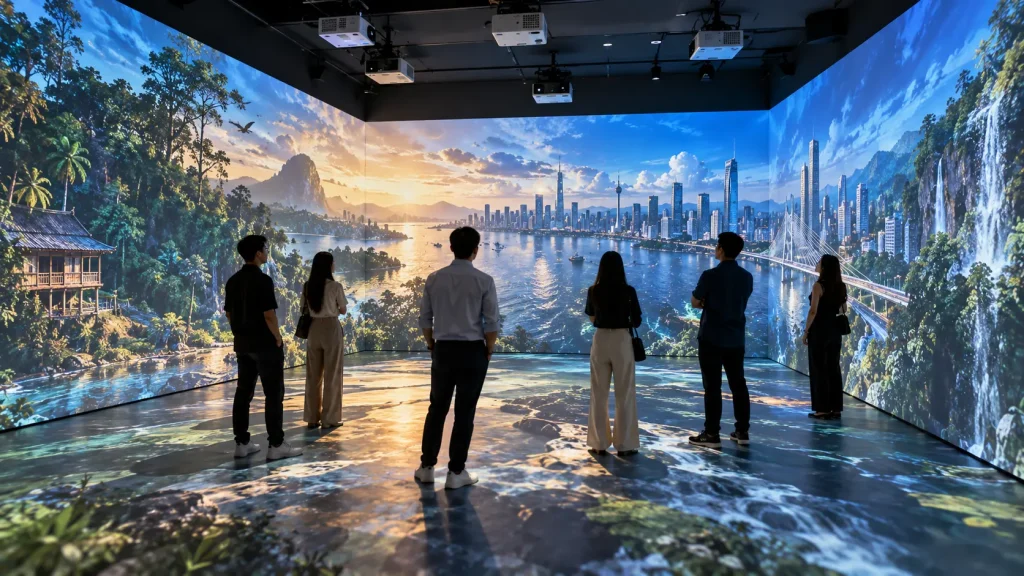
Immersive projection transforms walls, floors and physical spaces into large-scale digital environments that surround the audience with visual content.
Instead of watching content on a conventional screen, visitors step inside the experience. Projected visuals can extend across multiple walls, continue onto the floor and respond to the shape of the room, creating the impression that the physical environment has become part of the digital story.
In Malaysia, immersive projection can be developed for museums, visitor centres, exhibitions, corporate experiences, events, galleries, experience centres and permanent installations.
The experience may range from a three-wall projection room to a larger multi-surface environment with floor projection, spatial audio and interactive elements.
Key Takeaways
- Immersive projection surrounds visitors with content instead of limiting visuals to one conventional screen.
- Projection can cover multiple walls, floors and customised physical surfaces.
- An immersive room does not necessarily need to be a complete 360-degree environment.
- Multiple projectors can be aligned and blended to create a larger continuous visual canvas.
- The physical room, projector positions and content should be planned as one system.
- Interactive tracking can be added when visitors need to influence the projected environment.
- Immersive projection can be developed for temporary events or permanent visitor experiences.
What Is Immersive Projection?
Immersive projection uses one or more projectors to extend visual content across a physical environment rather than displaying it on a single rectangular screen.
For example, a conventional presentation may display a landscape on an LED screen at the front of a room.
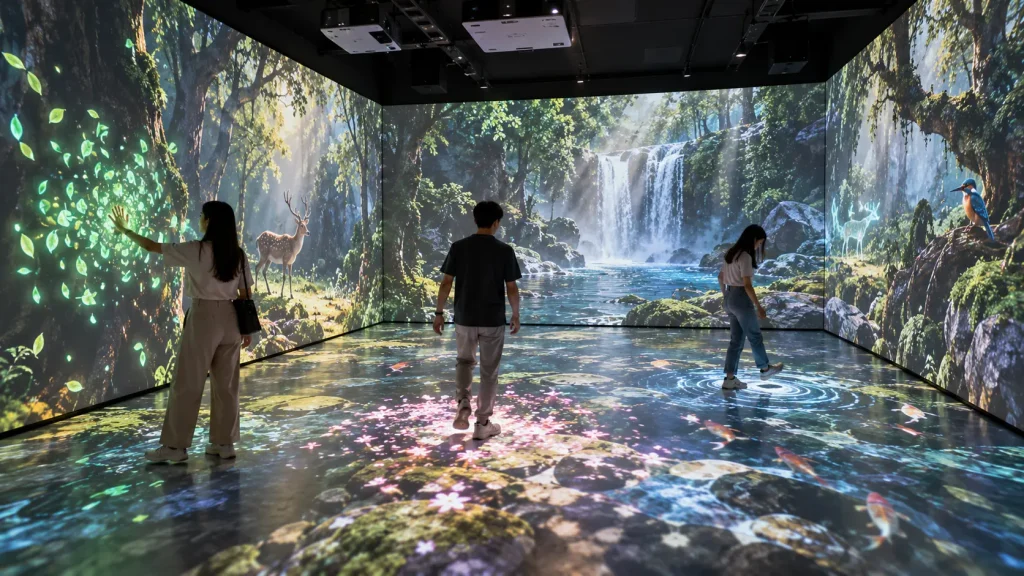
In an immersive projection environment, the same landscape could extend across the front wall, continue onto both side walls and flow across the floor around the audience.
The audience is therefore positioned inside the visual environment rather than only looking at it from outside.
How Is Immersive Projection Different from Projection Mapping?
Projection mapping is the broader technique of aligning projected content with physical surfaces.
It may be used on a building facade, stage structure, product, wall or other object.
Immersive projection uses similar projection and mapping principles but focuses specifically on creating an environment that surrounds the audience.
The objective is not simply to transform one object. It is to make the room or space itself become part of the experience.
In practice, many immersive environments use projection mapping, edge blending, multiple projectors and carefully designed content together.
Does an Immersive Projection Room Need to Be 360 Degrees?
No. A successful immersive experience does not necessarily require projection on every surface around the audience.
Depending on the venue and concept, an installation may use:
- One large panoramic wall
- Two connected walls
- Three-wall projection
- Three walls plus floor
- Four surrounding walls
- Walls and floor
- A complete multi-surface environment
A three-wall room can already create a strong sense of immersion because the visitor’s peripheral vision is filled with moving content.
Adding more surfaces can increase the visual impact, but it also increases projector coverage, content requirements and technical complexity.
The number of surfaces should therefore support the experience objective rather than being selected only to achieve the largest possible specification.
What Surfaces Can Be Used for Immersive Projection?
Immersive projection can be applied to different physical surfaces depending on the space.
Walls
Walls are the most common projection surfaces because they can create a large field of view around visitors.
Flat, light-coloured and relatively uniform surfaces generally provide a practical starting point, although custom scenic surfaces can also be incorporated into the experience.
Floor
Floor projection can visually connect the surrounding walls and make the environment feel more continuous.
For example, an ocean scene projected onto the walls can continue beneath the audience as moving water, while a digital landscape can extend from the horizon across the physical floor.
The floor remains physically flat; the sense of depth and movement is created through projected content.
Ceiling
Ceiling projection can be considered for selected installations where projector placement, room geometry and viewing conditions make it practical.
However, ceiling projection is not automatically required for an immersive experience.
Physical Scenic Elements
Real objects and scenic structures can also be placed inside the projected environment.
Projection mapping can then integrate these physical elements with the surrounding digital content, creating a stronger connection between the real and virtual environment.
How Do Multiple Projectors Create One Large Image?
A single projector has a limited image size and coverage area.
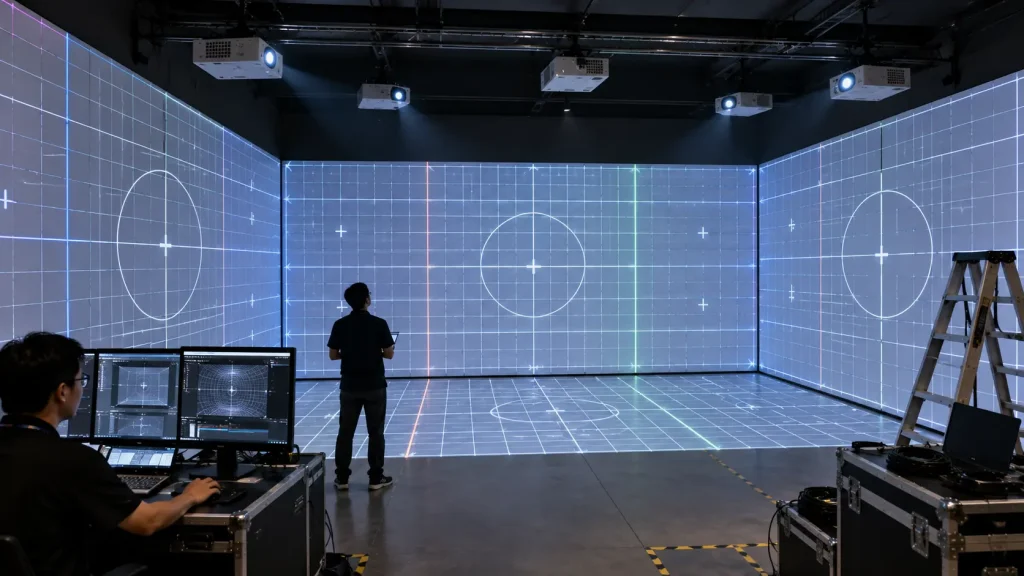
When an immersive environment requires larger walls or several connected surfaces, multiple projectors can be used together.
Each projector covers a specific portion of the environment.
The images are then aligned so the audience experiences them as one larger visual canvas.
Edge Blending
Where two projected images overlap on the same continuous surface, edge blending can be used to reduce the visible transition between them.
The objective is to avoid the audience seeing obvious rectangular projector boundaries across a large wall.
Correct blending depends on projector alignment, brightness consistency, content preparation and calibration.
Projection Mapping
Where content moves across corners, different walls or physical structures, projection mapping helps position each part of the visual correctly on the actual surfaces.
This is particularly important when the room is not a simple flat rectangular canvas.
How Do Visuals Continue Across Wall Corners?
Content for an immersive room should be designed according to the geometry of the actual space.
If a digital object moves from the front wall onto a side wall, its position and scale need to remain visually coherent as it crosses the corner.
This requires the content layout to correspond with the mapped projection surfaces.
Simply playing the same conventional video independently on several walls will not normally create the same sense of continuity.
How Many Projectors Are Needed for an Immersive Room?
There is no standard number of projectors for every immersive installation.
The quantity depends on factors such as:
- Room width and length
- Wall height
- Number of projected surfaces
- Required image resolution
- Projector brightness
- Lens and throw distance
- Available mounting positions
- Audience positions
- Ambient lighting
A compact room may require only a small number of projectors, while a large multi-wall environment can require significantly more coverage.
The projector count should therefore be calculated from the physical space rather than selected as a fixed package.
Can an Existing Room Be Converted into an Immersive Projection Space?
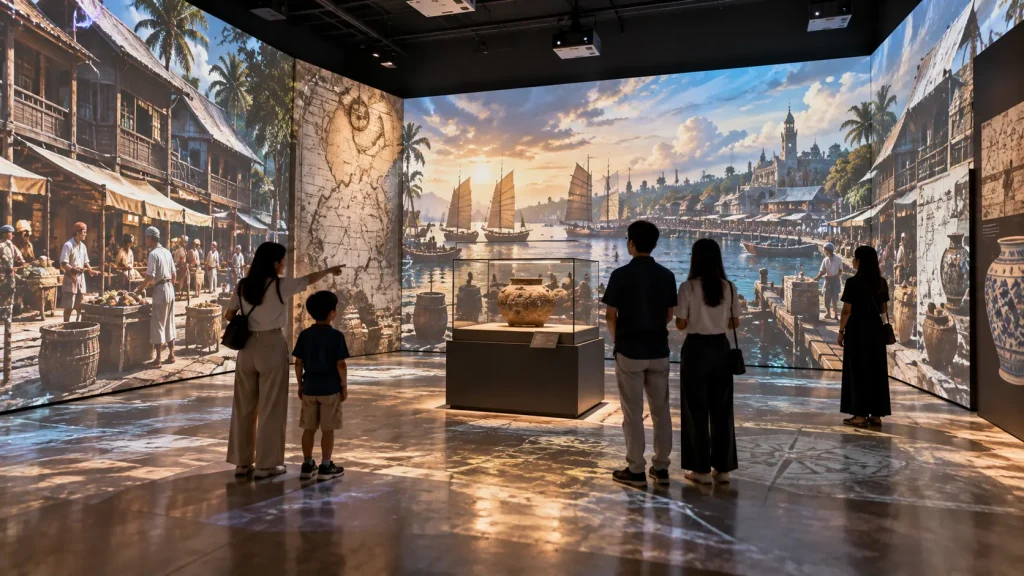
Yes, in many cases an existing room can be evaluated for immersive projection without constructing an entirely new venue.
Important considerations include:
- Room dimensions
- Wall condition and colour
- Ceiling height
- Projector mounting positions
- Columns or architectural obstructions
- Ambient light
- Doors and emergency exits
- Visitor circulation
- Power and equipment access
Some rooms may work with relatively minor preparation, while others may benefit from temporary projection surfaces or additional scenic treatment.
Does the Room Need White Walls?
Not necessarily, but the colour and finish of the projection surface affect image brightness and colour reproduction.
A neutral, relatively light and matte surface is generally easier to work with than a very dark, glossy or highly reflective wall.
Where an existing venue has unsuitable surfaces, temporary scenic panels or projection-friendly finishes may be considered.
The objective is not simply to make every wall white. The surface should support the required visual quality while fitting the overall environment.
Does an Immersive Room Need to Be Completely Dark?
No, but controlling ambient light significantly improves projection contrast.
Direct lighting on the projected surfaces should be minimised where possible.
Other lighting can still be incorporated for visitor safety, physical exhibits, pathways or atmosphere as long as it is planned around the projection environment.
For events and exhibitions, the experience can therefore remain visually comfortable without requiring visitors to enter a completely black room.
What Can Be Shown in an Immersive Projection Room?
The content should be designed around the purpose of the experience rather than treating the room as a large video player.
Possible applications include:
- Brand storytelling
- Corporate history
- Product journeys
- Historical environments
- Art and cultural experiences
- Educational simulations
- Environmental storytelling
- Data visualisation
- Destination experiences
- Future-city concepts
Because the audience is surrounded by the content, scale and movement can be used differently from a conventional screen presentation.
Immersive Projection for Museums
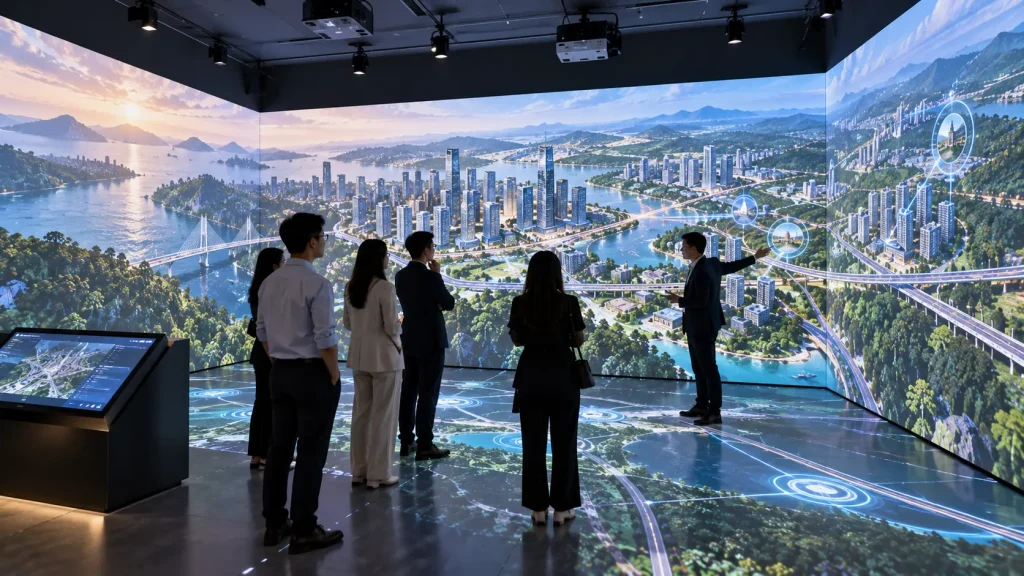
Museums can use immersive projection to move visitors from reading about a subject to experiencing a visual interpretation of it.
For example, an exhibition about marine ecosystems could surround visitors with underwater environments, while historical content could reconstruct the atmosphere of a particular place or period.
The projected environment can complement physical artefacts, information displays and interactive installations rather than replacing them.
Immersive Projection for Visitor Centres
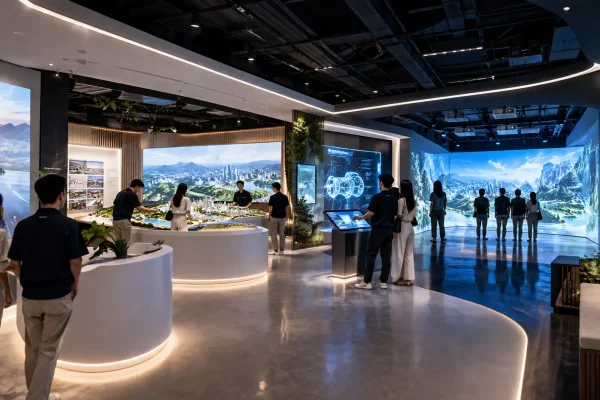
Visitor centres can use immersive projection to communicate complex information through a more visual and spatial format.
A property development, city planning project, destination or infrastructure programme could use an immersive room to take visitors through different stages of a story.
The content may transition from maps and data into full-scale environments, helping audiences understand information at a larger scale.
Immersive Projection for Exhibitions
An immersive projection room can create a destination within a larger exhibition.
Instead of presenting every message at the booth perimeter, visitors can enter a dedicated environment for a short branded experience.
This can be useful when an organisation needs to communicate a story, product ecosystem or campaign in a more memorable format.
The installation can be designed as a temporary structure within the exhibition hall, subject to available space, ceiling conditions and technical requirements.
Immersive Projection for Corporate Events
Corporate events can use immersive projection for selected experiences rather than applying it to the entire programme.
Possible applications include:
- Pre-function experience rooms
- Product launch journeys
- Corporate anniversary storytelling
- VIP experiences
- Brand experience zones
- Media or press experiences
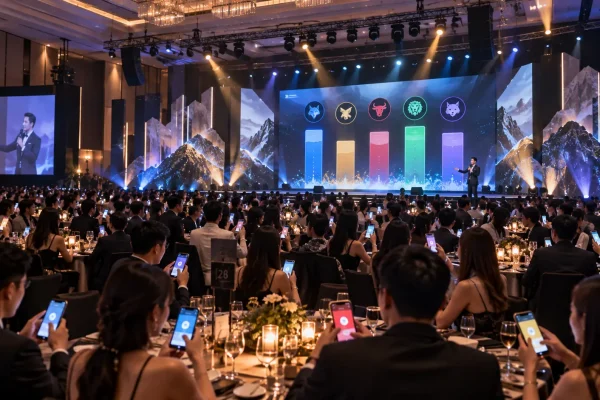
For a conventional ballroom event, stage-based projection mapping for corporate events may remain more practical for the main programme, while an immersive installation can provide a separate guest experience.
Can Immersive Projection Be Interactive?
Yes. Immersive projection can be combined with tracking technology and real-time software so the environment responds to visitors.
For example, projected particles may move around a visitor, a landscape may change as someone approaches a particular area, or floor visuals may react beneath footsteps.
This transforms the audience from passive viewers into participants.
However, not every immersive room needs interaction.
A carefully designed cinematic experience can be effective when the objective is storytelling, while interaction is more appropriate when visitor participation supports the experience.
For a deeper explanation of real-time tracking and responsive projection, see our Interactive Projection Mapping Malaysia guide.
Can the Floor Be Interactive While the Walls Play Cinematic Content?
Yes. Different surfaces can serve different functions within the same immersive environment.
The surrounding walls may present the main cinematic story while the floor responds to visitor movement.
This approach can provide interaction without requiring every element of the experience to react in real time.
For example, visitors could walk through a projected forest while leaves move beneath their feet, even though the wider landscape on the walls follows a controlled narrative sequence.
Our Interactive Floor Projection Malaysia guide explains floor-based interaction in more detail.
How Is Content Produced for an Immersive Projection Room?
Immersive projection content should be designed around the dimensions and geometry of the actual projection environment.
A conventional 16:9 corporate video can sometimes be incorporated into the experience, but simply stretching the same video across several walls will rarely create a convincing immersive result.
Before content production begins, the projected surfaces should be mapped into a digital layout that represents the real room.
The creative team can then determine:
- Where important visual elements should appear
- How content moves between different walls
- How visuals continue around corners
- Which areas may be obstructed by visitors
- How floor content connects with wall content
- Where physical exhibits or scenic elements are positioned
This allows the content to be created specifically for the physical environment rather than forcing conventional video into an unsuitable format.
Can Existing Corporate Videos Be Used?
Yes. Existing corporate videos, product animations, photographs and brand assets can often be incorporated into an immersive experience.
However, they may need to be reformatted or integrated into a larger visual composition.
For example, an existing product animation could appear on the main wall while supporting graphics, particles, environments or data visualisations extend onto the surrounding surfaces.
This can reduce the need to recreate every asset while still making the final presentation feel designed for the immersive space.
Does Immersive Projection Require 3D Content?
Not necessarily.
Immersive environments can be created using a combination of 2D motion graphics, photography, video, particles, illustration, data visualisation and 3D animation.
3D becomes particularly useful when the experience requires:
- Spatial environments
- Architectural transformation
- Product visualisation
- Camera movement through virtual spaces
- Depth-based visual illusions
- Complex transitions between environments
The content approach should be selected according to the story and budget rather than assuming that every immersive experience must be produced entirely in 3D.
What Resolution Is Required for Immersive Projection?
There is no single standard resolution for every immersive installation.
The required output depends on the total projection area, number of projectors, viewing distance and level of visual detail.
A large panoramic environment may use a canvas that is significantly wider than a conventional video.
The complete content can then be distributed across the individual projector outputs while maintaining the intended composition across the room.
Resolution planning is particularly important for experiences containing small text, detailed diagrams or product information. Content that looks clear on a computer monitor may become difficult to read when distributed across a very large physical environment.
How Is Content Played Across Multiple Projectors?
Multi-projector immersive installations require a playback system capable of delivering the correct visual output to each projection surface.
Depending on the scale of the project, this may involve a suitable playback computer, multi-output graphics system or dedicated media server configuration.
The playback system needs to maintain synchronisation so all projected surfaces remain part of the same experience.
If one wall plays slightly ahead of another, transitions moving across the room can become visibly disconnected.
What Does a Media Server Do?
A media server or suitable multi-output playback system can manage content across several projector outputs from one coordinated environment.
Depending on the project, it may support functions such as:
- Multi-output video playback
- Projection mapping
- Edge blending
- Warping and alignment
- Content sequencing
- Show control
- Real-time graphics
- Interactive input
The required system depends on the complexity of the installation. A compact immersive room and a large multi-surface interactive environment may require very different playback configurations.
Is Spatial Audio Important for an Immersive Experience?
Visual projection creates the environment, but sound can significantly strengthen the feeling of immersion.
Instead of treating audio as background music from one speaker position, sound can be designed to support what is happening across the room.
For example, an environmental experience may use different sound elements around the audience, while a corporate storytelling sequence may use directional effects to support transitions between visual scenes.
The complexity of the audio system should match the project objective. Not every installation requires advanced spatial audio, but sound should still be considered during experience design rather than added only after the visuals are complete.
Where Are Projectors Installed in an Immersive Room?
Projector placement depends on the room dimensions, projection surfaces, ceiling height, lens requirements and visitor positions.
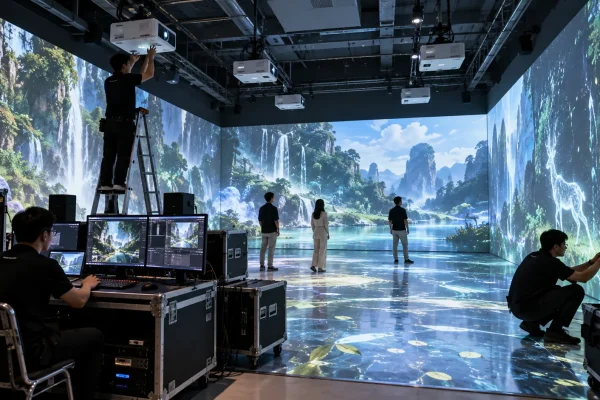
Projectors may be installed overhead, behind visitors, above scenic structures or in other suitable positions where they can cover the required surfaces without creating unnecessary obstruction.
The installation should also consider:
- Projector throw distance
- Lens selection
- Rigging or mounting points
- Visitor headroom
- Maintenance access
- Ventilation
- Cable routing
- Emergency access
The projector layout should be planned from the physical room geometry rather than placing equipment only after the creative design has been finalised.
Will Visitors Create Shadows?
Visitors can create shadows if they move between a projector and its projection surface.
This is especially important when projection extends onto lower sections of walls or across the floor.
Several approaches can help reduce the impact of shadows:
- Positioning projectors at suitable heights and angles
- Keeping important content away from frequently obstructed areas
- Using multiple projection positions where appropriate
- Planning visitor pathways around projection geometry
- Designing visual content that remains effective when people move through the space
In an immersive experience, visitor silhouettes are not always a problem. In some environments, seeing people physically inside the projected scene can actually reinforce the sense of scale and participation.
How Many Visitors Can Enter an Immersive Room?
Visitor capacity depends primarily on the physical size and intended experience rather than the projection technology alone.
A cinematic experience may allow a group to stand or sit inside the room together, while an interactive installation may require more personal space so tracking and movement remain clear.
Planning should consider:
- Usable floor area
- Viewing distance
- Visitor circulation
- Entry and exit points
- Experience duration
- Interactive zones
- Physical exhibits
- Venue safety requirements
For exhibitions and public installations, visitor throughput can be just as important as the maximum number of people who physically fit inside the room.
How Long Should an Immersive Experience Be?
The ideal duration depends on the environment and audience.
A temporary exhibition experience may need a relatively short sequence so visitor groups can move through efficiently.
A museum or visitor centre may allow a longer experience because visitors have intentionally entered the space to explore the content.
Some installations also avoid a fixed beginning and end by using continuously evolving content that visitors can enter at any time.
The format should be selected according to visitor behaviour rather than treating every immersive experience like a conventional film screening.
Can Visitors Sit Inside an Immersive Projection Room?
Yes. Seating can be incorporated when the experience is primarily cinematic or presentation-based.
However, furniture affects sightlines, visitor circulation and floor projection.
If the floor is an important visual surface, large amounts of conventional seating may reduce its impact.
Alternative layouts such as perimeter seating, limited central seating or standing experiences can be considered depending on the content and audience.
Can Physical Products Be Placed Inside the Room?
Yes. Physical products can become part of the immersive environment.
For a product launch or visitor experience, a real object may be positioned inside the room while the surrounding projection explains its story, features or environment.
Projection mapping can also be applied directly to suitable physical surfaces around the product.
This approach can connect a real product with large-scale digital storytelling without making the audience experience entirely screen-based.
For product-focused applications, see our Projection Mapping for Product Launches guide.
Temporary Immersive Projection for Events and Exhibitions
An immersive projection environment can be constructed temporarily inside an event venue or exhibition hall.
This may involve building suitable projection walls or scenic surfaces and integrating the projector, playback and audio systems into the temporary structure.
Temporary installations should be designed around:
- Available setup time
- Venue ceiling height
- Rigging restrictions
- Exhibition booth boundaries
- Equipment access
- Visitor flow
- Dismantling requirements
A temporary immersive room does not necessarily need to reproduce the complexity of a permanent museum installation. A focused three-wall experience can often provide strong visual impact while remaining practical for event deployment.
Permanent Immersive Projection Installation
Permanent installations require additional consideration because the system may need to operate regularly for months or years.
Typical environments include:
- Museums
- Visitor centres
- Experience centres
- Galleries
- Showrooms
- Educational environments
- Corporate experience spaces
The technical design should consider not only opening-day performance but also daily operation and maintenance.
How Is a Permanent Immersive System Maintained?
Maintenance planning should begin during system design.
Important considerations may include:
- Access to projectors
- Filter or equipment maintenance where applicable
- Projector alignment
- Computer and playback system access
- Ventilation and temperature
- Automatic startup and shutdown
- Content updates
- Remote troubleshooting
- Replacement access for technical equipment
Projectors should not be permanently enclosed in locations that become extremely difficult to reach once the interior is completed.
Where possible, technical equipment should remain serviceable without dismantling major parts of the visitor environment.
Can Immersive Content Be Updated Later?
Yes, if the system is designed with future content updates in mind.
A permanent visitor centre, for example, may keep the same projection hardware while introducing new stories, seasonal experiences or campaign content over time.
However, new content should continue to follow the mapped geometry and technical specifications of the installed environment.
This is one advantage of planning the room as a reusable digital platform rather than designing it around only one video.
Why Is a Site Survey Important?
A site survey is particularly important for immersive projection because several physical and technical systems need to work within the same room.
Important information includes:
- Room width, length and height
- Wall dimensions
- Floor dimensions
- Surface materials and colours
- Ceiling structure
- Available projector positions
- Columns and obstructions
- Ambient lighting
- Power availability
- Audio requirements
- Visitor entry and exit
- Equipment access
For an initial feasibility study, floor plans, photographs, videos and accurate dimensions can help determine the likely projection approach before detailed on-site planning begins.
What Is the Project Workflow?
A typical immersive projection project may follow these stages:
- Project Brief – Define the objective, audience, venue and required experience.
- Site Evaluation – Review the room dimensions, surfaces and technical conditions.
- Experience Concept – Develop the story, visitor journey and projected environments.
- Technical Design – Plan projector coverage, lenses, playback, audio and installation positions.
- Content Mapping – Create a digital layout based on the real projection surfaces.
- Content Production – Develop the 2D, 3D, video or real-time visual content.
- System Development – Configure playback, show control and interactive functions where required.
- Installation – Install projectors, computers, audio and supporting equipment.
- Calibration – Align, warp and blend the projected outputs across the physical environment.
- Testing – Review the complete experience under realistic visitor conditions.
- Operation – Launch the temporary or permanent immersive experience.
How Much Does Immersive Projection Cost in Malaysia?
The cost of immersive projection varies significantly because the physical scale and technical configuration can differ greatly between projects.
Major cost factors include:
- Room dimensions
- Number of projected surfaces
- Number and brightness of projectors
- Lens requirements
- Playback or media server configuration
- Content complexity
- 2D or 3D production
- Interactive tracking, if required
- Audio system
- Temporary scenic construction
- Rigging and installation
- Operating duration
- Temporary or permanent installation
A compact three-wall experience and a large multi-surface permanent installation therefore should not be expected to have the same budget.
For a broader explanation of projection-related budget factors, see our Projection Mapping Cost Malaysia guide.
How Can the Immersive Projection Budget Be Controlled?
One of the most effective ways to control budget is to prioritise the surfaces that contribute most to the visitor experience.
A well-designed three-wall environment may create stronger immersion than attempting to project onto every possible surface with insufficient brightness, resolution or content quality.
Budget can also be managed by:
- Focusing projection on key walls
- Adding floor projection only when it contributes to the concept
- Using 2D motion design where full 3D production is unnecessary
- Reusing suitable existing content and assets
- Controlling ambient lighting
- Using suitable existing venue infrastructure where technically possible
- Keeping interaction focused rather than adding unnecessary tracking features
The objective should be to create the strongest experience within the available space and budget rather than maximising the number of technical components.
What Information Is Needed for an Immersive Projection Quotation?
For an initial quotation or feasibility proposal, it is useful to provide:
- Project type
- Venue and location
- Event dates or installation timeline
- Room width, length and height
- Photos or videos of the space
- Floor plan, if available
- Surfaces intended for projection
- Expected visitor capacity
- Desired experience or storyline
- Interactive requirements, if any
- Audio requirements
- Temporary or permanent installation
- Available equipment, if any
- Estimated budget range, if available
If the exact projection configuration has not yet been decided, it can be proposed after reviewing the venue, objective and available budget.
How Early Should an Immersive Projection Project Be Planned?
Immersive projection should ideally be considered early because the physical space, technical system and content are closely connected.
A temporary three-wall experience may require less preparation than a permanent multi-surface installation, while customised interactive experiences require additional software development and testing.
Early planning also allows the creative team to design content around confirmed room dimensions instead of adapting completed content later.
Why Work with MyDigital Asia?
MyDigital Asia develops projection mapping, interactive and immersive experiences for events, exhibitions, museums, visitor centres and branded environments in Malaysia.
Our immersive projection projects can combine:
- Experience concept development
- Projection system planning
- Multi-projector mapping and edge blending
- 2D and 3D content production
- Interactive software development
- Tracking and sensor integration
- Playback and show control
- Audio integration
- On-site installation and calibration
- Testing and technical operation
By planning the physical environment, projection system and content together, the experience can be designed around the actual venue rather than treating the room as a collection of separate screens.
Frequently Asked Questions
Does an immersive projection room need 360-degree projection?
No. Two-wall, three-wall and wall-plus-floor environments can already create a strong immersive effect. The correct number of surfaces depends on the experience, venue and budget.
Can an existing room become an immersive room?
Potentially. The room should be evaluated based on dimensions, wall surfaces, ceiling height, projector positions, lighting and visitor circulation.
Does the room need to be completely dark?
No. However, controlling direct ambient light on the projected surfaces can significantly improve image contrast and visual quality.
Can the floor also be projected?
Yes. Floor projection can visually connect the surrounding walls and can also become interactive. See our Interactive Floor Projection Malaysia guide.
Can visitors interact with the immersive environment?
Yes. Tracking technology and real-time software can be added so selected visuals respond to visitor movement, gestures or position. Learn more in our Interactive Projection Mapping Malaysia guide.
Can physical products or exhibits be placed inside the room?
Yes. Real products, models and physical exhibits can be integrated into the projected environment when their position is considered during technical and content planning.
Can existing corporate videos be reused?
Yes. Existing videos and visual assets can often be incorporated, although they may need to be reformatted or combined with additional content designed specifically for the immersive canvas.
Can immersive projection be installed permanently?
Yes. Permanent systems can be developed for museums, visitor centres, experience centres, showrooms and other environments, with additional planning for maintenance and daily operation.
Create an Immersive Projection Experience in Malaysia
Immersive projection can transform an ordinary physical space into a digital environment where visitors are surrounded by content rather than watching it from a conventional screen.
The strongest experiences do not necessarily use the largest number of projectors or surfaces. They combine suitable projection coverage, carefully designed content, reliable playback and a physical environment that supports the visitor journey.
If you are planning an immersive projection project in Malaysia for a museum, visitor centre, exhibition, corporate event or permanent experience space, MyDigital Asia can support the project from concept and technical planning through content production, installation and calibration.
Contact MyDigital Asia to discuss your space, immersive experience concept and project requirements.
Related Projection Mapping Guides
- Projection Mapping Malaysia
- Projection Mapping Cost Malaysia
- Projection Mapping for Corporate Events
- Building Projection Mapping Malaysia
- Projection Mapping for Product Launches
- Projection Mapping for Annual Dinners
- Interactive Projection Mapping Malaysia
- Interactive Floor Projection Malaysia
- Projection Mapping vs LED Screen
Request a Free Consultation
Looking for Interactive Maps, Interactive Solutions or Event Technology?

LATEST POSTS