
Projection Mapping for Annual Dinners
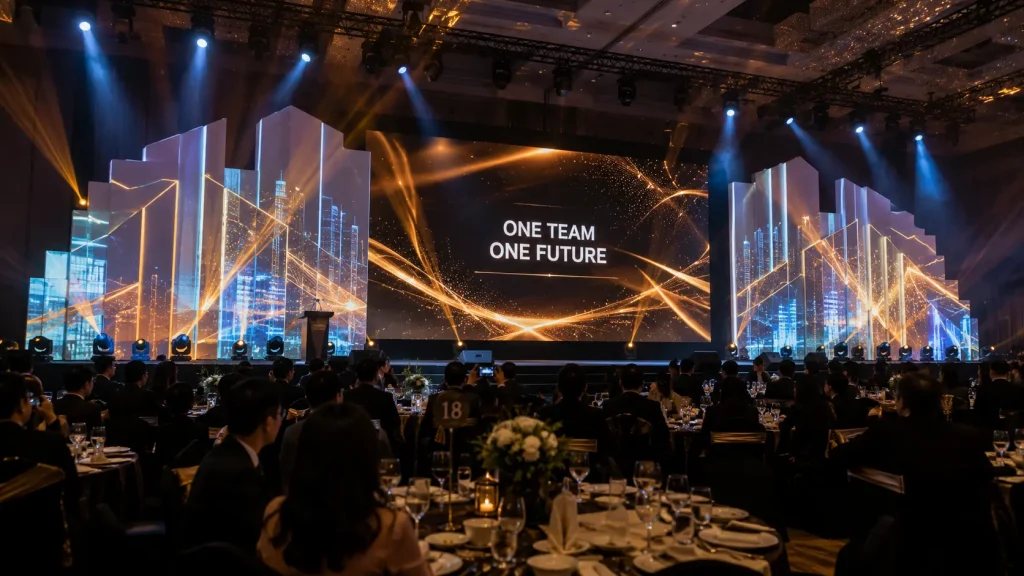
Projection Mapping for Annual Dinners can transform physical stage structures, walls, entrances and event spaces into customised visual experiences for corporate celebrations in Malaysia.
Instead of relying entirely on a conventional LED screen, projection mapping allows visual content to interact with the physical design of the venue.
A stage can appear to transform, architectural elements can become part of the animation, and an annual dinner theme can extend beyond a single rectangular screen.
Projection mapping can be used for opening shows, management entrances, award presentations, themed environments, entertainment segments and selected audience experiences.
Key Takeaways
- Projection mapping can complement an existing LED screen rather than replacing it.
- Physical stage structures can become part of the annual dinner visual content.
- Projection mapping is particularly effective for opening shows and major programme moments.
- The annual dinner theme can be extended across walls, scenic panels and other physical surfaces.
- Lighting, music and projection can be synchronised into one opening sequence.
- Projection does not need to run throughout the entire dinner.
- Interactive projection can create additional guest engagement before or during the event.
Why Use Projection Mapping for an Annual Dinner?
Corporate annual dinners often use a large LED screen as the main visual element on stage.
The LED screen remains highly practical for:
- Welcome Slides
- Corporate Videos
- Presentation Content
- Live Camera Feed
- Award Names
- Lucky Draw Results
- Event Information
However, the visual experience normally remains inside the boundaries of the screen.
Projection mapping can extend selected moments beyond those boundaries.
Instead of asking the LED screen to create every visual effect, physical stage structures or venue surfaces can become an additional canvas.
This can make an annual dinner feel more immersive without requiring projection to replace the complete event AV system.
Projection Mapping vs a Normal Annual Dinner LED Screen
An LED screen is a rectangular digital display.
Projection mapping is designed around a physical surface.
This difference creates opportunities for annual dinner stage design.
For example, an LED screen can remain at the centre of the stage while projection mapping is applied to:
- Side Scenic Panels
- Physical Frames
- Stage Wings
- Columns
- Entrance Structures
- Walls
- Custom Fabricated Shapes
During presentations, these surfaces can remain visually subtle.
During the opening show, awards or entertainment segments, they can become active parts of the visual experience.
For a more detailed comparison, see our upcoming Projection Mapping vs LED Screen guide.
Annual Dinner Opening Gimmick with Projection Mapping
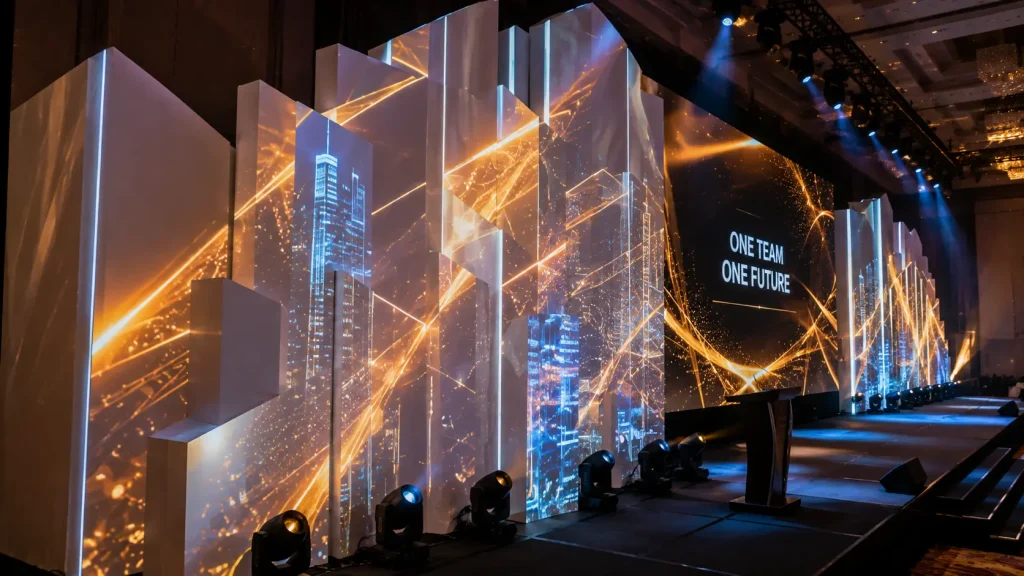
The opening is one of the strongest opportunities to use projection mapping during an annual dinner.
Instead of beginning immediately with an emcee introduction or corporate video, the room can transition into a short coordinated opening sequence.
A typical flow might include:
- House Lights Fade
- Opening Music Begins
- Projection Mapping Activates
- Stage Structures Transform Visually
- Corporate or Theme Story Develops
- Lighting Builds
- Main LED Screen Joins the Sequence
- Final Reveal or Management Entrance
The complete opening does not need to be long.
A carefully designed short sequence can establish the event atmosphere before the formal programme begins.
How Can Projection Mapping Transform an Annual Dinner Stage?
Projection mapping can change how physical stage elements appear without physically rebuilding the stage between programme segments.
A neutral scenic structure can support several visual identities throughout the same evening.
For example, the same stage can visually transition from:
- Corporate Welcome
- Futuristic Technology
- Elegant Awards Ceremony
- Celebration Graphics
- Entertainment Visuals
- Finale
The physical structure remains unchanged while customised projected content changes its appearance.
This is particularly useful when an annual dinner has several programme sections requiring different moods.
Projection Mapping for Annual Dinner Themes
Annual dinner themes often depend heavily on decoration, stage design and visual content.
Projection mapping can help extend the theme into the physical environment.
Futuristic Annual Dinner
Geometric light patterns, animated architecture, digital grids and moving technical graphics can transform simple scenic surfaces into a technology-inspired environment.
Luxury or Gala Theme
Subtle gold patterns, architectural textures, elegant movement and controlled lighting can create a premium visual atmosphere without overwhelming the stage.
Retro or Decade Theme
Different visual eras can appear across the same physical structures as the programme moves through different decades.
Cultural Theme
Illustration, patterns, architecture and animated cultural elements can be mapped onto stage structures while preserving a modern event presentation.
Nature or Sustainability Theme
Physical surfaces can transition through forests, water, energy patterns and environmental imagery to support sustainability-related storytelling.
The objective is not simply to place themed graphics everywhere.
The projection should use the shape of the physical environment so that the theme feels integrated into the venue.
Can Projection Mapping Be Used with an Existing Hotel Stage?
Yes, depending on the venue and available surfaces.
An annual dinner does not necessarily require a completely custom projection mapping stage.
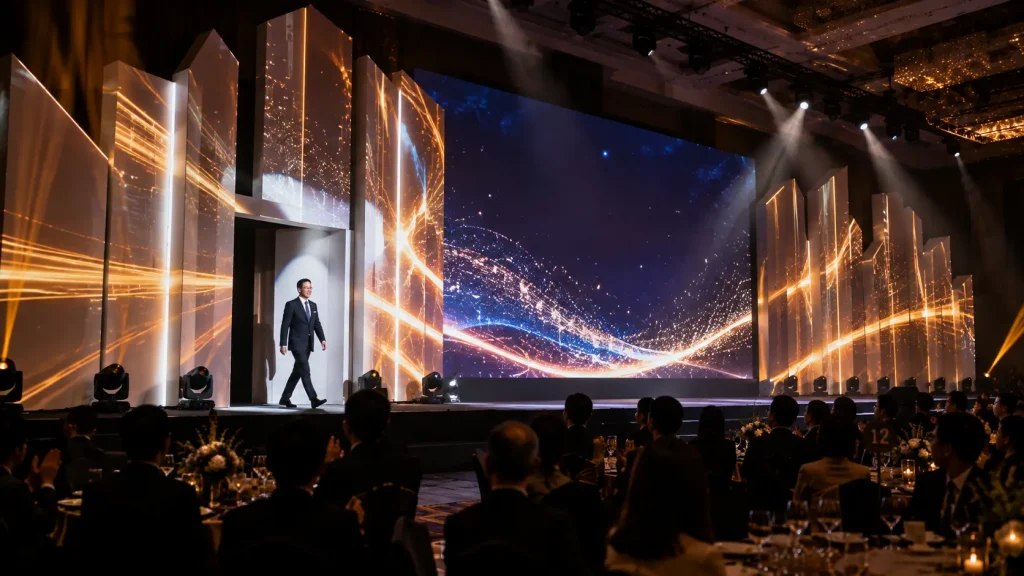
Existing hotel features may sometimes provide suitable projection surfaces, including:
- Ballroom Walls
- Stage Side Walls
- Columns
- Architectural Panels
- Foyer Walls
- Entrance Areas
However, surface colour, material, projector distance and ambient lighting should be evaluated before confirming the concept.
If existing surfaces are unsuitable, simple physical scenic panels can be designed specifically for projection.
Projection Mapping for CEO or Management Entrance
A management entrance can become part of the annual dinner opening rather than a separate walk-on after the video finishes.
For example, projection graphics can begin moving toward the centre of the stage while lighting gradually reveals the entrance route.
The visual sequence reaches its climax as the CEO, founder or management team enters.
Projection, music and lighting can then transition into the live stage programme.
This approach is particularly suitable when the annual dinner includes an important anniversary, milestone or leadership message.
Projection Mapping for Company Anniversary Celebrations
Annual dinners celebrating a company anniversary can use projection mapping to turn corporate history into a visual journey.
Instead of presenting a long timeline slide, key milestones can become part of the environment.
The sequence may move through:
- Company Foundation
- Early Years
- Important Projects
- Business Expansion
- Team Growth
- Major Achievements
- Present Day
- Future Vision
Historical photographs and videos can appear together with motion graphics while surrounding mapped surfaces visually change between different eras.
This allows the anniversary story to feel more cinematic than a conventional corporate presentation.
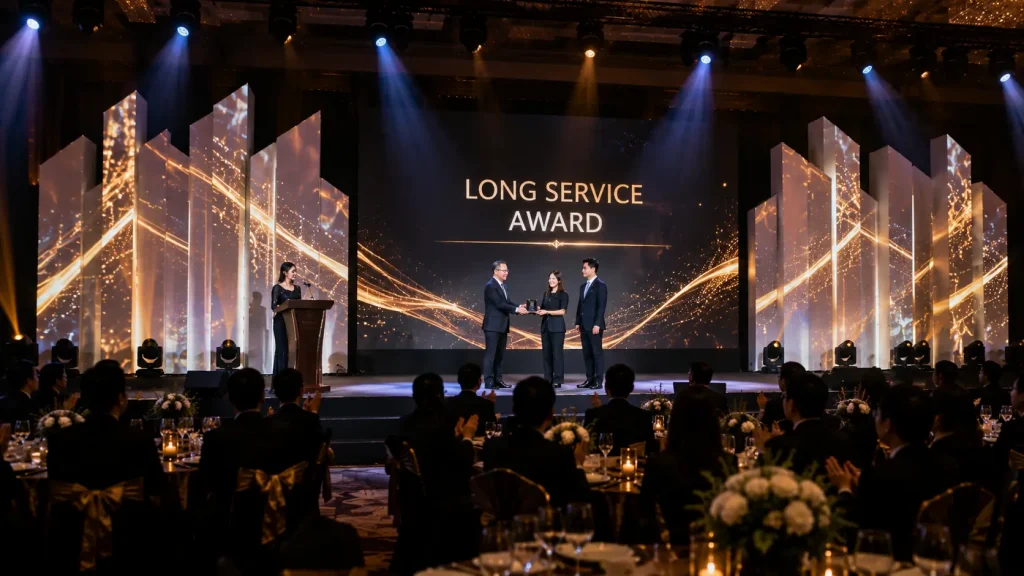
Projection Mapping for Long Service Awards
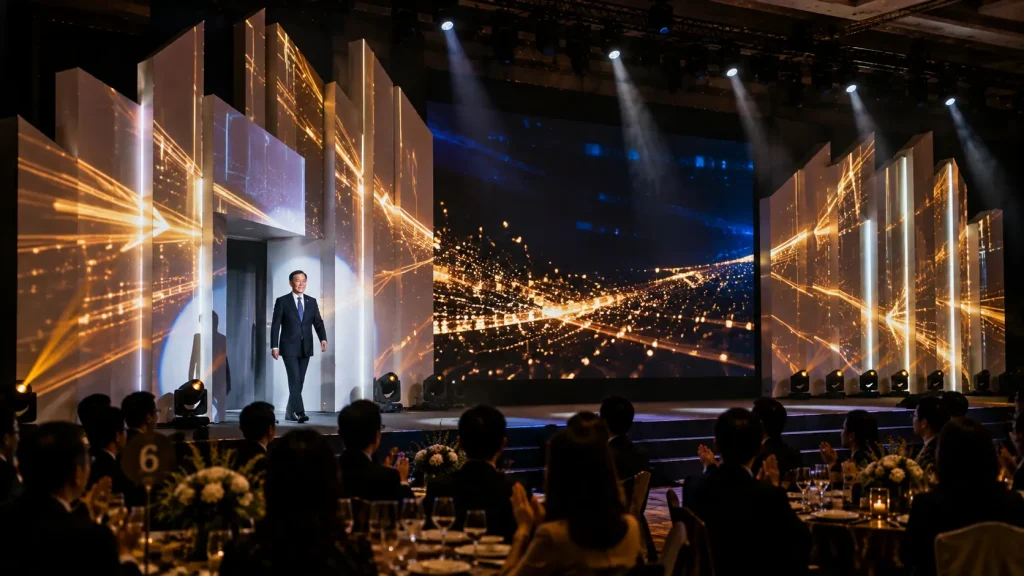
Projection mapping can also support award segments without turning every award presentation into a large visual show.
During a Long Service Award sequence, surrounding mapped surfaces can subtly change according to the award category.
For example:
- 5 Years
- 10 Years
- 15 Years
- 20 Years
- 25 Years
The main LED screen can continue displaying recipient names and photographs while the projection environment provides supporting motion and colour.
This keeps important information readable while giving each award category a stronger stage presence.
Projection Mapping for Awards and Recognition
Major awards can use a more dramatic sequence.
Before the winner is announced, mapped surfaces can transition into a dedicated award look.
Lighting and projection can then build toward the announcement before returning to the normal event environment.
This approach can be used for:
- Employee Awards
- Sales Awards
- Leadership Awards
- Dealer Awards
- Partner Recognition
- Best Dressed
- Special Achievement Awards
The projection does not need to contain detailed award information. The LED screen can handle names and data while projection creates atmosphere.
Projection Mapping for Annual Dinner Entertainment
Projection mapping can become part of live entertainment rather than functioning only as background decoration.
Possible combinations include:
- Dance Performances
- Opening Performers
- Live Music
- Drum Performances
- LED Performers
- Choreographed Light Shows
- Corporate Performances
Visual content can be timed around performer movement and music cues.
For example, a dancer may begin in front of a relatively simple stage before the physical environment gradually transforms around the performance.
The content should support the performer rather than compete for the audience’s attention.
Can Projection Mapping Cover the Entire Ballroom?
Yes, depending on the venue and project scope.
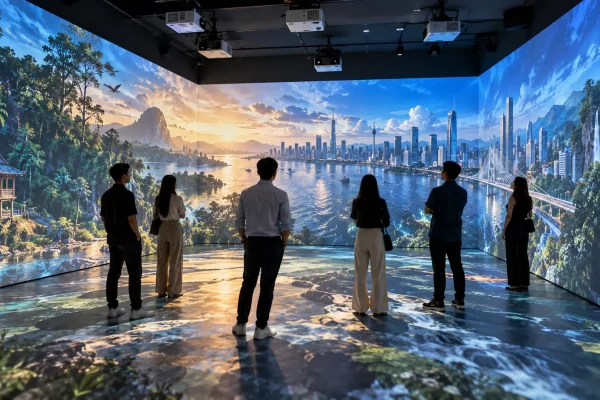
Projection can extend beyond the stage onto selected ballroom walls to create a more immersive environment.
This may be suitable for annual dinners where the venue itself needs to change significantly between programme segments.
However, projecting across the entire ballroom requires more equipment, calibration and content planning than mapping selected stage surfaces.
For many annual dinners, concentrating projection on one or two high-impact areas can provide a more practical balance between experience and budget.
For larger multi-wall environments, see our upcoming Immersive Projection Malaysia guide.
Projection Mapping for the Annual Dinner Entrance
The experience can begin before guests enter the ballroom.
A foyer wall, entrance tunnel or custom physical structure can become a projection surface.
Possible entrance applications include:
- Animated Event Theme
- Company Anniversary Story
- Welcome Visuals
- Dynamic Brand Patterns
- Guest-triggered Effects
- Interactive Projection
This can create a transition between the hotel environment and the themed annual dinner experience.
Interactive Projection Mapping for Annual Dinner Guests
Projection mapping can also become interactive.
Instead of guests only watching visual content, motion tracking or other interaction technologies can allow the projected environment to respond to them.
Examples include:
- Interactive Floor Effects
- Motion-responsive Walls
- Gesture-controlled Visuals
- Interactive Theme Installations
- Projection-based Games
These experiences can be installed in the foyer before dinner or used during selected programme segments.
For more possibilities, see our Interactive Projection Mapping Malaysia guide.
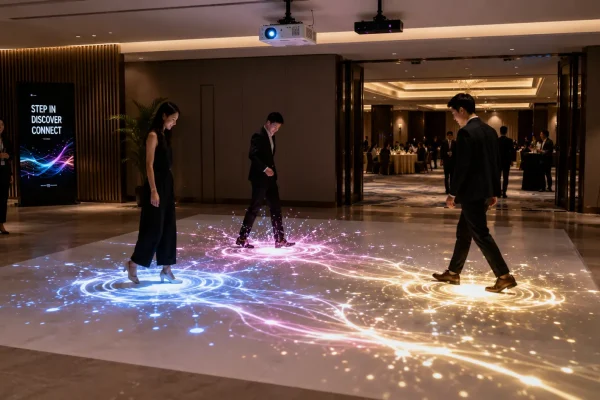
Interactive Floor Projection for Annual Dinners
An interactive floor can create a different type of experience from stage projection mapping.
Guests can walk across a projected surface while graphics respond to their movement.
Depending on the theme, the floor may react with:
- Light Trails
- Particles
- Water Effects
- Theme Graphics
- Digital Patterns
- Branded Visual Elements
This can be positioned near the entrance, photobooth area or another guest engagement zone.
Learn more in our upcoming Interactive Floor Projection Malaysia guide.
Projection Mapping and Annual Dinner Photo Opportunities
Projection can also create temporary visual environments for photography.
Instead of building several physical backdrops, one projection surface can change appearance throughout the event.
For example, guests may take photographs against different animated environments connected to the annual dinner theme.
However, projection brightness and camera exposure should be considered carefully because a scene that looks bright to the eye may behave differently in photography.
Should Projection Mapping Run Throughout the Entire Annual Dinner?
Usually, it does not need to.
If projection mapping remains visually intense for several hours, the effect can become less special.
A stronger approach is often to reserve the most complex content for selected moments.
For example:
- Guest Arrival
- Opening Show
- CEO Entrance
- Anniversary Segment
- Major Awards
- Entertainment
- Finale
Between these moments, mapped surfaces can display subtle ambient visuals or remain visually neutral.
This creates contrast and makes the major sequences feel more significant.
How Should an Annual Dinner Stage Be Designed for Projection Mapping?
Projection mapping works best when the physical stage design and projection concept are planned together.
A stage does not need to be extremely complicated. In many cases, relatively simple physical surfaces can create strong results when their shapes are intentionally designed for mapped content.
Suitable stage elements may include:
- Flat Scenic Panels
- Layered Walls
- Columns
- Geometric Structures
- Side Wings
- Physical Frames
- Textured Surfaces
- Custom Fabricated Features
These elements provide physical geometry that animation can follow, highlight or visually transform.
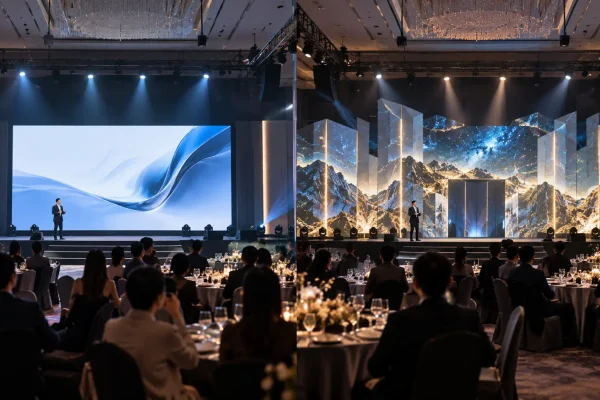
For example, several layered white panels surrounding a central LED screen can remain minimal during speeches and presentations. During the opening show, projection mapping can transform the same panels into a much larger visual environment.
This allows the physical stage design to remain practical while still supporting selected high-impact show moments.
Does the Stage Need to Be White?
No, but surface colour affects projection brightness and colour reproduction.
Light-coloured matte surfaces generally provide better projection visibility than very dark, glossy or highly reflective materials.
This does not mean every annual dinner projection stage must be completely white.
The scenic design can combine different materials while reserving selected surfaces for projection.
Surface selection should therefore be discussed before stage fabrication rather than after the stage has already been completed.
Where Should Projectors Be Positioned in a Hotel Ballroom?
Projector placement is one of the most important technical considerations for annual dinner projection mapping.
The projectors need a clear optical path toward the mapped surfaces while avoiding unnecessary obstruction to guests, cameras and event operations.
Possible projector positions may include:
- Front-of-House Technical Area
- Elevated Projection Platforms
- Ballroom Rear Area
- Side Projection Positions
- Approved Rigging Positions
The appropriate location depends on the ballroom dimensions, stage size, ceiling height, required image coverage and available projection lenses.
The projector lens must physically face the required projection surface with a clear line of sight.
How Do You Prevent Guests from Blocking the Projection?
People passing through a projection path can create visible shadows on the mapped surface.
This is particularly important when projection equipment is positioned near audience areas.
Possible solutions include:
- Elevating the Projector
- Using Suitable Long-throw or Shorter-throw Lens Configurations
- Positioning Projectors Outside Main Guest Routes
- Planning Camera Positions Around Projection Paths
- Controlling Performer and Presenter Movement
The projection layout should therefore be coordinated with the complete ballroom floor plan, not only the stage drawing.
What Hotel Ballroom Limitations Should Be Considered?
Hotel ballrooms provide controlled indoor environments, but they can also introduce practical limitations for projection mapping.
Ceiling Height
A low ballroom ceiling may limit projector rigging positions and the height of custom scenic structures.
Existing Chandeliers
Large chandeliers can obstruct projection paths or affect possible projector positions.
Ballroom Lighting
Existing ceiling lights and wall lighting may reduce projection contrast if they remain bright during mapped sequences.
Rigging Restrictions
Some venues have specific rules regarding ceiling rigging, equipment loading and allowable installation points.
Limited Setup Time
Annual dinner setups are sometimes completed within the same day as the event, creating limited time for projection calibration and rehearsal.
Guest Seating
Large guest capacities may leave limited space for projector platforms and technical control positions.
These factors should be reviewed before finalising the projection concept.
How Does Ballroom Lighting Affect Projection Mapping?
Projection becomes more visible when the mapped surface is not receiving strong competing light.
This does not mean the ballroom needs to remain completely dark throughout the event.
Instead, lighting can be programmed according to different programme segments.
During dinner and networking, normal ambient lighting may remain active.
When a projection mapping sequence begins, selected stage and ballroom lights can dim while the projection becomes the main visual focus.
Lighting can then return as the sequence transitions into a speech, award presentation or performance.
This coordination between lighting and projection can significantly improve the perceived impact of the show.
Can Projection Mapping Be Combined with Stage Lighting?
Yes. Projection mapping and stage lighting can be designed to support each other.
Possible combinations include:
- Moving Head Lighting
- Beam Effects
- Wash Lighting
- Architectural Lighting
- Follow Spots
- LED Lighting
- Haze
However, strong stage lights should not continuously illuminate the same surfaces being used for projection.
The lighting designer and projection team should coordinate cues so that each system becomes dominant at the appropriate moment.
Projection Mapping Content Production for Annual Dinners
Annual dinner projection content should be designed around the event programme rather than produced as one continuous visual loop.
The content can be divided into different visual states.
For example:
- Guest Arrival Look
- Opening Show
- Corporate Welcome
- Dinner Ambience
- Award Look
- Entertainment Look
- Lucky Draw Look
- Finale
Each state can use the same physical stage while changing its visual identity.
This creates consistency across the event while avoiding the need to produce a completely different physical setup for every programme segment.
2D vs 3D Projection Mapping Content for Annual Dinners
Not every annual dinner requires complex 3D animation.
2D motion graphics can work effectively for:
- Animated Patterns
- Theme Graphics
- Corporate Colours
- Light Trails
- Particle Effects
- Elegant Ambient Motion
- Award Transitions
3D animation can be introduced for selected high-impact moments such as the opening show.
For example, physical stage panels may appear to move, open, rotate or transform through carefully aligned animation.
A practical annual dinner approach may therefore combine relatively simple ambient content with a shorter customised 3D sequence for the main opening.
Can Existing Corporate Videos Be Used?
Yes, but a conventional corporate video should not automatically be stretched across irregular projection surfaces.
Existing videos can remain on the central LED screen while customised projection content supports them on surrounding physical structures.
Corporate assets such as photographs, historical footage, brand graphics and product visuals can also be incorporated into newly designed mapped content.
This allows existing materials to remain useful without compromising the architectural relationship between the projection and stage.
How Does Show Control Work?
An annual dinner may involve projection, LED content, lighting, audio, videos and live stage activities.
These systems need clearly defined show cues.
A projection mapping sequence may be triggered according to:
- Show Caller Cue
- Audio Cue
- Timecode
- Playback Sequence
- Manual Operator Cue
The appropriate method depends on the complexity of the programme.
For a short annual dinner opening, a pre-produced sequence with coordinated technical cues may be sufficient.
More complex productions may require closer synchronisation between media servers, lighting and audio systems.
Why Is Rehearsal Important?
Annual dinner projection mapping should be rehearsed together with the programme elements surrounding it.
A typical opening may involve several actions within a short period:
- Emcee Clears the Stage
- House Lights Fade
- Opening Audio Starts
- Projection Sequence Begins
- Lighting Cues Activate
- LED Content Changes
- Management Enters
- Final Reveal Happens
- Stage Lighting Returns
A full technical rehearsal helps confirm that these transitions happen in the intended order.
It also provides an opportunity to adjust projection alignment, brightness, audio levels and lighting before guests enter the ballroom.
How Much Does Projection Mapping for an Annual Dinner Cost?
The cost of annual dinner projection mapping in Malaysia depends on the venue, stage design, projection area, content and technical requirements.
Major cost factors include:
- Projection Surface Size
- Number of Projection Areas
- Projector Quantity
- Projector Brightness
- Lens Requirements
- Stage or Scenic Fabrication
- Content Duration
- 2D or 3D Animation Complexity
- Media Server Requirements
- Installation Time
- Interactive Features
- Technical Crew
- Rehearsal Requirements
A focused opening projection on selected stage panels will have very different requirements from transforming multiple walls of a large ballroom.
For a detailed explanation of projection mapping budget factors, see our Projection Mapping Cost Malaysia guide.
How Can Annual Dinner Projection Mapping Cost Be Controlled?
Projection mapping does not need to cover every surface in the ballroom.
For many annual dinners, a better approach is to identify one or two moments where projection can create the strongest impact.
Possible ways to control the project scope include:
- Focus Projection Around the Main Stage
- Use Existing LED Screens for Standard Event Content
- Create One Strong Opening Sequence
- Reuse the Same Physical Surfaces Throughout the Event
- Use Simpler Ambient Content Between Major Segments
- Combine 2D Motion Graphics with Selected 3D Effects
- Avoid Unnecessary Full-ballroom Coverage
- Plan Stage Fabrication Around Projection from the Beginning
For example, an annual dinner that already has a large LED screen may not need another large projection canvas.
Instead, projection mapping can concentrate on the physical structures surrounding the LED screen, creating a much wider visual experience specifically during the opening and major programme moments.
Do You Need Projection Mapping for the Whole Event?
No.
For many annual dinners, projection mapping can be treated as a premium show element rather than a continuous display system.
A practical setup could use projection for:
- Opening Sequence
- CEO Entrance
- Anniversary Story
- Major Award Reveal
- Entertainment Segment
- Finale
The existing LED screen can continue handling normal event content during the rest of the evening.
This hybrid approach can provide a strong visual difference without requiring the complete annual dinner programme to be produced as projection mapping content.
Annual Dinner Projection Mapping Project Workflow
A typical project can be developed through the following stages.
1. Event Brief
The event date, venue, guest count, theme, programme and objectives are reviewed.
2. Venue and Stage Assessment
The ballroom, existing AV system, stage dimensions and potential projection surfaces are evaluated.
3. Projection Concept
The team identifies where projection mapping can add the most value to the annual dinner.
4. Technical Planning
Projector positions, brightness, lenses, media server requirements and projection paths are planned.
5. Creative Development
The opening concept, storyboard, styleframes and other required content are developed.
6. Content Production
2D motion graphics, 3D animation and supporting visual content are produced.
7. Installation and Calibration
Projection equipment is installed and the content is mapped to the actual physical surfaces.
8. Technical Rehearsal
Projection, LED, audio, lighting and live stage cues are tested together.
9. Live Event Operation
The technical team operates the approved projection sequences according to the event rundown.
What Information Is Needed for an Annual Dinner Projection Mapping Quotation?
The following information can help prepare an initial recommendation:
- Event Date
- Hotel or Venue
- Expected Number of Guests
- Ballroom Name
- Stage Dimensions
- Stage Design, If Available
- LED Screen Size
- Annual Dinner Theme
- Event Rundown
- Required Opening Show Duration
- Reference Videos or Images
- Existing AV Equipment
- Estimated Budget
If the final stage design is not yet available, the projection concept can be discussed earlier so that suitable physical surfaces are incorporated into the stage design.
How Early Should Annual Dinner Projection Mapping Be Planned?
Projection mapping should ideally be discussed before the final stage design and event programme are locked.
This provides sufficient time for:
- Venue Assessment
- Stage Planning
- Technical Design
- Creative Concept Development
- Storyboard Approval
- Animation Production
- Equipment Coordination
- Installation Planning
- Mapping Calibration
- Rehearsal
Early planning is especially useful when projection mapping needs to interact with custom scenic structures or become part of the opening gimmick.
Why Work with MyDigital Asia for Annual Dinner Projection Mapping?
MyDigital Asia provides creative and technical projection mapping solutions for corporate annual dinners in Malaysia.
Depending on the event requirements, the scope can include:
- Annual Dinner Creative Concept
- Opening Gimmick Development
- Projection Mapping Storyboard
- 2D Motion Graphics
- 3D Projection Mapping Animation
- Stage Projection Planning
- Projector and Lens Planning
- Media Server Setup
- Mapping and Calibration
- Lighting and Show Cue Coordination
- Interactive Projection Experiences
- Technical Rehearsal
- Live Event Operation
The projection system can also be planned together with existing event elements such as LED screens, lighting, audio and interactive technology rather than treating each component as an isolated installation.
Frequently Asked Questions
Can projection mapping be used if our annual dinner already has an LED screen?
Yes. This is often one of the most practical approaches. The LED screen can handle presentations, videos and event information while projection mapping transforms surrounding physical surfaces during selected show moments.
Do we need to build a special stage?
Not always. Existing ballroom surfaces may sometimes be suitable. Alternatively, relatively simple scenic panels can be designed as projection surfaces around the main stage.
Can projection mapping be used only for the opening?
Yes. A focused opening sequence is one of the most effective ways to introduce projection mapping without requiring mapped content throughout the entire annual dinner.
Can projection mapping match our annual dinner theme?
Yes. Customised content can be developed around the event theme, corporate identity, anniversary story or creative direction.
Can projection mapping work in a hotel ballroom?
Yes, subject to projector positioning, projection distance, ceiling height, ambient lighting and available surfaces.
Can projection mapping be synchronised with lighting and music?
Yes. Projection, lighting, audio and other show elements can be coordinated through planned cues or time-based playback depending on the production requirements.
Can you create the projection mapping animation?
Yes. MyDigital Asia can provide customised 2D and 3D content production together with projection mapping technical implementation depending on the project scope.
Can guests interact with the projection?
Yes. Motion tracking, interactive floors and other interactive projection technologies can be incorporated into suitable annual dinner experiences.
Plan Projection Mapping for Your Annual Dinner in Malaysia
Projection mapping can give an annual dinner something that a conventional screen cannot provide: the ability to turn physical parts of the venue into part of the visual story.
It can be used for one focused opening gimmick or developed into a wider experience involving the stage, entrance, awards, entertainment and interactive guest areas.
The right approach depends on the ballroom, stage design, existing AV system, event programme and available budget.
Send MyDigital Asia your event date, venue, stage layout, annual dinner theme, reference ideas and estimated budget so that we can evaluate a suitable projection mapping approach.
Planning a corporate annual dinner in Malaysia?
Contact MyDigital Asia to discuss projection mapping, opening show content, stage technology and interactive experiences for your event.
Related Projection Mapping Guides
- Projection Mapping Malaysia: Complete Guide
- Projection Mapping Cost Malaysia
- Projection Mapping for Corporate Events
- Building Projection Mapping Malaysia
- Projection Mapping for Product Launches
- Interactive Projection Mapping Malaysia
- Interactive Floor Projection Malaysia
- Immersive Projection Malaysia
- Projection Mapping vs LED Screen
Request a Free Consultation
Looking for Interactive Maps, Interactive Solutions or Event Technology?

LATEST POSTS