
10 Immersive Room Ideas for Events, Museums & Experience Centres
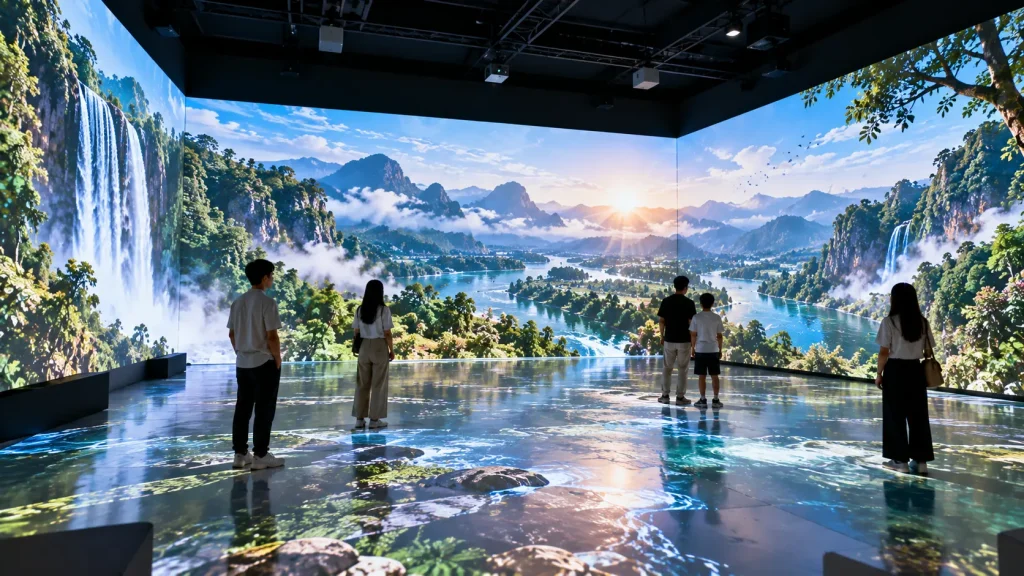
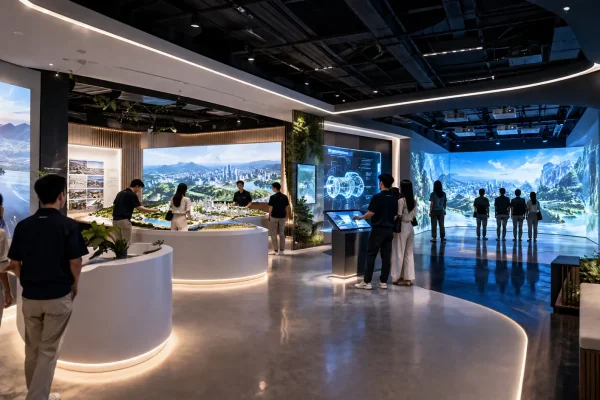
Immersive room ideas can transform an ordinary indoor space into an environment where visitors experience a story, product or destination through large-scale visuals, sound, lighting and spatial design.
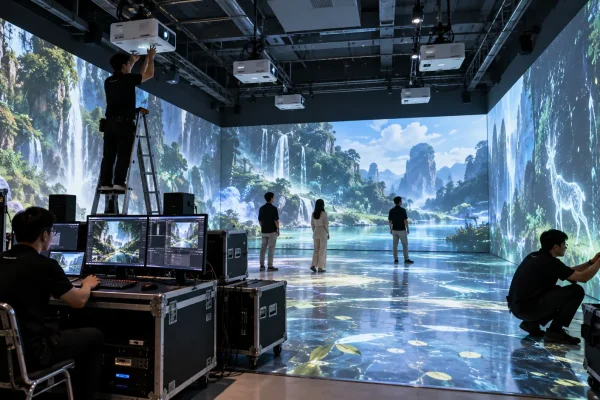
Unlike a conventional exhibition display, an immersive room surrounds visitors with content. Depending on the concept, the experience may use wall projection, floor projection, LED displays, spatial audio, interactive sensors or synchronised lighting.
For brands, museums, visitor centres and exhibitions in Malaysia, immersive rooms can help communicate complex stories, create memorable experiences and introduce visitors to environments that would otherwise be difficult to experience physically.
Here are 10 immersive room concepts with different storytelling approaches and commercial applications.
1. Journey Through Time Immersive Room
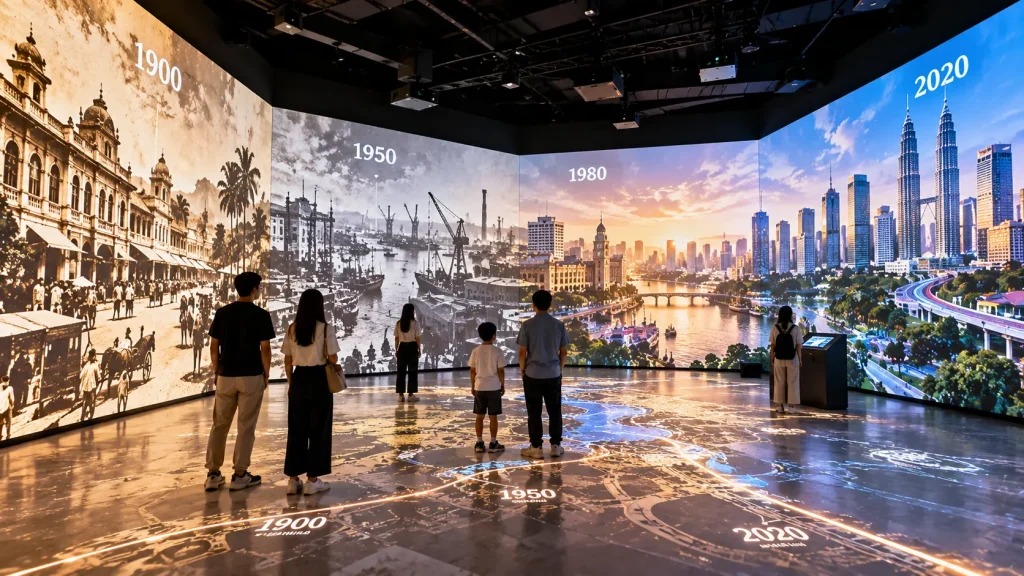
Imagine entering a room that transports visitors through different historical periods.
The experience begins in an early settlement, gradually transforms into an industrial environment and eventually reveals a modern city. Surrounding walls show how architecture, transportation, communities and technology evolve over time.
Transitions can be supported by environmental sound, narration and synchronised lighting to make each period feel distinct.
This concept works particularly well when an organisation needs to communicate a long history without relying entirely on traditional timeline panels.
How it works:
A pre-programmed audiovisual timeline synchronises panoramic visuals, sound and lighting across the room. Visitors can experience the story as a continuous presentation or select different chapters through a separate control interface.
Best for:
Corporate heritage centres, museums, government galleries, historical exhibitions and visitor centres.
2. Underwater Discovery Room
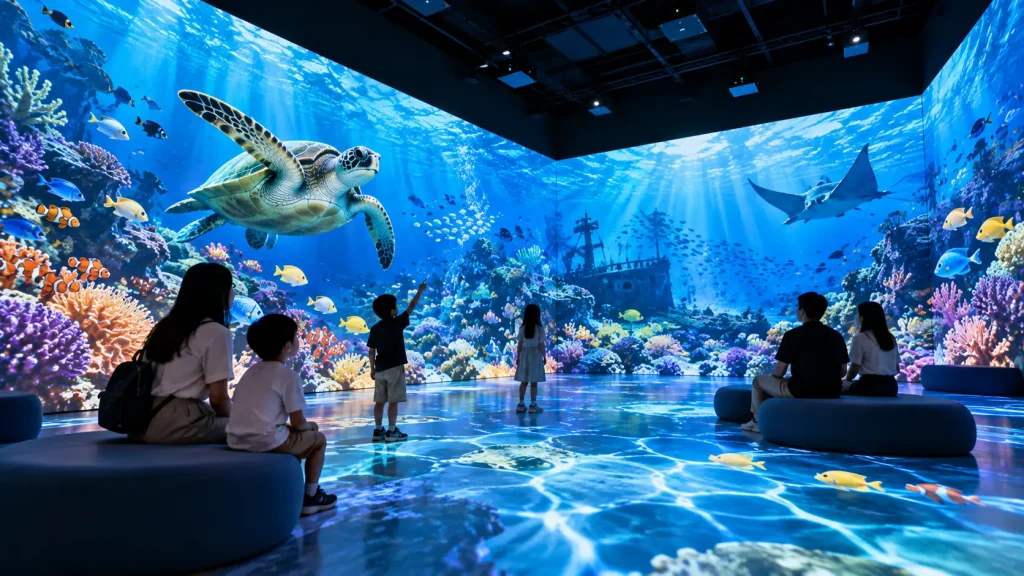
An ordinary exhibition room can become an underwater environment filled with marine life, coral reefs and changing ocean conditions.
Visitors are surrounded by animated fish, sea turtles, rays and underwater landscapes. The experience can gradually move from shallow coral reefs into deeper ocean environments.
Rather than presenting marine information as static facts, the room can communicate different ecosystems through visual storytelling.
Educational content can also introduce coral conservation, marine biodiversity and the effects of pollution.
How it works:
Multi-surface projection or LED displays create the underwater environment, supported by synchronised ocean soundscapes and optional interactive features.
Best for:
Aquariums, marine museums, family attractions, education centres and environmental exhibitions.
3. Inside the Human Body Immersive Room
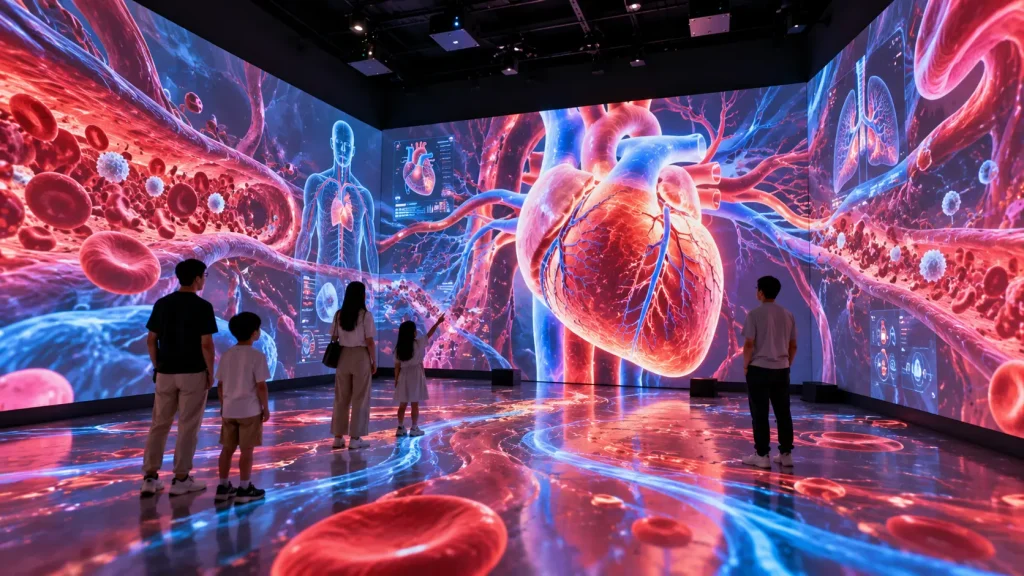
This concept takes visitors on a visual journey through the human body.
The room begins with a full-body anatomical overview before transitioning into the bloodstream, heart, lungs, nervous system or individual cells.
Large-scale animation helps visitors understand structures and processes that are difficult to demonstrate using physical models alone.
For example, visitors could follow the journey of oxygen from the lungs into the bloodstream or explore how the heart circulates blood throughout the body.
How it works:
Medical visualisation and 3D animation are adapted into a panoramic audiovisual presentation. Content can be organised into short chapters for different learning objectives.
Best for:
Healthcare exhibitions, hospitals, medical museums, science centres and educational institutions.
4. Future City Immersive Experience
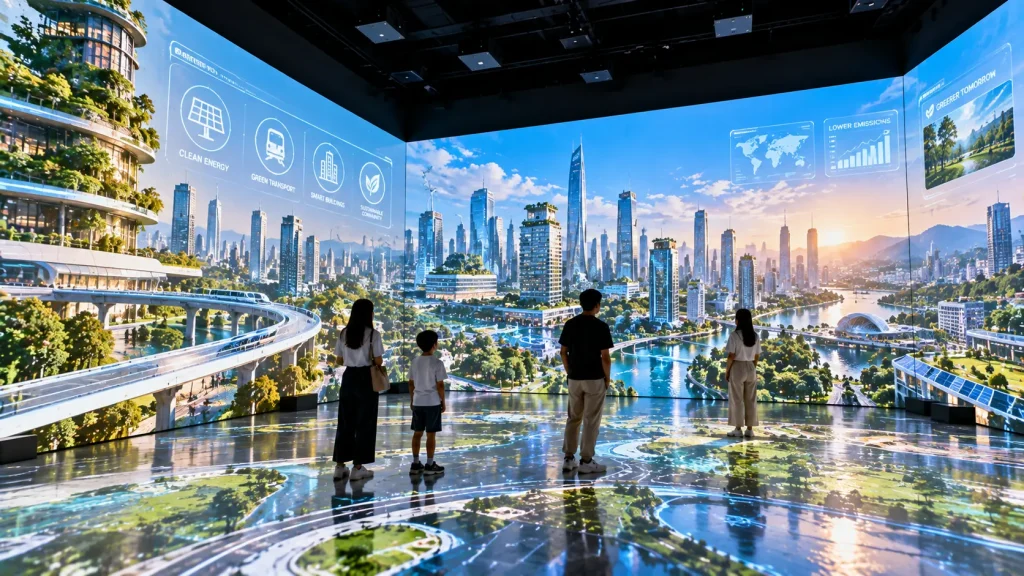
A Future City Room allows visitors to experience how urban environments could evolve through technology, mobility, sustainability and intelligent infrastructure.
Surrounding walls can display a city transforming from its present condition into different future scenarios.
Visitors might see electric transportation networks, connected buildings, green infrastructure and energy-efficient communities develop across the environment.
Instead of explaining each technology separately, the room presents how these systems could work together.
How it works:
A panoramic city animation synchronises visual changes across the room. Optional scenario controls allow visitors to compare different planning or technology concepts.
Best for:
Property developers, smart-city galleries, government exhibitions, infrastructure companies and corporate experience centres.
5. Rainforest Ecosystem Immersive Room
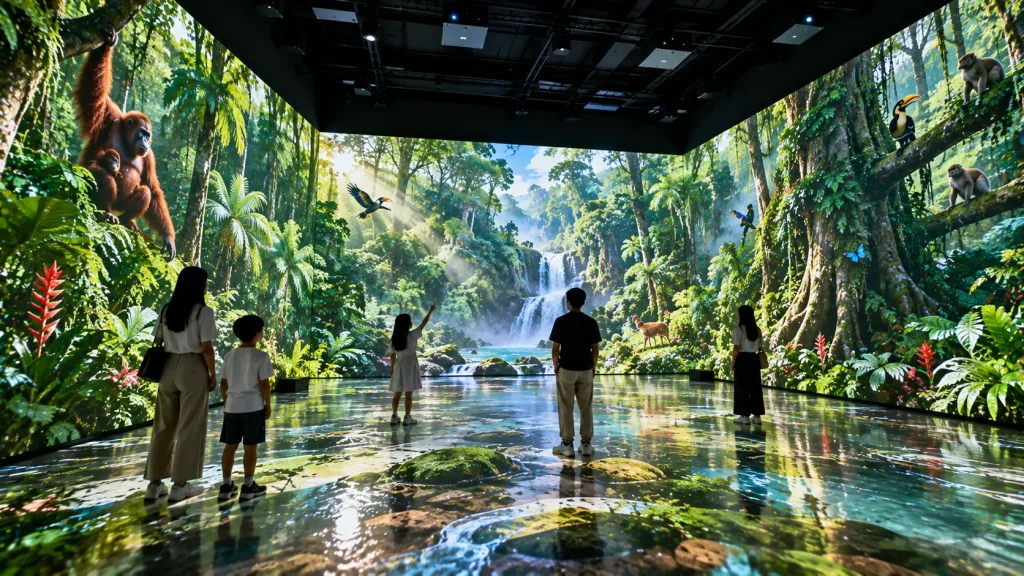
Visitors enter a digital rainforest surrounded by towering trees, moving foliage, wildlife and natural soundscapes.
The environment can transition between morning, afternoon, rainfall and nighttime to demonstrate how rainforest ecosystems change throughout the day.
Bird calls, insects, flowing rivers and environmental lighting help create a stronger sense of place.
For Malaysian visitor centres, the concept can introduce tropical biodiversity, conservation and the relationship between wildlife and natural habitats.
How it works:
Panoramic forest visuals, animated environmental elements and spatial audio create the experience. Carefully designed transitions can move visitors through different habitats without requiring them to physically walk between rooms.
Best for:
Nature centres, tourism galleries, conservation exhibitions, museums and educational attractions.
6. Product Innovation Immersive Room
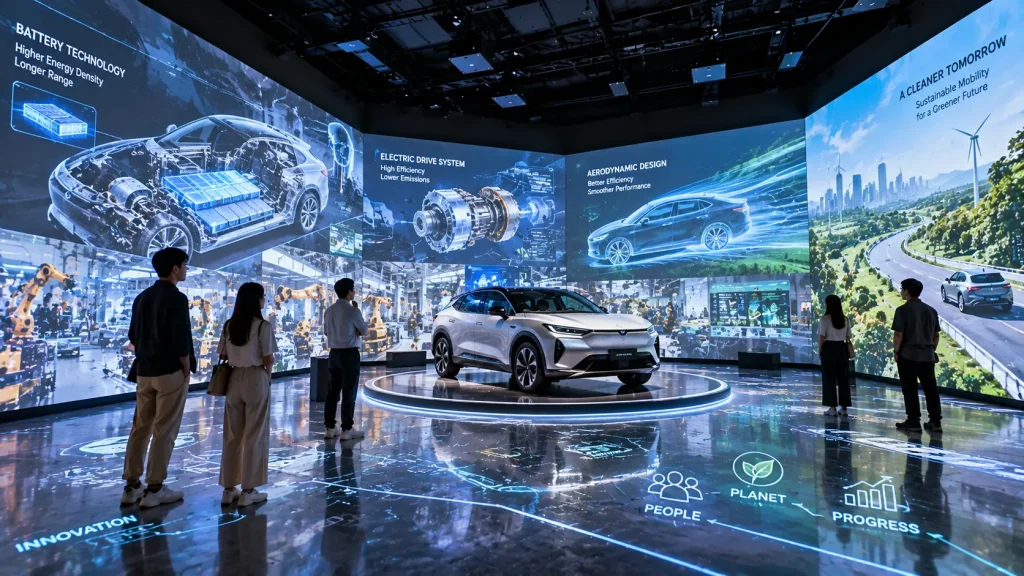
An immersive room can present a product’s engineering, design and innovation journey at architectural scale.
Imagine an automotive brand introducing a new electric vehicle. The room begins with raw materials and design sketches before transforming into manufacturing processes, internal components and the final vehicle.
Instead of relying on a conventional product video, the presentation uses the surrounding environment to reveal different stages of development.
This approach is especially useful for products whose technology or manufacturing process forms an important part of their value.
How it works:
Custom 3D animation is synchronised across the room, potentially combined with lighting, sound and a physical product reveal.
Best for:
Automotive brands, manufacturing companies, technology showcases, product launches and corporate innovation centres.
7. Space Exploration Immersive Room
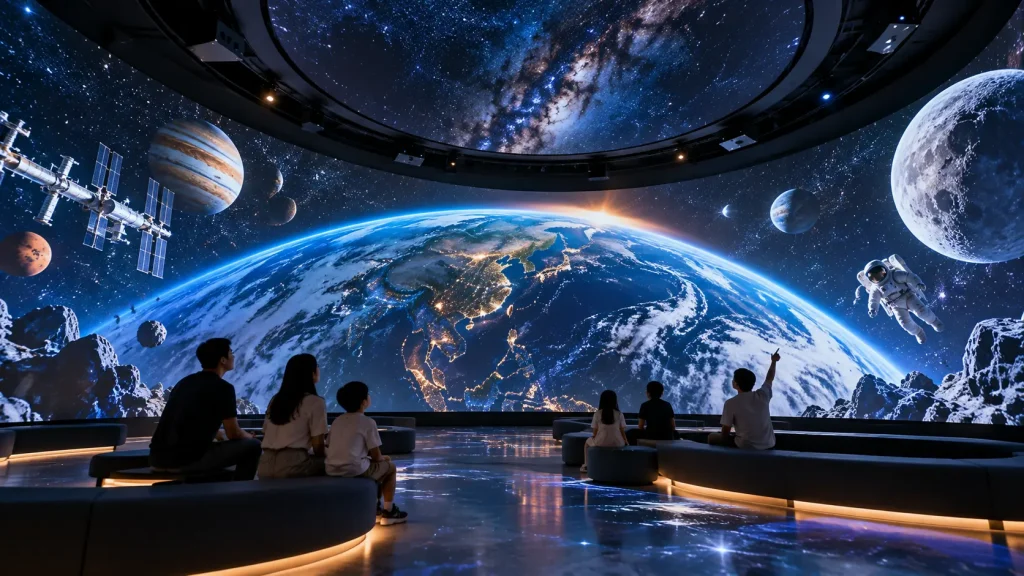
A Space Exploration Room allows visitors to travel through a digital universe without leaving the exhibition.
The experience can begin on Earth, move through the atmosphere and continue towards the Moon, planets and distant star systems.
Surrounding visuals help communicate the scale of space, while narration and sound design explain key scientific concepts.
Different chapters can focus on planetary exploration, satellites, space technology or astronomy.
How it works:
High-resolution space animation is mapped across the room using projection or LED technology. A synchronised presentation controls the journey and transitions between environments.
Best for:
Science museums, education centres, space exhibitions, family attractions and technology galleries.
8. Immersive Brand Storytelling Room
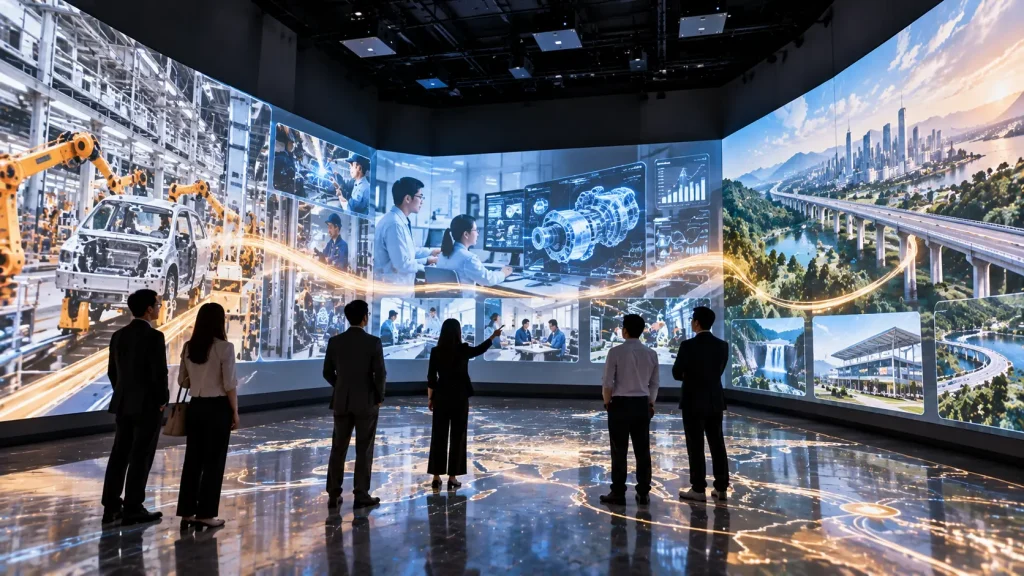
A brand can use an immersive room to communicate its identity, values and long-term vision through a structured audiovisual story.
For example, the experience might begin with a challenge faced by an industry, introduce the brand’s approach and conclude with the impact of its products or services.
The room can change visual style between chapters, moving from realistic environments to product details, abstract graphics or real project footage.
This can be particularly effective for B2B organisations whose services are difficult to demonstrate using a physical product display.
How it works:
A scripted audiovisual experience combines brand footage, motion graphics, animation, narration and synchronised environmental effects.
Best for:
Corporate headquarters, brand experience centres, investor presentations, VIP tours and product launches.
9. Interactive Digital Art Room
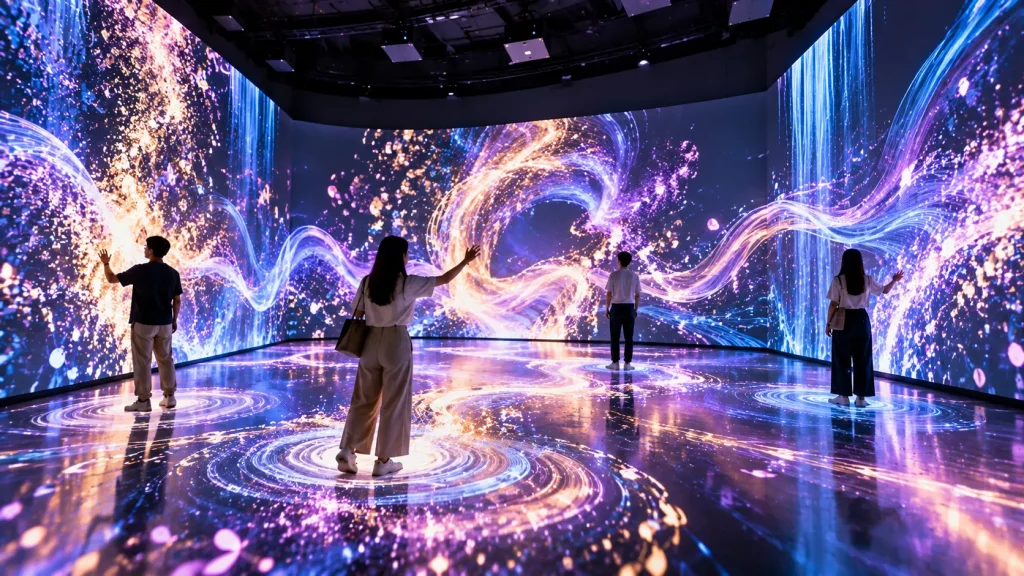
An immersive room does not always need a fixed storyline. It can become a continuously evolving digital artwork that responds to visitors.
For example, visitors moving through the room could influence flowing particles, abstract light fields or generative landscapes.
Different parts of the environment may respond independently, allowing several visitors to contribute to one shared visual experience.
The artistic direction can be adapted to a brand theme, seasonal campaign or permanent public installation.
How it works:
Depth cameras, tracking sensors or other suitable detection systems provide visitor-position data to real-time visual software. The generated visuals respond according to the interaction design.
Best for:
Art exhibitions, shopping malls, public installations, creative brand activations and experience centres.
10. Immersive Decision-Making Room
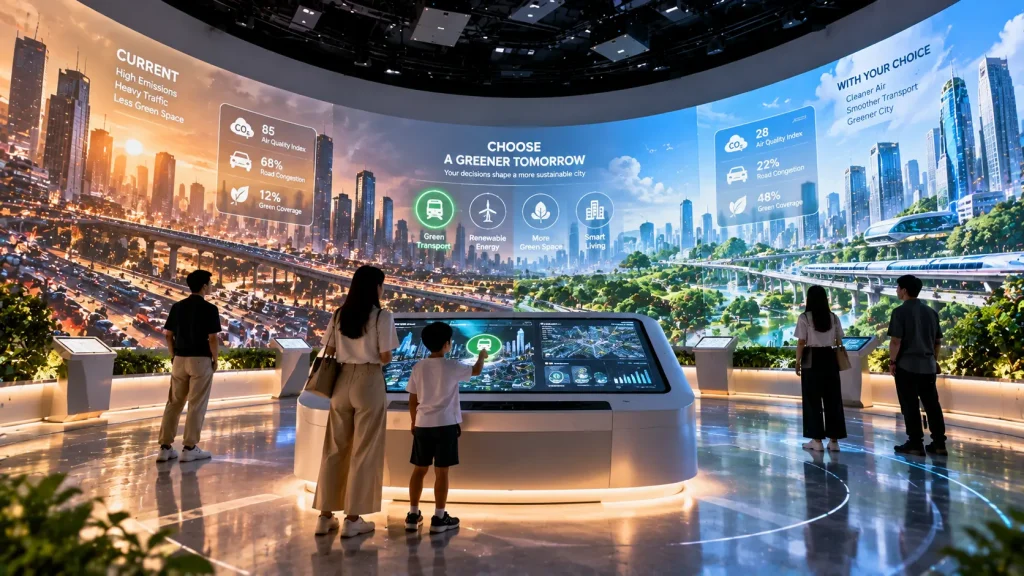
Rather than watching a predetermined presentation, visitors can influence the outcome of an immersive scenario.
For example, a sustainability room could ask visitors to choose between different energy strategies. Their decisions would change the surrounding city environment, energy indicators and future conditions.
A disaster preparedness experience could demonstrate how different infrastructure decisions affect a community during extreme weather.
The objective is to make cause-and-effect relationships easier to understand through an experience visitors actively influence.
How it works:
Visitors select scenarios through physical buttons, tablets or other control interfaces. Interactive software updates the room’s visual environment and corresponding outcomes based on the selected choices.
Best for:
Sustainability centres, government galleries, corporate training, educational institutions and visitor centres.
Which Immersive Room Concept Is Best for Your Project?
| Project Objective | Recommended Immersive Room |
|---|---|
| Communicate history | Journey Through Time |
| Explain marine ecosystems | Underwater Discovery |
| Teach healthcare concepts | Inside the Human Body |
| Present future infrastructure | Future City |
| Introduce nature and conservation | Rainforest Ecosystem |
| Showcase product technology | Product Innovation |
| Explore science and astronomy | Space Exploration |
| Communicate brand identity | Immersive Brand Storytelling |
| Create participatory digital art | Interactive Digital Art |
| Demonstrate decision outcomes | Immersive Decision-Making |
How Do You Build an Immersive Room?
An immersive room combines visual content, display technology, sound and spatial design to create a coordinated experience across multiple surfaces.
The typical development process is:
Experience Concept → Room Layout → AV System Design → Content Production → Installation → Calibration → Testing
For example, a rainforest immersive room may use synchronised wall projections, ambient forest sounds and programmed lighting changes. An interactive version could also include sensors that respond to visitor movement.
The room layout and technical system should be planned together because projector positions, viewing angles, lighting and content dimensions affect the final experience.
Projection vs LED: Which Is Better for an Immersive Room?
Both technologies can create immersive environments, but they have different advantages.
| Consideration | Projection | LED Display |
|---|---|---|
| Best Environment | Controlled or darkened spaces | Bright or controlled spaces |
| Installation Surface | Suitable walls, floors and irregular surfaces | Structured display walls |
| Brightness | More affected by ambient lighting | Generally higher brightness |
| Visual Continuity | Requires blending for overlapping projections | Requires suitable panel layout and seam management |
| Physical Space | Requires suitable projection distance and mounting positions | Requires display structure and maintenance access |
| Typical Application | Immersive projection rooms and floor experiences | Premium brand environments and high-brightness installations |
Projection is often suitable when the objective is to transform existing architectural surfaces. LED can be preferable when brightness, image contrast or display performance under ambient lighting is a priority.
Some immersive rooms combine both technologies.
What Room Size and Ceiling Height Are Required?
There is no single minimum room size for an immersive experience. The technical requirements depend on the number of projection surfaces, viewing distance, projector throw ratio and expected visitor capacity.
Before planning an immersive room, confirm:
- Room width, length and ceiling height
- Number of walls to be covered
- Available projector mounting positions
- Entrance and exit locations
- Expected simultaneous visitors
- Ambient lighting conditions
- Power and equipment access
Low ceilings or limited projection distances do not automatically make a project impossible. However, they may require short-throw projectors, alternative mounting positions, adjusted image coverage or a different display solution.
A site survey or technical layout is recommended before confirming projector specifications.
Can an Existing Room Be Converted Into an Immersive Room?
Yes. Existing meeting rooms, exhibition spaces, galleries and commercial interiors can potentially be converted into immersive environments.
However, the wall finish, room geometry, windows, lighting and ceiling structure should be evaluated first.
For projection-based installations, smooth matte light-coloured surfaces are generally preferable to glossy or highly textured walls. White walls may be usable, but surface preparation or projection screens can improve consistency.
Other considerations include sound isolation, equipment ventilation, cable routes and safe visitor circulation.
How Is Immersive Room Content Produced?
Immersive room content is different from a conventional video displayed on a single screen.
The content must be planned around the actual room dimensions, display layout and viewing positions. A panoramic environment may require custom animation, adapted footage, spatial composition and synchronised transitions across several surfaces.
Content production can involve:
- Experience storyboard and visual direction
- 2D motion graphics or 3D animation
- Adaptation of licensed footage
- Multi-surface content layout
- Sound design and voice-over
- Media server programming
- Projection mapping and edge blending
- On-site content alignment and revisions
Stock footage can sometimes reduce production requirements, but not every video is suitable for immersive environments. Camera movement, framing, resolution and continuity between surfaces must be considered.
Can an Immersive Room Be Interactive?
Yes. An immersive room can operate as a fixed audiovisual show or as an interactive environment.
Interactive options may include motion tracking, depth cameras, LiDAR, pressure sensors, physical buttons, touchscreen controllers and scenario-selection interfaces.
For example, visitors could select different future-city scenarios, influence generative artwork through movement or activate story chapters using a physical control.
Interaction should be added when it supports the visitor experience. A well-produced five-minute immersive story may be more effective than unnecessary interaction for certain corporate presentations or guided tours.
What Affects Immersive Room Cost in Malaysia?
The cost of an immersive room in Malaysia depends on the room dimensions, display technology, content complexity and installation requirements.
Major cost factors include:
- Number and specifications of projectors or LED displays
- Projection coverage and surface preparation
- Media server and playback system
- Custom animation and content duration
- Audio and lighting integration
- Interactive sensors and software development
- Mounting structures and cabling
- Installation, calibration and testing
- Temporary rental or permanent installation
- Technical support and maintenance
A single-wall immersive presentation and a multi-wall interactive room can have significantly different budgets. An accurate quotation should therefore be based on the actual site layout and experience requirements rather than room size alone.
What Information Is Needed for an Immersive Room Quotation?
To evaluate the project, prepare the following information:
- Project location and target opening date
- Room dimensions or floor plan
- Photos or videos of the existing space
- Number of projection or display surfaces
- Temporary or permanent installation
- Preferred immersive concept
- Required content duration
- Interactive or non-interactive experience
- Expected visitor capacity
- Existing AV equipment, if any
- Indicative project budget, if available
Frequently Asked Questions
Does an immersive room require four projection walls?
No. An immersive experience can use one or more walls, a combination of walls and floor projection, or other suitable display arrangements. The design depends on the intended visitor experience and available space.
Can immersive room content be changed later?
Yes. Content can be updated or replaced when the playback system and project files support the required changes. New content may require additional adaptation, programming or calibration.
How long can an immersive room presentation run?
The content can be designed as a short presentation, a longer guided experience or a continuously looping environment. The suitable duration depends on visitor flow, storytelling requirements and operating conditions.
Can an immersive room operate automatically?
Yes. Permanent installations can include scheduled startup, automatic playback, looping content and shutdown procedures, subject to the selected equipment and control system.
Immersive Room Design & Installation in Malaysia
MyDigital Asia provides custom immersive experience solutions in Malaysia for corporate experience centres, museums, visitor centres, exhibitions and brand environments.
Depending on project requirements, solutions can include immersive projection, projection mapping, multi-display integration, custom animation, interactive software, sensors and audiovisual system coordination.
Planning an immersive room? Share your room dimensions, site photos, location and preferred experience concept with MyDigital Asia to discuss technical feasibility and a suitable quotation.
Related Guides
- Immersive Experience Malaysia
- Projection Mapping Malaysia
- Sensor-Based Interactive Installation Ideas
- Interactive Installation Malaysia
- Physical-Digital Interactive Experience Ideas
Request a Free Consultation
Looking for Interactive Maps, Interactive Solutions or Event Technology?

LATEST POSTS