
10 Interactive Floor Ideas for Events, Malls & Experience Centres
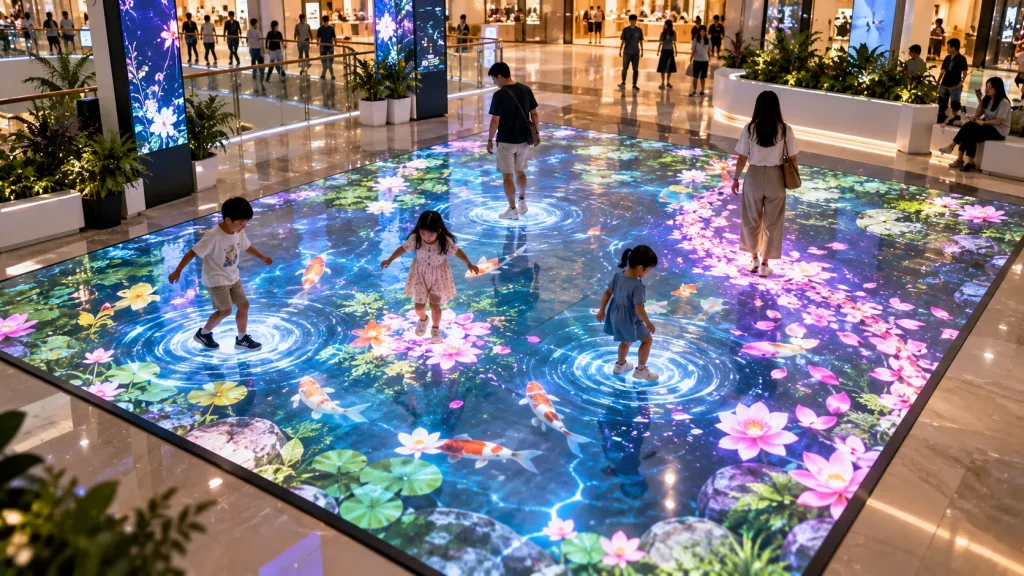
Interactive floor ideas turn ordinary walking surfaces into engaging digital experiences that respond to footsteps, movement, position or physical pressure.
Unlike conventional display screens, an interactive floor uses the ground itself as part of the experience. Visitors can walk across digital environments, trigger animations, complete challenges or explore educational content through natural body movement.
Interactive floors can be created using projection, pressure-sensitive LED floor systems or other suitable technologies. The right approach depends on the space, visitor flow, lighting conditions and intended interaction.
Here are 10 interactive floor concepts for corporate events, shopping malls, museums, visitor centres and permanent installations in Malaysia.
1. Digital Water Ripple Floor
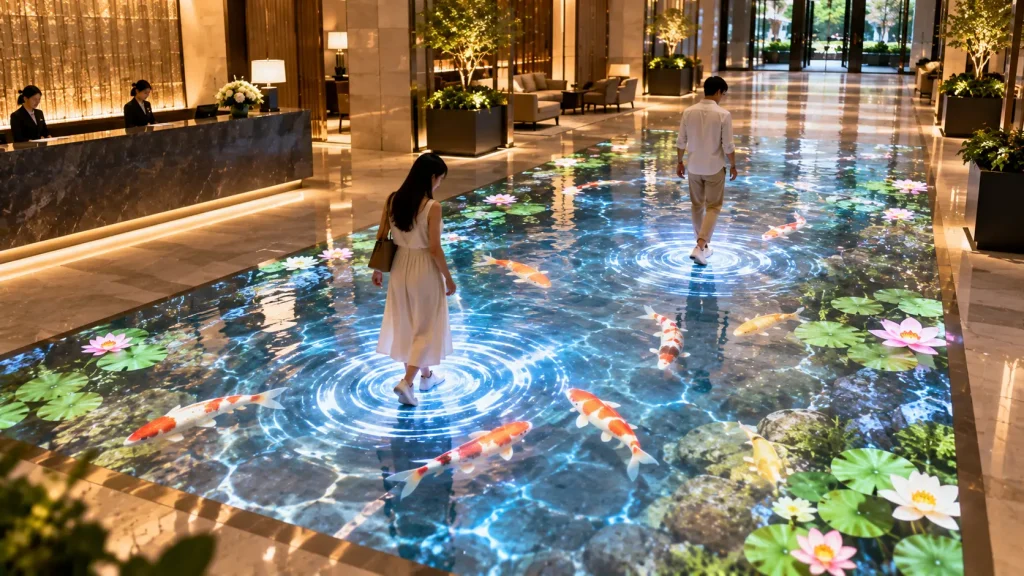
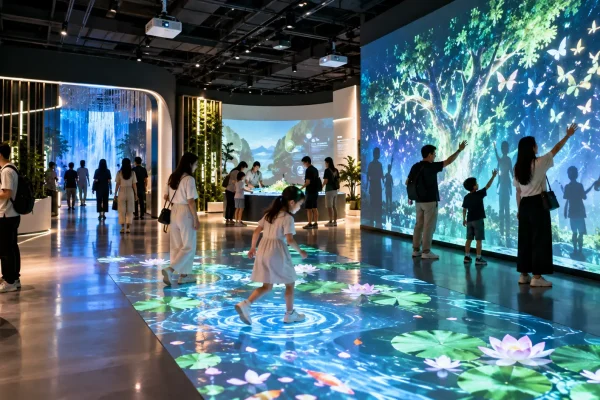
A digital water ripple floor transforms an entrance or walkway into a calm, responsive environment.
As visitors walk across the surface, circular water ripples spread outward from their footsteps. Digital fish, floating leaves or gentle reflections can move naturally around them.
The effect works especially well in a lobby or transition area because visitors can understand the interaction immediately without instructions.
For hospitality and premium brand environments, the visuals can be designed to complement the surrounding interior rather than appear like an arcade game.
How it works:
Overhead motion tracking detects visitor positions and movement. Interactive software generates water ripples and related visual effects at the corresponding floor locations.
Best for:
Hotel lobbies, shopping malls, premium events, visitor centres and immersive entrances.
2. Follow the Light Path
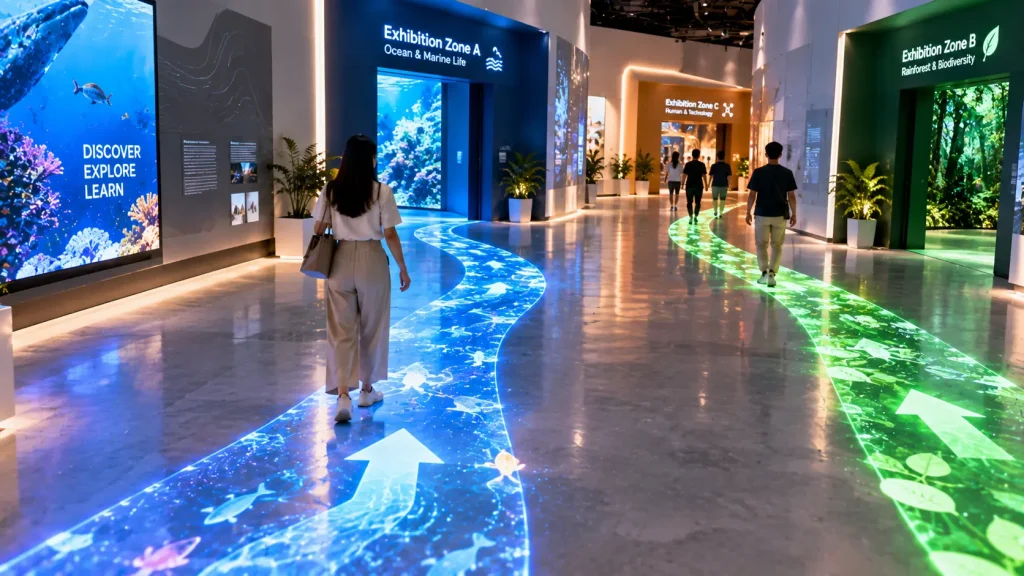
This concept uses an interactive floor to guide visitors through a space.
When a visitor approaches, a glowing pathway appears beneath their feet and gradually extends towards the next destination.
Different routes can use different colours or visual themes. For example, a visitor centre might guide guests towards separate exhibition zones, while a brand experience centre could use the pathway to introduce different chapters of a story.
The experience combines wayfinding with a visual effect that makes movement through the space more memorable.
How it works:
Presence or movement tracking activates predefined animated pathways. The routes are coordinated with the actual floor layout and visitor circulation plan.
Best for:
Experience centres, exhibition entrances, museums, corporate galleries and themed attractions.
3. Interactive Lava Escape
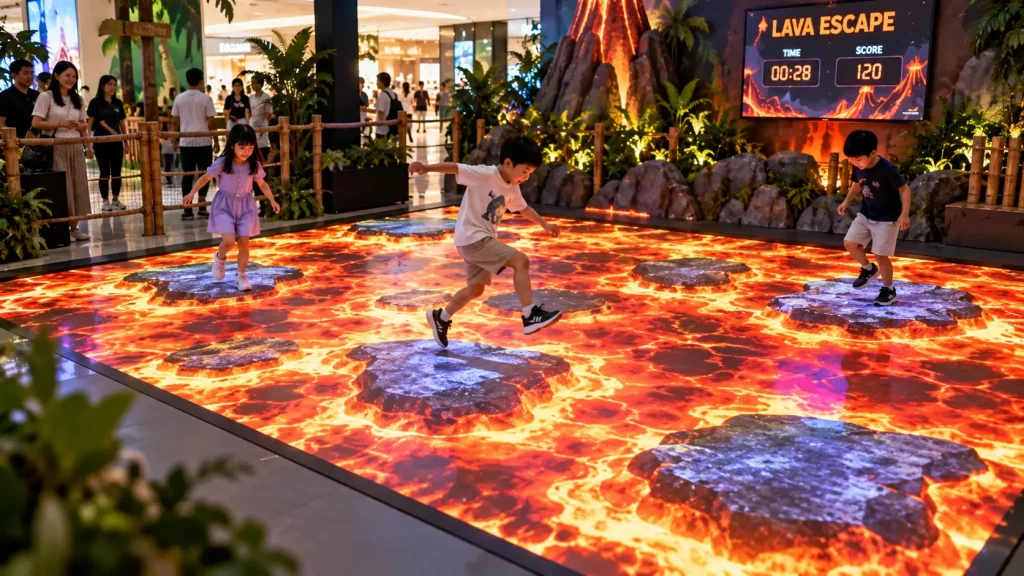
An ordinary floor becomes a playful volcanic environment where visitors must avoid stepping on digital lava.
Safe zones appear as rocks or platforms, while the surrounding surface changes into animated lava. Players move between safe areas before the next section becomes active.
The experience can be designed as a short timed challenge, making it suitable for high-traffic family attractions.
Difficulty levels can be adjusted based on player age, available space and expected visitor turnover.
How it works:
Overhead tracking identifies player positions. The software checks whether each player is standing inside a safe zone and updates the game accordingly.
Best for:
Shopping malls, family entertainment, children’s events, roadshows and interactive play zones.
4. Step-to-Grow Digital Garden
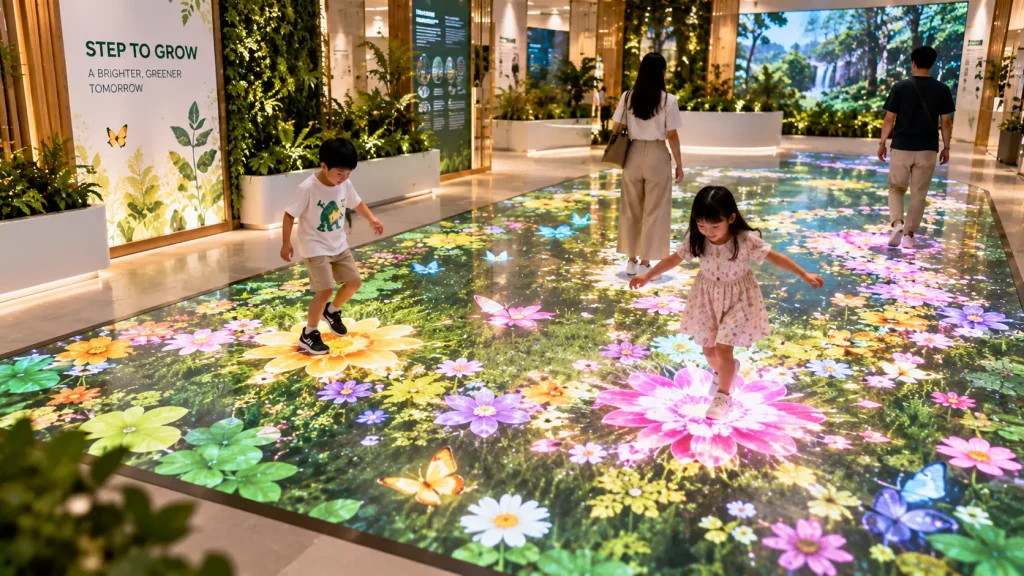
A digital garden begins as an empty landscape. Every visitor’s footsteps cause flowers, grass or plants to grow across the floor.
As more people enter, the garden becomes richer and more colourful. Butterflies or other small environmental elements can appear as the collective activity increases.
This concept turns ordinary movement into a shared creative experience rather than a competition.
It can also support sustainability or nature-related storytelling when the visuals are designed around a specific campaign message.
How it works:
Movement tracking identifies foot positions and triggers growth animations. The software can maintain the garden’s progress for a defined period before gradually resetting the environment.
Best for:
Sustainability exhibitions, shopping malls, public installations, family attractions and visitor centres.
5. Interactive Floor Piano
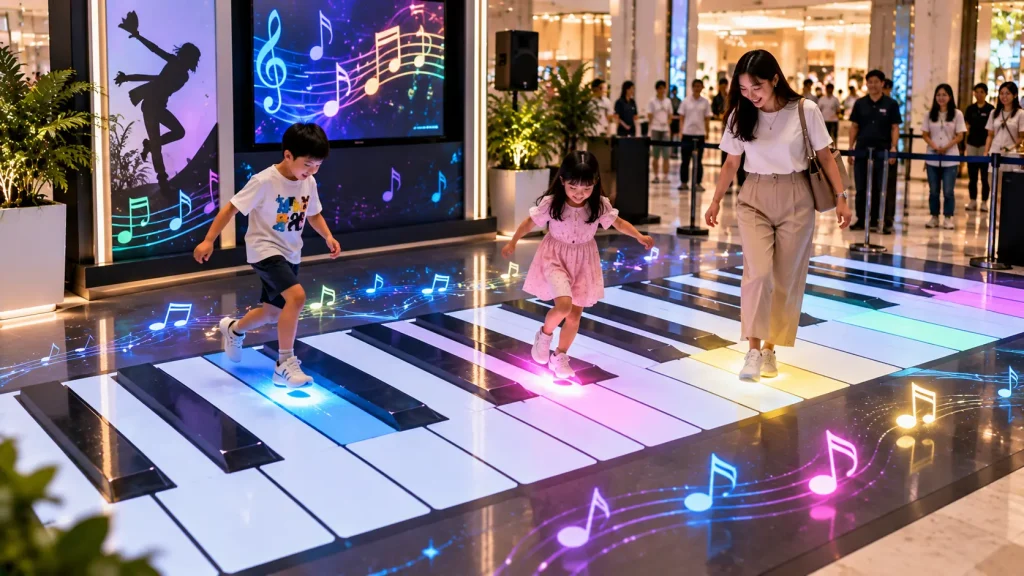
A large digital piano keyboard is displayed across the floor, allowing visitors to create music by stepping on different keys.
Each key produces a corresponding note and visual response. Several visitors can participate together, creating a collaborative musical experience.
The floor can also introduce simple guided challenges, such as following a sequence of illuminated notes to complete a melody.
Unlike a conventional touchscreen music game, the entire body becomes part of the interaction.
How it works:
Position tracking or pressure-sensitive floor hardware detects which keys are activated. The system triggers synchronised sound and visual feedback.
Best for:
Shopping malls, music-themed events, children’s attractions, educational exhibitions and public spaces.
6. Digital Football Target Challenge
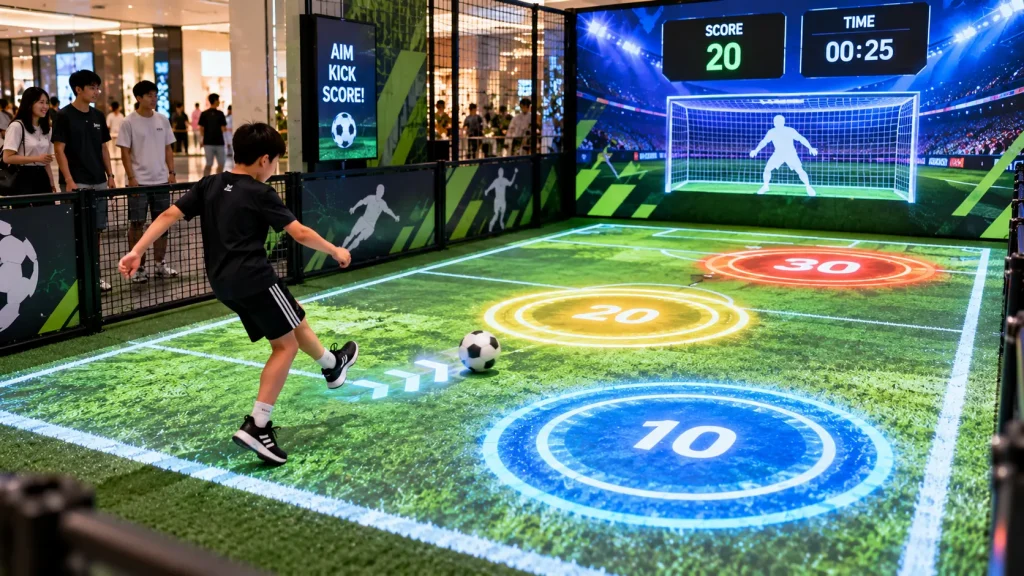
A digital football challenge can combine a real ball with an interactive floor environment.
Visitors kick a soft ball towards designated floor targets. Each successful target activates an animation and contributes to the player’s score.
The game can include different target sizes, moving objectives or a limited time for each round.
For sports brands and event organisers, the visual theme can be adapted to a football campaign, tournament or branded challenge.
How it works:
A suitable tracking system identifies the ball’s movement or target contact. Interactive software updates the score and triggers the corresponding animation.
Best for:
Sports activations, shopping mall roadshows, brand campaigns and family entertainment events.
7. Interactive Learning Floor
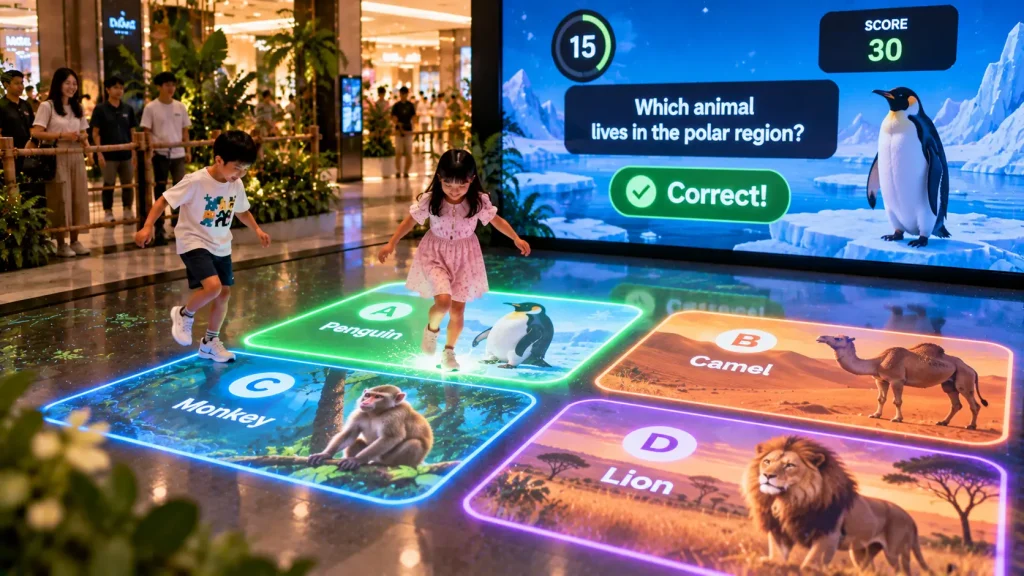
An interactive learning floor turns educational content into a movement-based activity.
Children might step on the correct animal habitat, identify shapes, solve simple maths questions or move between different planets in the solar system.
Instead of answering questions through a touchscreen, participants physically move to the answer they believe is correct.
The learning content can be adapted to different age groups and educational objectives.
How it works:
The system displays questions and answer zones on the floor. Position tracking detects the selected area and provides visual or audio feedback.
Best for:
Schools, museums, science centres, children’s discovery centres and educational exhibitions.
8. Interactive Digital Footprint Journey
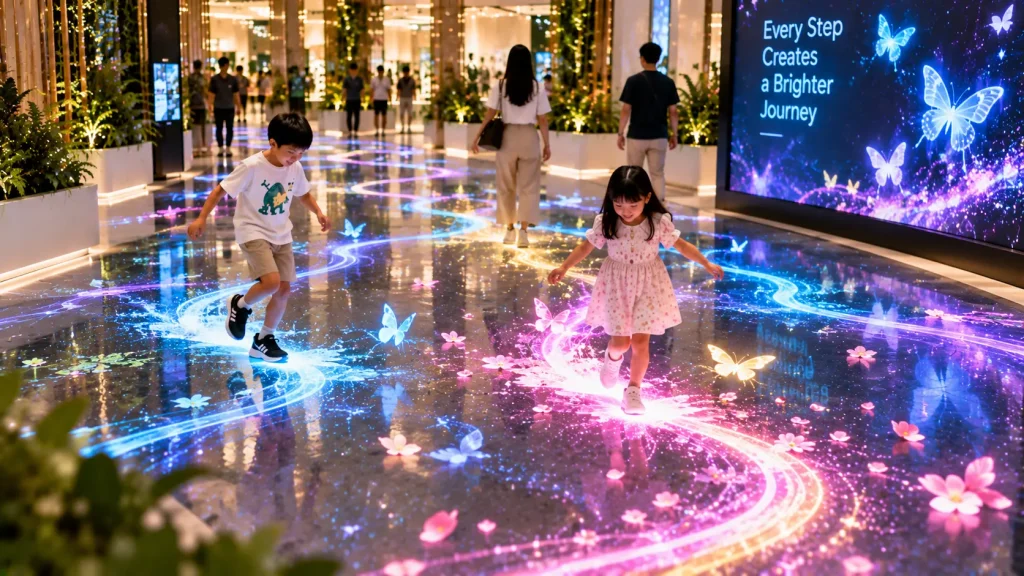
This concept allows visitors to see the digital footprint of their movement across a space.
As someone walks, a trail of light, particles or animated symbols follows their route. Different visitors can generate different colours, creating overlapping patterns across the floor.
The experience can become a collective artwork as more visitors participate.
For a brand installation, the trails could gradually form a larger visual pattern or reveal a campaign message once enough movement has been detected.
How it works:
Overhead tracking records visitor movement and generates a temporary visual trail. The trails can fade automatically or contribute to a shared animation.
Best for:
Corporate events, shopping malls, digital art installations, exhibition entrances and brand activations.
9. Interactive Floor Map Explorer
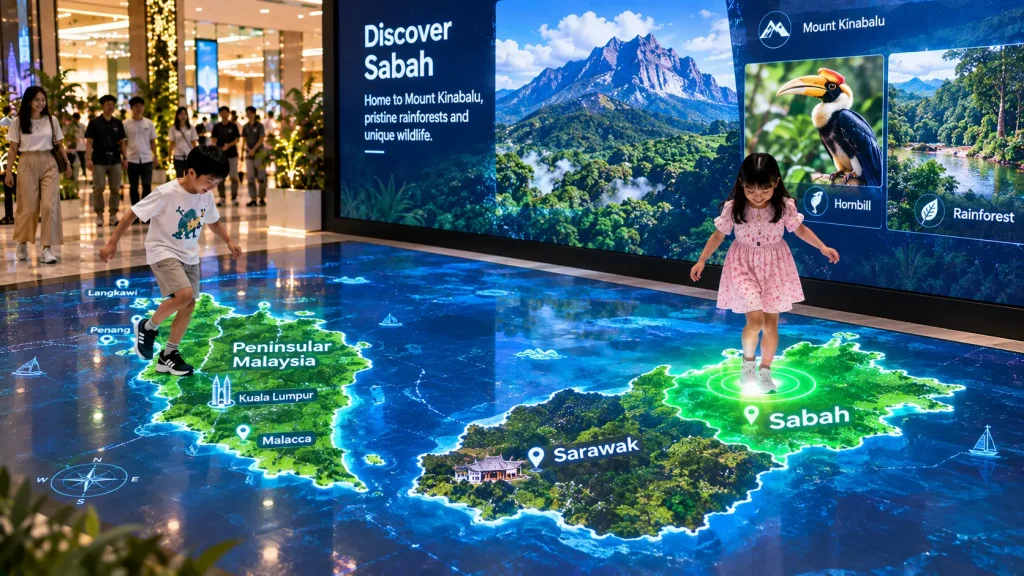
A large geographical map is projected onto the floor, allowing visitors to explore destinations by physically walking onto them.
For example, a Malaysia tourism installation could display different states across the floor. Stepping onto Sabah might activate wildlife visuals, while stepping onto Penang could reveal heritage attractions.
Additional content can appear on a nearby wall display so visitors do not need to read detailed information directly from the floor.
This concept combines geographical discovery with movement-based learning.
How it works:
Position tracking identifies the selected map region. The interactive software triggers the corresponding floor animation and synchronised content on an additional display.
Best for:
Tourism centres, museums, educational galleries, government exhibitions and visitor centres.
10. Collaborative Energy Floor
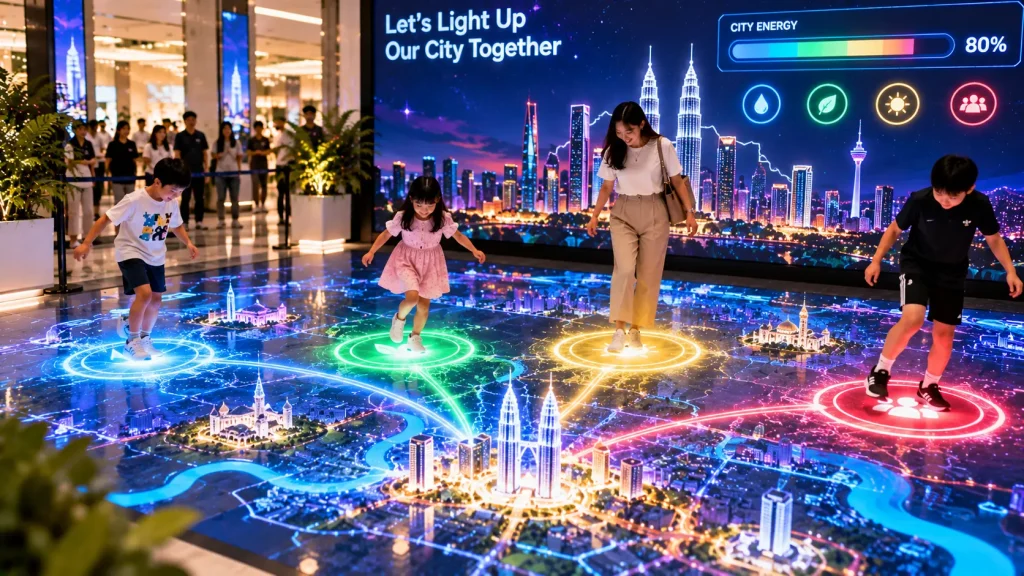
A collaborative energy floor encourages several visitors to activate an installation together.
Different zones on the floor represent energy sources or parts of a shared system. Visitors must occupy or activate the required zones to generate energy and complete a collective objective.
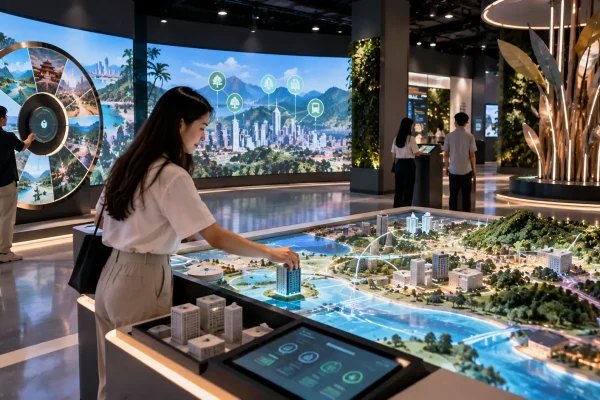
For example, when enough participants activate the correct areas, a digital city on the surrounding wall gradually lights up.
The experience communicates teamwork and collective contribution rather than individual competition.
How it works:
Position tracking or suitable pressure-sensitive hardware detects activity across multiple zones. The software combines these inputs to control the shared progress and audiovisual response.
Best for:
Corporate team-building, sustainability centres, science exhibitions, school programmes and brand experiences.
Which Interactive Floor Concept Is Best for Your Project?
| Project Objective | Recommended Concept |
|---|---|
| Create an immersive entrance | Digital Water Ripple Floor |
| Guide visitors through a space | Follow the Light Path |
| Attract families with a game | Interactive Lava Escape |
| Communicate nature and sustainability | Step-to-Grow Digital Garden |
| Create a musical experience | Interactive Floor Piano |
| Support a sports campaign | Digital Football Target Challenge |
| Encourage movement-based learning | Interactive Learning Floor |
| Create collaborative digital artwork | Interactive Digital Footprint Journey |
| Explore geographical destinations | Interactive Floor Map Explorer |
| Encourage teamwork | Collaborative Energy Floor |
How Does an Interactive Floor Work?
An interactive floor combines a visual display system, movement detection and interactive software to create an experience that responds to visitors.
For a projection-based interactive floor, the typical process is:
Visitor Movement → Sensor Detection → Interactive Software → Floor Visual Response
For example, when a visitor steps onto a projected water surface, an overhead tracking system detects their position. The software then generates digital ripples at the corresponding location.
Not every interactive floor requires pressure-sensitive flooring. Many interactive projection installations use cameras or depth sensors to detect movement without modifying the floor structure.
Interactive Floor Projection vs LED Floor: Which Is Better?
Interactive floor projection and LED floor systems serve different installation requirements.
| Consideration | Interactive Floor Projection | LED Floor System |
|---|---|---|
| Visual Technology | Overhead projector | Floor-rated LED panels |
| Interaction Detection | Camera, depth sensor or other tracking | External sensors or integrated sensing where supported |
| Lighting Conditions | Best with controlled ambient light | Generally more suitable for brighter spaces |
| Floor Requirements | Suitable projection surface | Structural support and dedicated floor installation |
| Installation Flexibility | Often suitable for temporary installations | Requires more substantial physical installation |
| Typical Applications | Interactive games, museums and exhibitions | Permanent attractions and high-brightness installations |
Important: A standard LED floor does not automatically detect footsteps. Interactive functionality requires a compatible sensing system and software.
Projection is often a practical option for temporary event activations, while purpose-built LED flooring may be considered when brightness, durability and long-term operation are priorities.
What Sensors Are Used for Interactive Floor Installations?
The appropriate sensor depends on whether the installation needs to detect visitor presence, foot position, body movement or physical pressure.
- Depth Camera: Detects movement and position, depending on mounting height, field of view and environmental conditions.
- Computer Vision Camera: Uses image-processing software to identify movement or objects within the monitored area.
- LiDAR: Can support spatial tracking and position detection in suitable installations.
- Pressure Sensors: Detect physical force or contact at designated floor locations.
- Ball or Object Tracking: Uses suitable cameras or sensors to track physical objects in specific games.
Sensor selection should be confirmed during technical planning. The detection area, number of simultaneous visitors, mounting positions and required tracking accuracy all affect performance.
What Floor Surface Is Suitable for Interactive Projection?
A smooth, stable, matte and relatively light-coloured floor generally provides a better starting point for projection-based installations.
Glossy surfaces may create distracting reflections, while dark or heavily patterned flooring can reduce image visibility.
Depending on the project, suitable options may include a prepared exhibition floor, a dedicated projection surface or an appropriately rated floor covering.
For public installations, the surface must also be appropriate for pedestrian traffic, cleaning and slip resistance.
A floor that looks good for projection is not necessarily safe for visitors, so both visual quality and physical safety must be evaluated.
How Much Space and Ceiling Height Are Required?
There is no universal minimum size for an interactive floor. Requirements depend on the intended projection area, projector throw ratio, sensor coverage and visitor capacity.
Key considerations include:
- Floor interaction area and available walking space
- Ceiling height and projector mounting position
- Projector brightness and image coverage
- Sensor field of view and tracking accuracy
- Potential shadows and projector obstruction
- Nearby ambient lighting
- Safe entry, exit and circulation routes
Low ceilings may require short-throw projection solutions or changes to the installation layout. The final equipment specification should be based on the actual site dimensions rather than a fixed projector recommendation.
Can Interactive Floors Support Multiple Players?
Yes. Interactive floors can be designed for individual visitors or multiple simultaneous participants.
However, the maximum number of players depends on the tracking system, interaction area, software design and expected movement patterns.
For example, a digital water ripple floor may allow several visitors to interact freely, while a competitive game may require clearly defined player zones to prevent tracking conflicts.
For public exhibitions, the interaction should remain understandable even when several people enter or leave unexpectedly.
Are Interactive Floors Safe for Public Events?
Safety should be considered from the beginning of the installation design.
Interactive floor experiences should avoid encouraging uncontrolled running, collisions or sudden movements in unsuitable spaces.
Important considerations include slip resistance, cable management, floor level changes, equipment mounting, crowd flow and accessibility.
For games involving jumping, kicking or rapid movement, the physical play area should be reviewed carefully. Additional supervision or safety boundaries may be required.
Public installations should also use suitable equipment and materials for their intended traffic and operating environment.
What Affects Interactive Floor Installation Cost in Malaysia?
The cost of an interactive floor in Malaysia depends on the technology, installation area, game complexity and project duration.
Major cost factors include:
- Projection area and projector specifications
- Number and type of tracking sensors
- Custom game or interactive software development
- Content design and animation
- Floor surface preparation
- Mounting structure and cabling
- Audio integration and additional displays
- Temporary rental or permanent installation
- On-site setup, calibration and testing
- Technical support and maintenance
A simple motion-reactive projection floor and a custom multiplayer installation can have very different budgets.
For accurate pricing, the installation area, technical environment and required experience should be confirmed before preparing a quotation.
What Information Is Needed for an Interactive Floor Quotation?
To evaluate an interactive floor project, prepare the following details:
- Event date or target installation date
- Venue and project location
- Available floor dimensions
- Ceiling height
- Photos or videos of the installation area
- Indoor lighting conditions
- Preferred interactive floor concept
- Expected number of simultaneous players
- Temporary or permanent installation
- Existing projector or AV equipment, if any
- Indicative budget, if available
Frequently Asked Questions About Interactive Floors
Does an interactive floor require a special floor?
Not always. Projection-based interactive floors can use a suitable existing or prepared surface. Pressure-sensitive and LED floor systems may require dedicated flooring hardware.
Can an interactive floor work in a bright shopping mall?
It may be possible, but ambient light can significantly affect projection visibility. The site should be evaluated to determine whether a brighter projection system, lighting control or an alternative display technology is appropriate.
Can interactive floor games be customised with a company logo?
Yes. Suitable games can incorporate brand colours, logos, themed visuals, scoring systems and campaign messages.
Can the interactive floor operate automatically?
Yes. Depending on the system, an installation can run continuously, return to an attract-mode animation when idle and activate automatically when visitors enter the tracking area.
Interactive Floor Design & Installation in Malaysia
MyDigital Asia provides custom interactive technology solutions in Malaysia for corporate events, exhibitions, shopping malls, museums and experience centres.
Depending on project requirements, an interactive floor solution can combine projection mapping, motion tracking, custom interactive software, branded game development and audiovisual integration.
Planning an interactive floor installation? Share your venue photos, floor dimensions, ceiling height, event date and preferred concept with MyDigital Asia to discuss technical feasibility and quotation requirements.
Related Interactive Technology Guides
- Interactive Installation Malaysia
- Sensor-Based Interactive Installation Guide
- 10 Sensor-Based Interactive Installation Ideas
- 10 Immersive Room Ideas
- 10 Interactive Exhibition Booth Ideas
Request a Free Consultation
Looking for Interactive Maps, Interactive Solutions or Event Technology?

LATEST POSTS