
10 Interactive Exhibition Booth Ideas to Attract Visitors
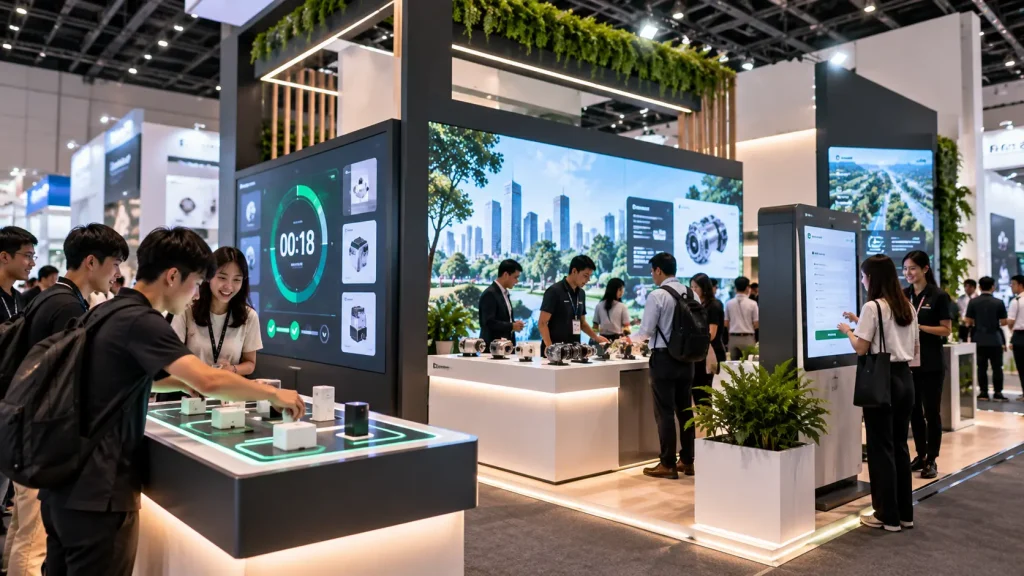
Looking for interactive exhibition booth ideas that can actually help people stop, participate and remember your brand?
A good exhibition activation should do more than add another touchscreen to the booth. It should support a clear objective: attract passing visitors, explain a product, collect leads, encourage participation or increase the amount of time people spend at your booth.
Here are 10 interactive exhibition booth ideas built around different visitor behaviours and business goals.
1. Beat the Clock Challenge
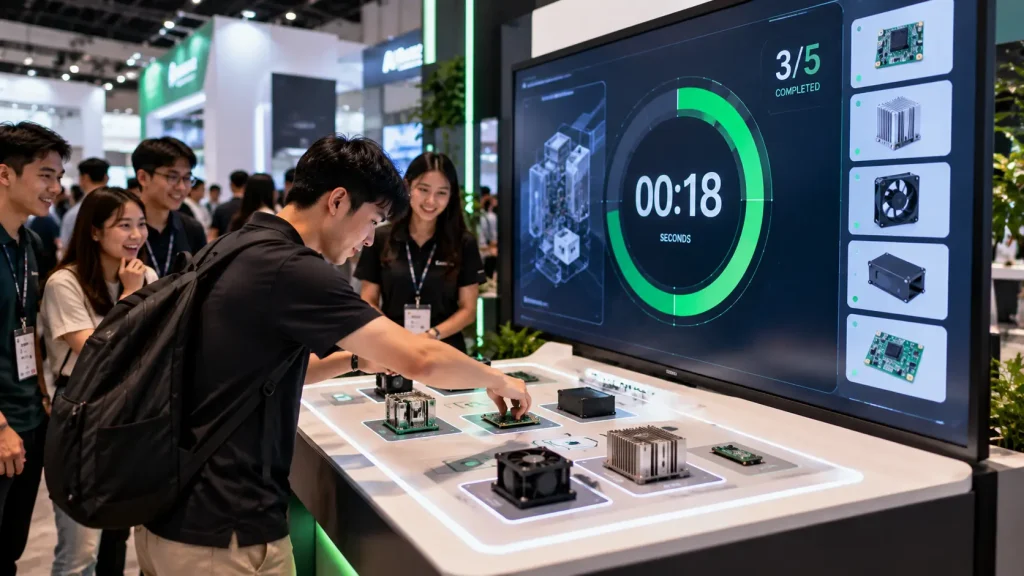
Give visitors a simple challenge they must complete before the timer reaches zero.
The activity can be adapted to the brand: arrange products correctly, identify the right answer, tap a sequence, complete a matching task or solve a short puzzle within 30 seconds.
A visible countdown and live score make the activity easy for people outside the booth to understand, which can also attract spectators.
How it works:
Start Challenge → Complete Task → Timer Stops → Score Appears
Best for: Roadshows, consumer brands, technology exhibitions and high-traffic trade shows.
2. Mystery Box Challenge
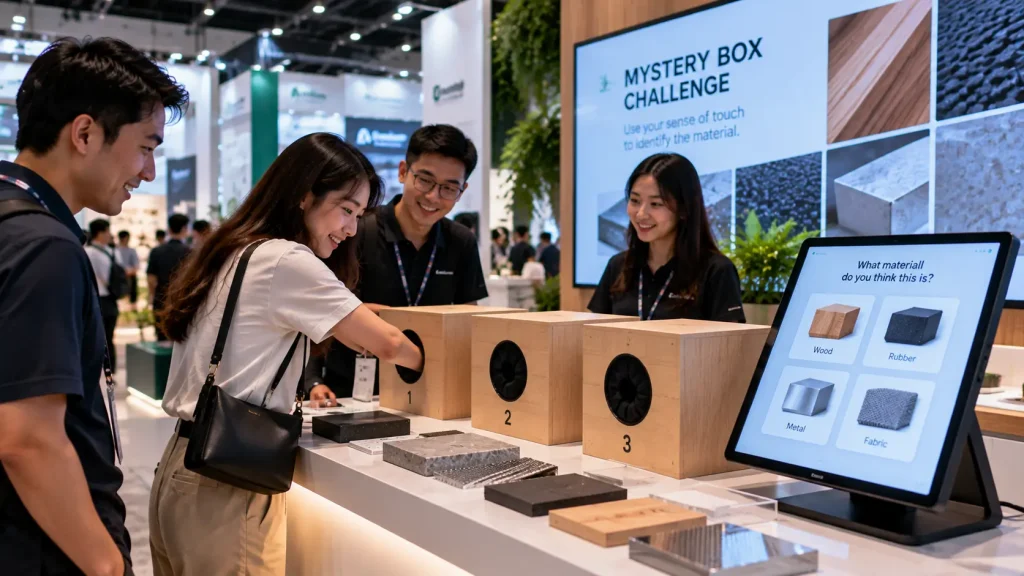
A mystery box adds a physical element to the booth instead of making every interaction screen-based.
Visitors place their hand inside a concealed box and identify a product, material, texture or object using touch. Their answer can then be submitted through buttons or a small digital interface.
The screen reveals whether the answer is correct and can immediately connect the object to the product story.
For example, a materials company could ask visitors to identify different surfaces, while a food or consumer brand could use packaging or product-related objects.
How it works:
Touch Hidden Object → Make a Guess → Submit Answer → Reveal Result
Best for: Consumer products, materials, manufacturing, food brands and educational exhibitions.
3. Build Your Own Product Station
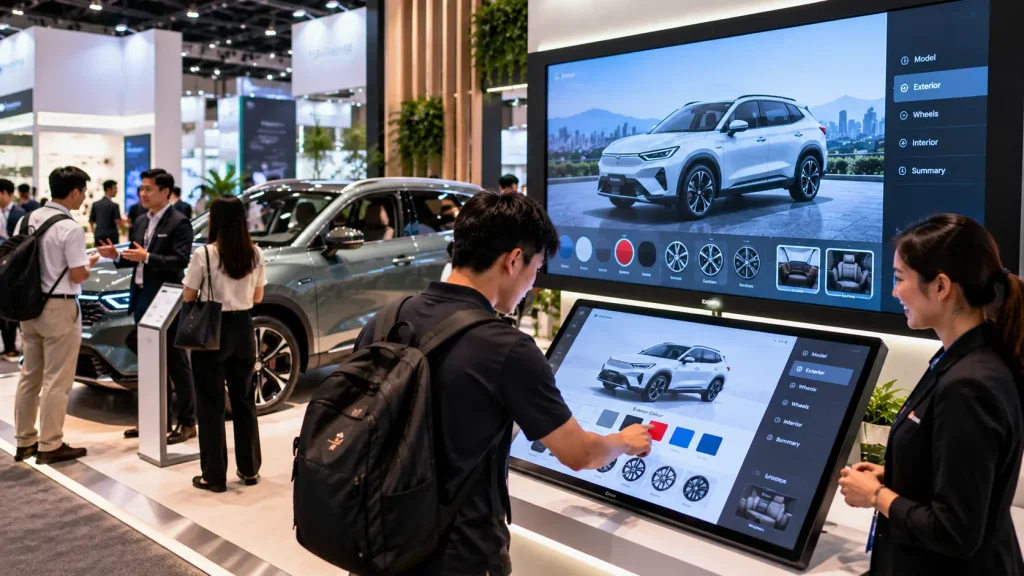
Instead of simply showing a finished product, let visitors create their own version.
Visitors can choose colours, materials, components, features or packages through an interactive interface. The product changes visually as each option is selected.
For automotive brands, this could be a vehicle configurator. For property, visitors could customise a room. For consumer products, they might create their preferred packaging or product combination.
The final configuration can be saved through a QR code, giving visitors something personalised to take away.
How it works:
Choose Product → Select Options → See Live Changes → Generate Personalised Result
Best for: Automotive, property, furniture, electronics, manufacturing and configurable products.
4. Digital Prize Vault
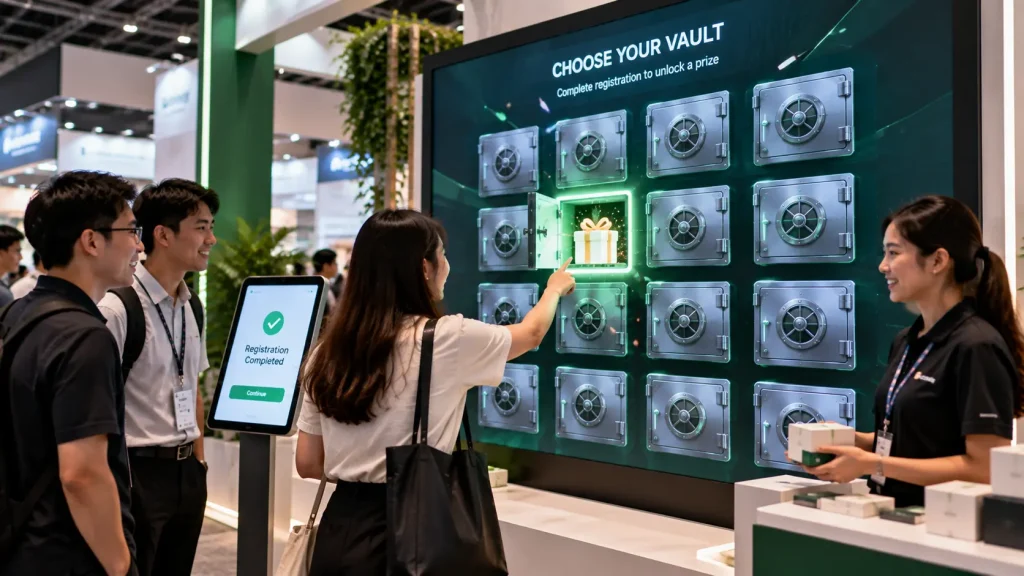
Turn a giveaway into part of the exhibition experience.
After completing a registration form or another required action, the visitor gets a chance to choose one of several digital vaults, boxes or doors displayed on a screen.
The selected vault opens to reveal a prize, voucher or reward. The system can control prize quantities in the background so higher-value rewards remain limited.
This creates a stronger visual moment than simply handing out a gift after registration.
How it works:
Register → Unlock Game → Choose Vault → Reveal Prize → Redeem
Best for: Lead-generation campaigns, corporate exhibitions, consumer brands and product roadshows.
5. RFID Product Discovery Table
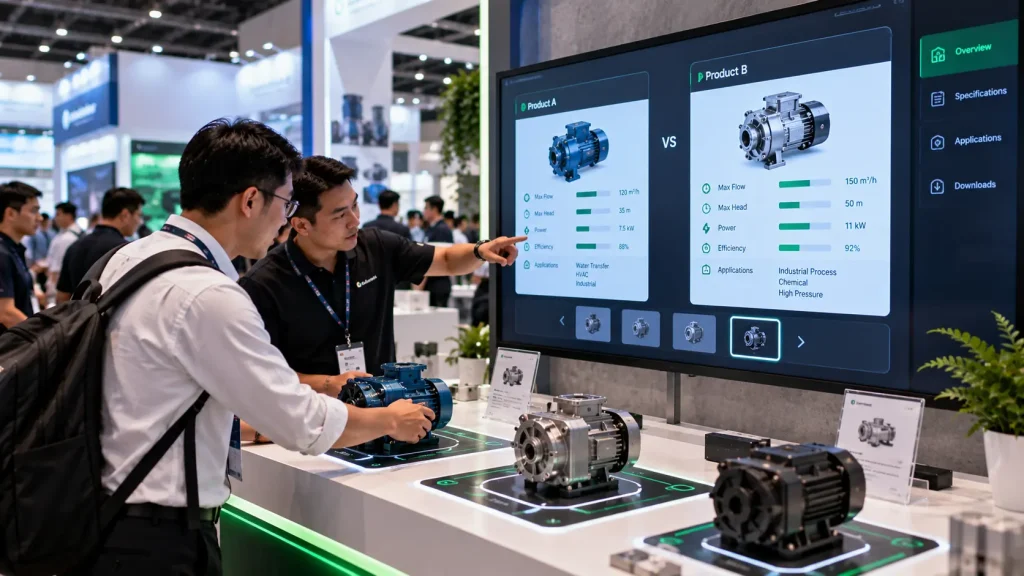
An RFID discovery table lets visitors explore products by moving physical cards, samples or tokens rather than navigating a conventional menu.
Each object contains an RFID or NFC tag. When it is placed on the reading area, the system recognises it and displays the corresponding product information.
Two products can also be placed together to trigger a comparison of specifications, applications or benefits.
This works particularly well when the exhibitor has many products that look similar but serve different purposes.
How it works:
Pick Product / Token → Place on Reader → Product Recognised → Content Appears → Compare
Best for: Industrial products, electronics, building materials, healthcare products and technology exhibitions.
6. Human Energy Challenge
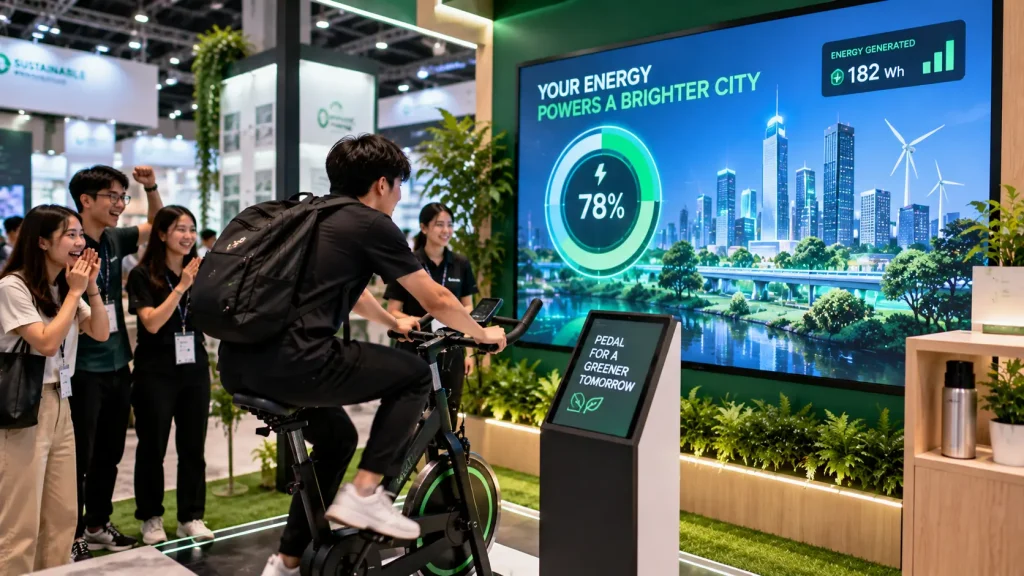
Make visitors physically generate the energy needed to complete a digital challenge.
The participant might pedal a bicycle, turn a wheel, pull a handle, step repeatedly or perform another physical action. A connected sensor measures the activity and converts it into progress on a large display.
The faster or harder the participant moves, the faster the digital meter fills.
The concept can be themed around sustainability, performance, speed, power or teamwork depending on the brand.
How it works:
Physical Action → Sensor Measures Input → Digital Meter Increases → Reach Target
Best for: Energy companies, automotive brands, sustainability campaigns, sports brands and public exhibitions.
7. Collaborative Puzzle Wall
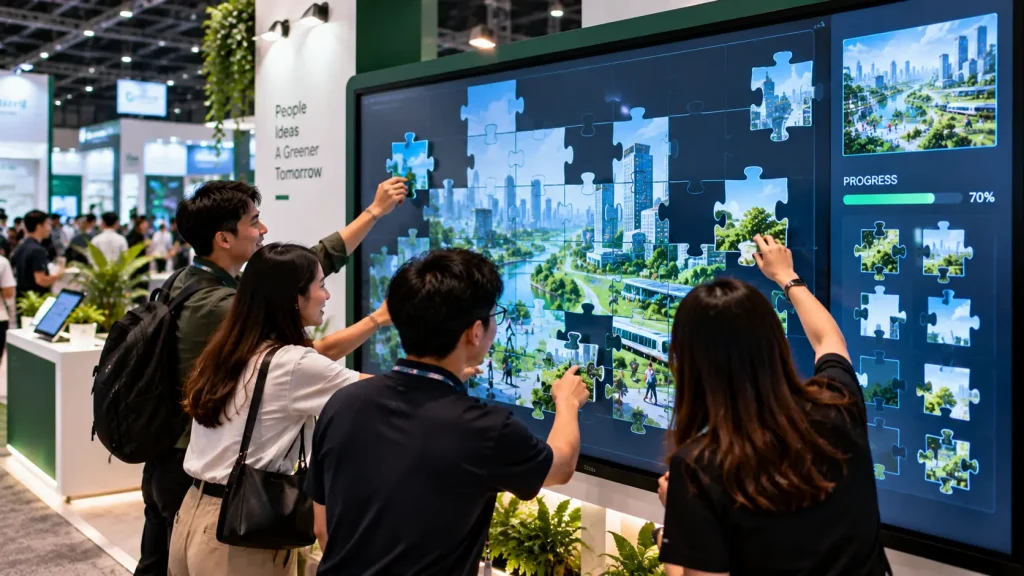
Not every exhibition game needs to create competition. A collaborative wall encourages visitors to complete something together.
Participants may need to move pieces, activate different areas, answer questions or complete separate parts of one larger digital puzzle.
When enough people contribute, the wall reveals the completed image, message, product or campaign visual.
This works well for brands that want the interaction to communicate teamwork, community or collective achievement.
How it works:
Visitors Join → Complete Individual Tasks → Progress Combines → Final Visual Unlocks
Best for: Corporate exhibitions, recruitment fairs, community campaigns and team-focused brands.
8. Live Poll & Data Wall
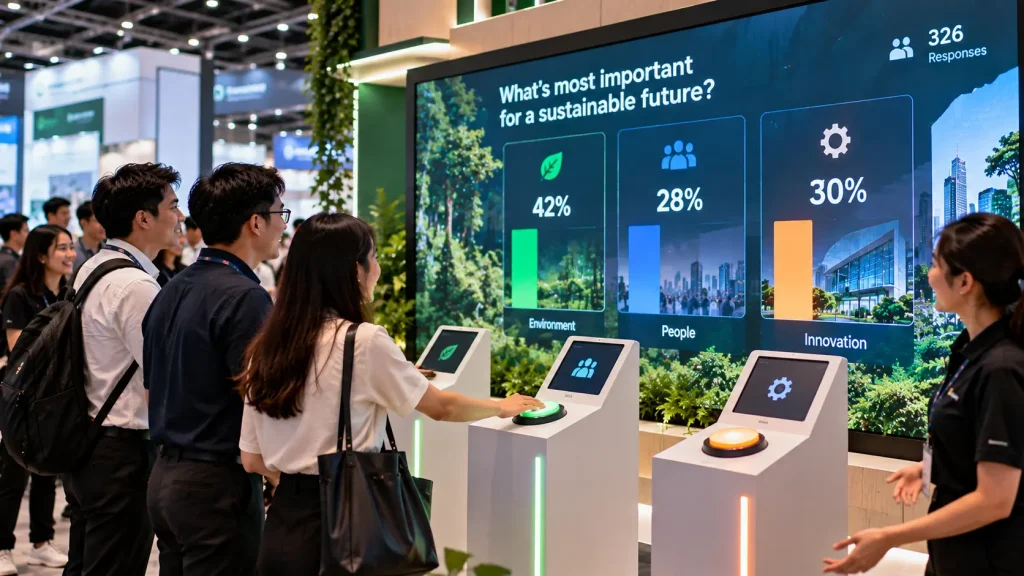
Ask every booth visitor one useful question and turn their answers into live exhibition content.
Visitors vote using a touchscreen, tablet, QR code or physical buttons. Their answers immediately update a large visualisation showing percentages, charts or other simple data graphics.
For a technology exhibition, the question might be about future industry priorities. At a sustainability event, visitors might vote on the environmental issue they consider most important.
As more people participate, the wall becomes a live snapshot of what exhibition visitors think.
How it works:
Answer Question → Submit Vote → Data Updates → Live Results Displayed
Best for: Conferences, B2B exhibitions, corporate booths, education events and industry showcases.
9. Personalised Takeaway Generator
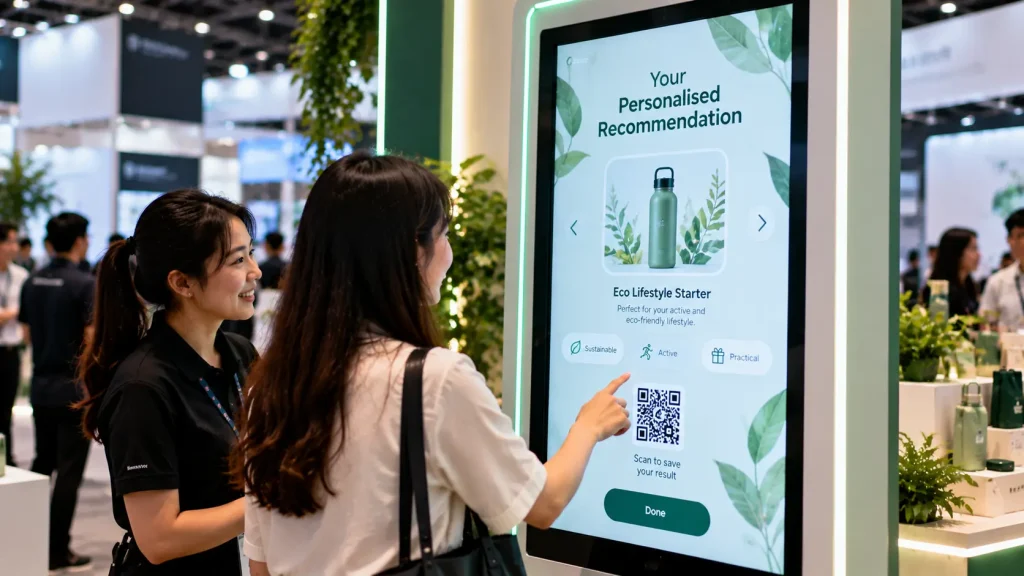
Give visitors a result that is useful after they leave the booth.
The visitor answers several short questions about their needs, preferences or situation. The system then generates a personalised recommendation, profile or suggested solution.
Instead of printing everything, the final result can be accessed through a QR code and saved on the visitor’s phone.
For B2B exhibitors, this can also help turn a generic registration into a more useful lead by identifying what the visitor is actually interested in.
How it works:
Answer Questions → System Analyses Choices → Personalised Result → Scan QR to Save
Best for: B2B services, property, financial services, healthcare, education and solution-based products.
10. Booth Mission & Digital Passport Challenge
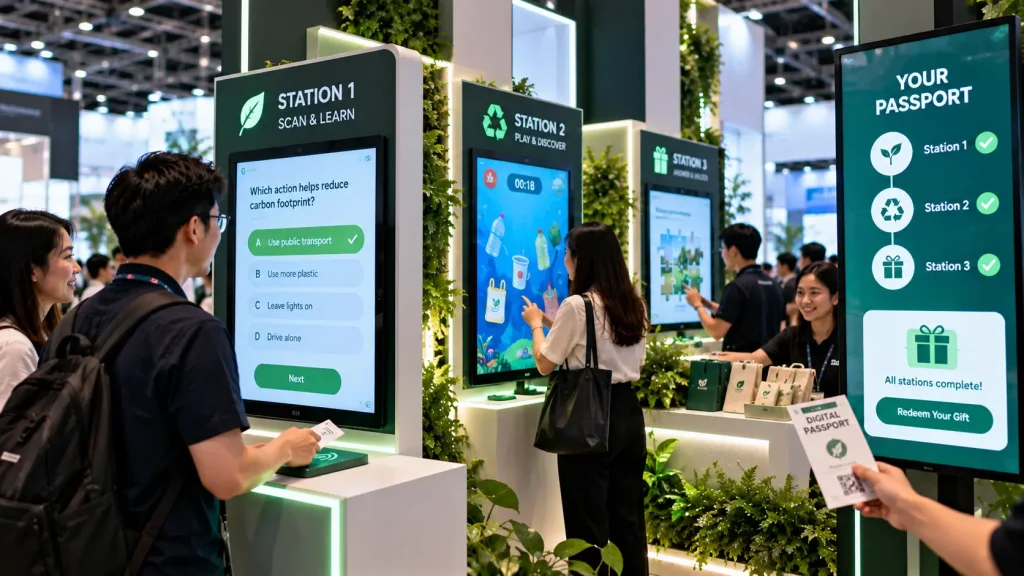
Instead of asking visitors to interact with only one station, turn the entire booth into a short mission.
Visitors complete several checkpoints around the booth. Each checkpoint might involve scanning a QR code, tapping an RFID card, answering a question, discovering product information or completing a small activity.
Each completed station earns a digital stamp. After collecting all required stamps, the visitor unlocks a reward or final experience.
This encourages people to explore more of the booth instead of entering, collecting a brochure and leaving immediately.
How it works:
Start Mission → Visit Checkpoints → Collect Digital Stamps → Complete Passport → Unlock Reward
Best for: Large exhibition booths, product ecosystems, tourism exhibitions, universities and multi-zone brand experiences.
Choose the Idea Based on Your Exhibition Goal
| Your Main Goal | Interactive Idea |
|---|---|
| Stop passing visitors | Beat the Clock Challenge |
| Create curiosity | Mystery Box Challenge |
| Explain product options | Build Your Own Product |
| Collect leads | Digital Prize Vault |
| Compare multiple products | RFID Product Discovery |
| Attract a crowd | Human Energy Challenge |
| Encourage group participation | Collaborative Puzzle Wall |
| Collect audience opinions | Live Poll & Data Wall |
| Create a personalised follow-up | Personalised Takeaway Generator |
| Increase booth dwell time | Booth Mission & Digital Passport |
What Makes an Exhibition Booth Interactive?
An interactive exhibition booth gives visitors something meaningful to do rather than only something to look at.
The interaction might involve completing a challenge, configuring a product, answering a question, moving a physical object, collecting digital stamps or generating a personalised result.
The best interactive exhibition booth ideas connect that action to a business objective such as attracting visitors, explaining products, collecting leads or increasing booth dwell time.
Which Interactive Idea Works for a Small Exhibition Booth?
A small booth does not necessarily need a large LED wall or complicated installation.
Compact concepts such as a Digital Prize Vault, Personalised Takeaway Generator, Mystery Box Challenge or Build Your Own Product Station can operate from a touchscreen, tablet or small physical station.
For limited spaces, it is usually better to create one clear interaction with a short visitor flow than to fit several activities into the same booth.
How Can an Interactive Booth Help Collect Leads?
Lead collection works best when registration is naturally connected to the experience.
For example, visitors might register before unlocking a prize vault, enter their details to receive a personalised result, or submit their information before starting a digital passport challenge.
Depending on the project, the system can collect information such as:
- Name and contact details
- Company and job role
- Product interests
- Survey or quiz responses
- Selected product configurations
- Game scores
- Completed booth activities
The amount of information requested should remain appropriate for the experience. A 30-second game should not begin with a long registration form.
Should Visitors Register Before or After Playing?
It depends on the objective.
| Registration Flow | When It Works Well |
|---|---|
| Register Before | When participation is directly linked to lead generation, prize redemption or personalised results |
| Register After | When the priority is attracting as many visitors as possible before requesting information |
| No Registration | When the activity is mainly for crowd engagement or brand awareness |
For busy exhibitions, reducing the number of steps before the interaction can help keep the queue moving.
Does an Interactive Exhibition Booth Need Wi-Fi?
Not always.
Many exhibition games and touchscreen applications can run locally from a dedicated computer without relying on venue Wi-Fi.
An internet connection may be required for cloud databases, online registration, QR-based experiences, remote APIs or content that needs to synchronise between different systems.
For important event applications, an offline or local fallback should be considered where technically possible instead of depending entirely on public exhibition Wi-Fi.
How Long Should an Exhibition Booth Activity Take?
For high-traffic exhibitions, a simple activity can often be completed within approximately 30 seconds to 2 minutes.
Fast challenges such as Beat the Clock can be shorter, while product configuration, RFID discovery or a multi-zone booth mission may require more time because the objective is deeper product exploration.
The ideal duration depends on the expected crowd, booth size and business objective.
A longer experience is not automatically better. If the activity creates a queue but does not improve product understanding or lead quality, it may be working against the booth objective.
Can Several Visitors Participate at the Same Time?
Yes. Multi-user interaction can be useful when exhibition traffic is high.
A collaborative puzzle may support several participants at once, while an RFID discovery table can provide multiple product exploration positions. Larger booths can also use several independent stations connected to the same campaign.
Capacity should be planned before development because the number of simultaneous users can affect hardware, sensors, interface design and visitor flow.
Rental System or Custom Development?
Both approaches can work depending on how customised the experience needs to be.
A reusable game format may be suitable when the objective is simple engagement and only the branding, questions or prizes need to change.
Custom development becomes more relevant when the experience needs unique game mechanics, product data, RFID integration, APIs, personalised recommendations or a visitor journey designed specifically around the exhibitor’s products.
| Reusable / Adapted System | Custom Development |
|---|---|
| Faster preparation | Designed around a specific visitor journey |
| Suitable for simpler campaigns | Supports more specialised interactions |
| Branding and content can be changed | Can integrate products, databases or APIs |
| Useful for short-term activations | Useful when the experience itself is a key part of the booth concept |
How to Plan an Interactive Exhibition Booth
Start with the exhibition objective before choosing the technology.
A practical planning sequence is:
Goal → Visitor → Attraction → Interaction → Brand Message → Lead / Outcome.
For example:
Generate Leads → Passing Exhibition Visitors → Digital Prize Vault → Register and Choose a Vault → Product Message Appears → Lead Captured + Prize Redeemed.
Or:
Explain Products → B2B Buyers → RFID Discovery Table → Compare Physical Product Samples → Specifications Displayed → Sales Conversation Begins.
This approach helps avoid adding technology simply because it looks impressive.
Interactive Exhibition Booth Planning Checklist
Before requesting a proposal, prepare the following information where possible:
- Exhibition name and venue
- Event and setup dates
- Booth dimensions
- Booth layout or 3D design if available
- Expected visitor profile
- Main objective: engagement, product education, leads or sales
- Expected number of participants
- Products or services being promoted
- Preferred interactive concept
- Existing LED screens or displays
- Available internet connection
- Required registration fields
- Prize or redemption requirements
- Brand assets and product content
For physical interactive installations, booth drawings are especially useful for checking visitor flow, equipment positioning and available installation space.
Frequently Asked Questions About Interactive Exhibition Booths
What is the best interactive idea for attracting exhibition visitors?
Fast and visually understandable activities such as a Beat the Clock Challenge, Human Energy Challenge or prize-based interaction can work well for attracting passing visitors because spectators can quickly understand what is happening.
What is the best exhibition idea for B2B products?
For B2B exhibitions, interactions that help visitors understand or compare products can be more useful than entertainment alone. RFID Product Discovery, product configurators and personalised recommendation tools can support a sales conversation after the interaction.
Can exhibition games include a leaderboard?
Yes. Scores can be displayed immediately after each game and added to a daily or event-wide leaderboard. This works particularly well for timed challenges and competitive activities.
Can the system export visitor data?
Yes, if data collection is included in the system requirements. Registration information, responses, scores and other relevant interaction data can be structured for export depending on the project.
Can the same interactive system be reused for another exhibition?
In many cases, yes. Reusable software can be updated with new branding, questions, products or campaign content. Hardware and booth fabrication requirements may differ between venues.
How early should an interactive exhibition concept be planned?
Planning should begin once the booth objective, approximate space and event date are known. Concepts involving custom software, physical fabrication, sensors, RFID, product integration or multiple stations generally require more preparation than a simple branded game.
Interactive Exhibition Solutions in Malaysia
MyDigital Asia develops interactive exhibition experiences for trade shows, roadshows, product showcases and brand activations in Malaysia.
Depending on the project, the solution can combine custom software, touchscreen displays, physical buttons, RFID or NFC, sensors, interactive games, registration, scoring, QR experiences and other digital-physical interactions.
The objective is not simply to place more screens inside the booth. The interaction should help the exhibitor attract visitors, communicate the product and create a useful next step after participation.
Planning an Interactive Exhibition Booth?
Send MyDigital Asia your event date, venue, booth size, booth layout, target audience and main campaign objective.
If you have not selected an activity yet, the interactive concept can be developed around the behaviour you want from visitors: stop, play, explore, compare, register or complete a booth journey.
Related Interactive Experience Guides
- Interactive Event Ideas Malaysia
- Interactive Event Technology Malaysia
- Interactive Wall Ideas
- Interactive Installation Malaysia
Request a Free Consultation
Looking for Interactive Maps, Interactive Solutions or Event Technology?

LATEST POSTS