
Immersive Visitor Centre Malaysia
An immersive visitor centre helps people understand a destination, development, attraction or region before they explore it physically.
Instead of relying only on information counters, brochures and static maps, a visitor centre can combine physical models, interactive maps, digital storytelling, projection and immersive experiences to make information easier to discover.
MyDigital Asia develops immersive and interactive visitor centre experiences in Malaysia for tourism destinations, government agencies, city developments, heritage locations, infrastructure projects and public information spaces.
The objective is not simply to digitise existing information. It is to help visitors answer the most important questions quickly: where am I, what is here, what should I explore and why does it matter?
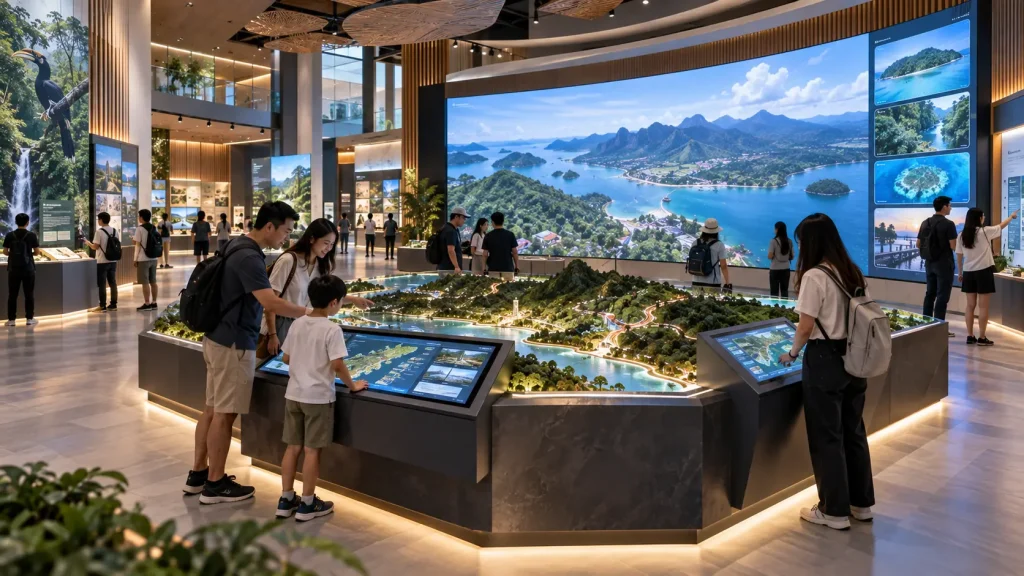
Immersive Visitor Centre at a Glance
| Visitor Need | Possible Experience |
|---|---|
| Understand the Destination | Immersive introduction, digital storytelling or overview experience |
| Know Where to Go | Interactive map, physical model or digital wayfinding |
| Discover Attractions | Interactive destination explorer with photos, videos and information |
| Understand History | Interactive timeline, archive or immersive historical storytelling |
| Explore a Development | Physical masterplan connected to interactive digital content |
| Plan the Visit | Routes, facilities, points of interest and visitor information |
What Is an Immersive Visitor Centre?
An immersive visitor centre is a physical information and experience space designed around how visitors discover a place.
The centre may contain conventional information, but important subjects are presented through visual, interactive or immersive experiences where this makes them easier to understand.
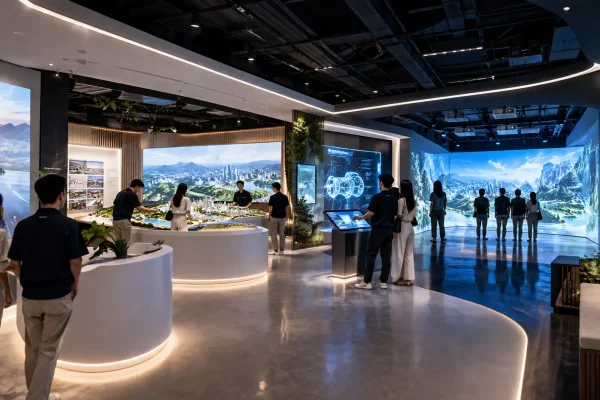
For example, a visitor arriving at a large destination could first see a physical model showing the entire area.
They select a location on an interactive map, the corresponding area on the physical model illuminates, and a larger digital display shows what can be experienced there.
The journey becomes:
See the Destination → Find a Location → Discover the Experience → Plan the Visit
Who Can Use an Immersive Visitor Centre?
Visitor centres can support many types of public destinations and developments, including:
- Tourism destinations
- City and municipal visitor centres
- Heritage districts
- National parks and nature attractions
- Large property developments
- Townships
- Infrastructure projects
- Government information centres
- Educational campuses
- Cultural destinations
The appropriate experience depends on what visitors need to understand before they continue into the destination.
Interactive Maps for Visitor Centres
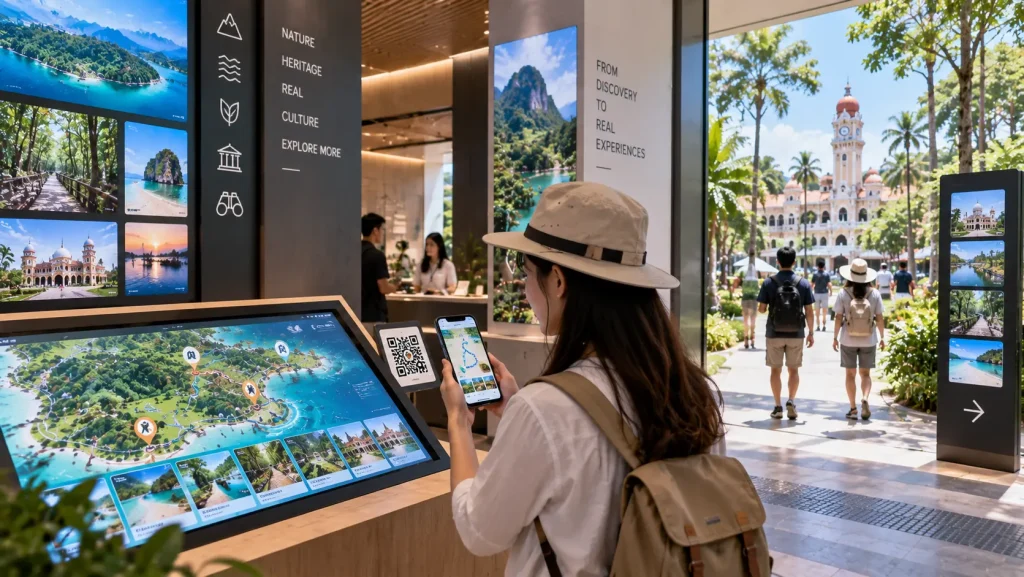
An interactive map is one of the most useful tools for a visitor centre because location is often central to the visitor’s decision.
Instead of showing every attraction and facility simultaneously, visitors can select categories or locations according to their interests.
An interactive map may allow visitors to explore:
- Attractions
- Heritage sites
- Facilities
- Walking routes
- Transport connections
- Events
- Food and retail areas
- Nature trails
- Development zones
Each location can reveal supporting photographs, videos or other useful information.
For larger spaces, the same map logic can also support interactive wayfinding to help visitors understand how to reach a selected destination.
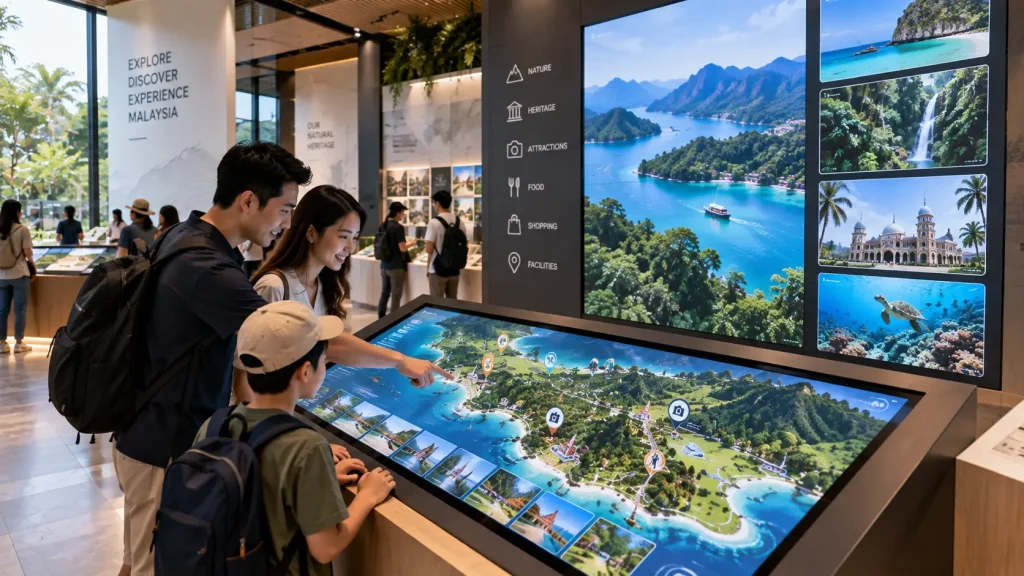
Physical Models with Interactive Digital Content
A physical model can give visitors an immediate understanding of scale and geography.
This is particularly useful for townships, city developments, infrastructure projects and large tourism destinations.
The model can be connected to an interactive control system.
For example:
Select Attraction → Physical Location Illuminates → Supporting Content Appears
A visitor can therefore understand both where something is and what can be experienced there.
This is often more intuitive than asking visitors to interpret a large two-dimensional masterplan.
Tourism Visitor Centres
A tourism visitor centre should help visitors move from general interest to a practical decision about what to explore.
Instead of displaying dozens of destination posters, an interactive system can allow visitors to choose what interests them.
For example, categories could visually represent:
- Nature
- Culture
- Food
- Family activities
- Adventure
- Heritage
- Shopping
After selecting an interest, visitors can discover relevant places and understand their locations through an interactive map.
The experience should help visitors make decisions rather than simply presenting more promotional content.
City and Government Visitor Centres
Government and city visitor centres may need to explain a much larger story than individual tourist attractions.
The centre may communicate:
- City development
- Public infrastructure
- History
- Culture
- Future plans
- Transport networks
- Sustainability initiatives
- Public services
These subjects can be divided into different experience zones rather than presented as one large information wall.
An interactive city model, for example, could allow visitors to explore different infrastructure projects while an immersive presentation shows how the city may develop over time.
Heritage Visitor Centres
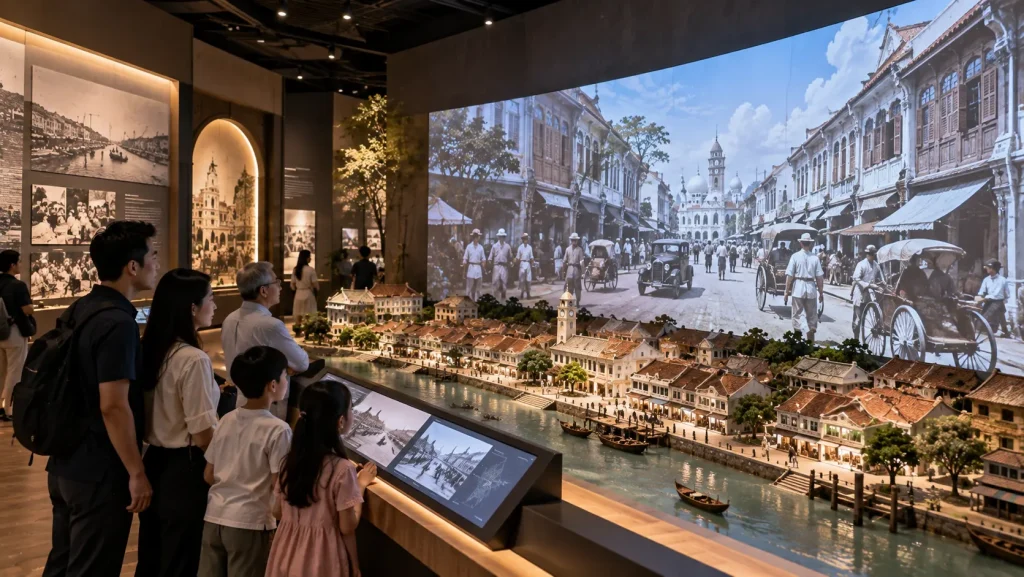
Heritage destinations often need to explain the historical context before visitors enter the actual site.
A visitor may see an old building, landscape or archaeological site but understand very little without additional interpretation.
A visitor centre can introduce:
- Historical timelines
- Old maps
- Archive photographs
- Reconstructed environments
- Historical characters and events
- Archaeological discoveries
Digital storytelling can help visitors understand what the physical destination may have looked like in the past before they explore the real location.
For projects centred heavily on collections and artefacts, see our Immersive Museum Malaysia guide.
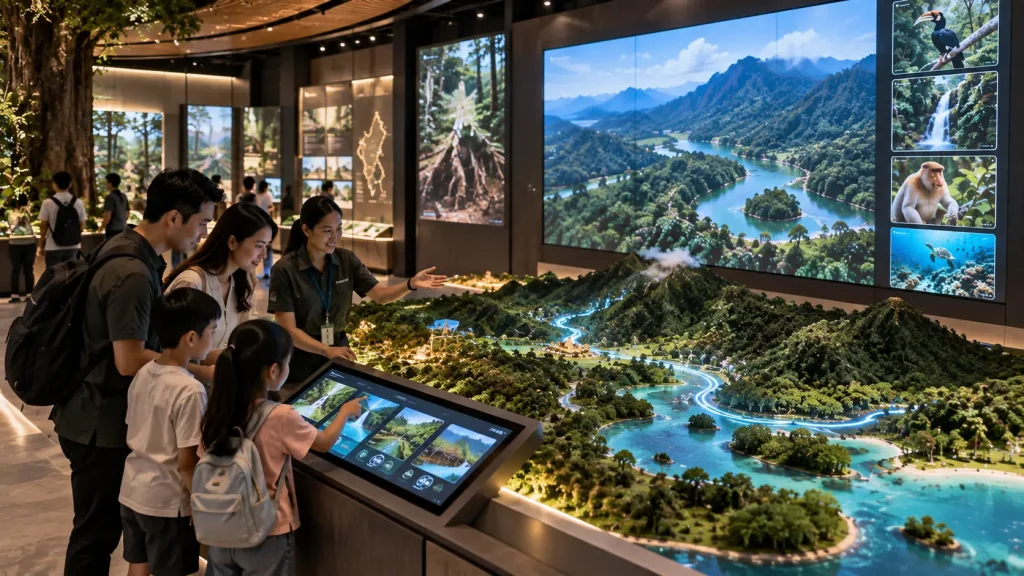
Nature and Environmental Visitor Centres
National parks, conservation areas and environmental destinations can use interactive experiences to explain ecosystems that visitors may not easily observe directly.
For example, visitors could explore:
- Wildlife habitats
- Forest ecosystems
- River systems
- Marine environments
- Geology
- Conservation programmes
- Seasonal environmental changes
A physical terrain model could show the geography while projection highlights different ecosystems or water systems.
An interactive display could then provide deeper information about selected species or conservation topics.
Immersive Storytelling for Visitor Centres
Some subjects are easier to understand when visitors experience them as an environment rather than through individual screens.
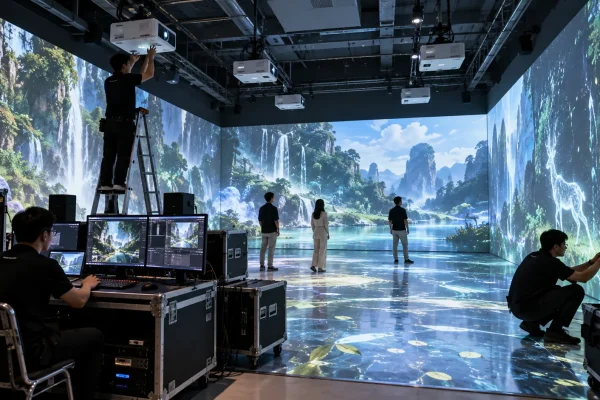
A dedicated immersive zone may use multiple projection surfaces, environmental sound and spatial content to introduce a destination or tell one important story.
For example, visitors entering a nature destination could experience a short visual journey moving from mountain landscapes through rainforest and river environments before exploring those subjects in greater detail elsewhere in the centre.
The immersive experience can function as an introduction rather than replacing the entire visitor centre.
See Immersive Room Malaysia for more information about multi-surface projection environments.
Interactive Timelines and Historical Content
Long historical timelines can become difficult to read when presented entirely on physical wall panels.
An interactive timeline allows visitors to move through different periods and reveal information only when they want to explore deeper.
Content may include:
- Historical photographs
- Maps
- Documents
- Video
- Animation
- Major events
- Development milestones
Physical historical material can remain nearby so visitors can connect digital information with real objects and places.
Interactive Walls
An interactive wall can provide a shared exploration experience for families, school groups or guided visitors.
Instead of one person operating a small touchscreen, a larger interactive surface can allow multiple visitors to discover locations, stories or environmental information together.
The interaction can use touch, gesture or motion depending on the space and experience objective.
Interactive Experiences for Children
Visitor centres often serve families and school groups, so selected information can be transformed into educational interaction.
Examples may include:
- Matching wildlife to habitats
- Building a sustainable city
- Exploring historical routes
- Identifying landmarks
- Environmental cause-and-effect activities
- Interactive quizzes
The objective should remain educational.
Instead of adding an unrelated game, the activity should help younger visitors understand something about the destination they are visiting.
Can Visitors Plan Their Route Digitally?
Yes. An interactive visitor centre can help people move from discovery to practical route planning.
After selecting attractions or points of interest, the system may show their locations and suggested routes.
Depending on the project, visitors may also be able to continue selected information on their own mobile device through a QR code or other digital handoff.
This creates a useful transition:
Visitor Centre → Personal Route → Physical Destination
Guided and Self-Guided Visitor Centres
Some visitor centres are designed primarily for independent public visitors, while others also receive school groups, VIPs or official delegations.
A flexible centre can support both.
| Self-Guided | Guided |
|---|---|
| Visitors explore according to their interests | A host follows a planned presentation sequence |
| Interfaces must be easy to understand | Presenter controls can trigger selected content |
| Useful for continuous public access | Useful for groups and official visits |
| Content can branch into different topics | Content can follow one structured story |
How Should the Visitor Journey Be Planned?
The strongest visitor centres begin with the questions visitors need answered rather than the technologies available.
A practical journey may be:
Welcome → Understand the Place → Explore the Map → Discover Interests → Learn the Story → Plan the Visit
Not every stage requires interaction.
A large physical model may communicate geography immediately, while an interactive map provides deeper exploration and an immersive experience creates an emotional introduction to the destination.
Combining different forms of communication creates a more varied visitor journey than placing a touchscreen at every section.
This approach is part of wider immersive experience design, where space, physical exhibits, content and technology work together.
Can a Visitor Centre Support Multiple Languages?
Yes. Multilingual content is particularly important for tourism destinations and public visitor centres that serve both local and international visitors.
Digital systems can provide language selection without placing every translation on the same physical wall panel.
Depending on the experience, multiple languages can be supported through:
- Interactive touchscreens
- Digital maps
- Subtitles
- Audio narration
- Interactive timelines
- Selected immersive content
The language structure should be planned during content development so visitors can switch languages without making the interface unnecessarily complicated.
Accessibility in an Interactive Visitor Centre
A public visitor centre should be usable by people with different physical, sensory and digital abilities.
Depending on the project, accessibility planning may consider:
- Suitable touchscreen heights
- Clear interface navigation
- Large touch targets
- Readable visual contrast
- Subtitles for video and narration
- Wheelchair circulation around exhibits
- Alternative ways to access important information
- Experiences that do not depend entirely on physical movement
Important destination information should remain accessible even when a visitor cannot participate in a particular interactive activity.
Can Visitor Information Be Updated?
Yes. Visitor centres often contain information that changes over time, so selected digital content can be designed for future updates.
This may include:
- Attractions
- Facilities
- Images and videos
- Points of interest
- Development information
- Opening information
- Temporary campaigns
- Selected map content
The appropriate update method depends on how frequently the information changes.
Content that changes regularly may benefit from a structured content management approach, while permanent historical or interpretive content may not require frequent editing.
Can Live Information Be Included?
Yes, where suitable data sources are available.
A visitor centre may incorporate selected live or frequently updated information such as:
- Event information
- Transport information
- Facility status
- Environmental data
- Visitor announcements
- Selected destination updates
Live information normally requires a reliable data source, network connection and suitable system integration.
Before developing the interface, it is important to confirm how the data will be provided and how frequently it needs to update.
Can Visitors Continue the Experience on Their Phones?
Yes. A visitor centre does not need to be the end of the digital journey.
Visitors may discover information on a large interactive display and then continue selected content on their own mobile devices.
For example:
Explore Destination → Select Location → Scan QR Code → Continue on Mobile → Visit Physical Location
The mobile experience may provide a route, destination information or other useful content depending on the project.
This is particularly useful because visitors do not need to remember every detail they discovered inside the centre.
Can an Existing Visitor Centre Be Upgraded?
Yes. An existing visitor centre can often be modernised without replacing the entire physical environment.
The first step is to identify which parts of the current visitor journey are no longer effective.
For example, a centre containing many static information panels may retain selected physical displays while adding:
- An interactive destination map
- Digital archive content
- Interactive physical model
- Updated audiovisual storytelling
- Immersive introduction zone
- Digital route planning
This allows investment to focus on areas where digital technology improves visitor understanding rather than rebuilding every part of the centre.
How Should Technology Be Integrated into the Space?
For a permanent visitor centre, technology should be coordinated with the architecture and exhibition design.
Touchscreens can be integrated into furniture or walls, while computers and playback equipment can be placed inside ventilated technical compartments.
Projectors, sensors and speakers should be positioned according to both technical performance and the visitor experience.
Planning should consider:
- Power and data points
- Cable routes
- Screen mounting
- Projector positions
- Equipment ventilation
- Maintenance access
- Lighting conditions
- Visitor circulation
Early coordination with the architect, interior designer, exhibition contractor and technology team can reduce modifications during installation.
Can the System Operate Offline?
Yes. Many core visitor centre experiences can operate locally without continuous internet access.
Interactive maps, touchscreens, projection content, videos and sensor-based installations can be stored and operated from local systems.
This can improve reliability for permanent installations.
Internet access is mainly required when the experience depends on live information, cloud services, remote databases or external online systems.
Daily Operation of a Visitor Centre
A permanent visitor centre should be practical for staff to operate every day.
Depending on the project, systems can be designed with simplified or automated procedures for:
- Startup
- Application launch
- Default attract content
- Audio control
- System reset
- Shutdown
- Recovery after power interruption
Public interactive stations should also be able to return to a default state after inactivity so they are ready for the next visitor.
Maintenance and Long-Term Reliability
Permanent visitor centre installations may operate for many hours each day and serve large numbers of visitors.
The technical design should therefore consider long-term operation from the beginning.
Important factors can include:
- Commercial-grade displays where appropriate
- Secure equipment mounting
- Computer ventilation
- Protected cabling
- Projector and sensor access
- Replaceable components
- Software recovery
- Maintenance documentation
Equipment should be integrated cleanly but remain accessible for servicing. A system that looks seamless to visitors should not require major dismantling every time a component needs maintenance.
How Much Does an Immersive Visitor Centre Cost in Malaysia?
There is no fixed price because visitor centres can range from a focused interactive information space to a large multi-zone public experience.
Major cost factors may include:
- Size and number of experience zones
- Interactive maps and touchscreens
- Physical models
- Projection and immersive systems
- Interactive walls or floors
- Sensors and tracking technology
- Custom software development
- 2D and 3D content production
- Multilingual content
- Audio systems
- System integration
- Installation and commissioning
- Content management requirements
- Long-term support
The budget should therefore be based on what visitors need to experience rather than the number of screens alone.
For broader budgeting considerations, see our Immersive Experience Cost Malaysia guide.
How Can the Budget Be Prioritised?
Not every part of a visitor centre needs the same level of technology.
A practical approach is to concentrate investment on the experiences that solve the most important visitor needs.
| Visitor Centre Zone | Possible Priority |
|---|---|
| Welcome | Strong visual introduction to the destination |
| Orientation | Physical model or interactive map |
| Discovery | Interactive attraction and destination explorer |
| Storytelling | One immersive or high-impact digital experience |
| Planning | Routes, wayfinding and mobile continuation |
This creates a complete visitor journey without turning every wall into an expensive digital installation.
Immersive Visitor Centre Project Process
A typical visitor centre project can follow these stages:
- Destination & Content Review – Understand the place, attractions, stories and available information.
- Visitor Needs – Identify what different visitor groups need to know and do.
- Visitor Journey – Plan how visitors move from orientation to discovery and exploration.
- Experience Concept – Select suitable physical, interactive and immersive experiences.
- Spatial & Technical Planning – Coordinate technology with architecture and exhibition design.
- Content & Software Development – Produce digital content, maps and interactive applications.
- Fabrication & System Integration – Connect technology with physical exhibits and the built environment.
- Installation & Commissioning – Install, calibrate and test the complete system.
- Training & Handover – Prepare the operator for normal daily use and basic system management.
What Information Is Needed for a Proposal?
Useful information for an initial proposal includes:
- Visitor centre location and objective
- Target visitor groups
- Floor plan and dimensions
- Existing or proposed interior design
- Destination, development or stories to be presented
- Expected visitor volume
- Required languages
- Available maps, images, videos and 3D assets
- Existing physical models or exhibits
- Required live data or system integrations
- Project timeline
- Estimated budget range
If the centre is still at the planning stage, developing the visitor journey before finalising the interior design can help ensure the physical environment supports the required experiences.
Why MyDigital Asia?
MyDigital Asia develops immersive and interactive visitor centres by combining physical environments, digital storytelling, software and interactive technology into one connected visitor journey.
Depending on the project, our scope can include:
- Visitor journey and experience concept
- Interactive maps
- Interactive wayfinding
- Touchscreen applications
- Physical model integration
- Interactive walls and floors
- Projection mapping
- Immersive rooms
- Motion tracking and sensors
- 2D and 3D content production
- Multilingual digital content
- System integration
- Installation and commissioning
The objective is to help visitors understand the destination and confidently decide what to explore next.
Frequently Asked Questions
Can an existing visitor centre be upgraded without rebuilding everything?
Yes. Existing physical exhibits and suitable interior elements can often be retained while selected areas are upgraded with interactive maps, digital content, projection or immersive experiences.
Can the visitor centre support multiple languages?
Yes. Touchscreens, maps, subtitles, audio and selected digital experiences can support multiple languages according to the project requirements.
Can visitors send routes or information to their phones?
Yes. Selected information can be continued through a mobile experience, such as using a QR code to access a route or destination information.
Can the system display live information?
Yes, if a reliable data source or API is available. The technical approach depends on what information is required and how frequently it changes.
Does the visitor centre need internet access?
Not for every experience. Many core interactive systems can operate locally, while internet access can be reserved for functions that depend on live or cloud-based information.
Do we need technical staff to operate the centre every day?
Not necessarily. Permanent installations can be designed with simplified startup, shutdown and recovery procedures so normal daily operation can be handled by the centre’s team.
Create an Immersive Visitor Centre in Malaysia
A successful visitor centre should help people understand a place before asking them to explore it.
Physical models can explain geography, interactive maps can support discovery, immersive storytelling can communicate the larger story and digital tools can help visitors continue into the real destination.
MyDigital Asia can support visitor centre projects from experience planning and interactive software through digital content, physical-digital integration, installation and permanent system commissioning.
Contact MyDigital Asia with your floor plan, destination, visitor objectives and project timeline to discuss an immersive visitor centre in Malaysia.
Related Immersive Experience Guides
- Immersive Experience Malaysia
- Immersive Room Malaysia
- Immersive Exhibition Malaysia
- Immersive Museum Malaysia
- Interactive Experience Centre Malaysia
- Immersive Brand Experience Malaysia
- Immersive Technology for Events
- Immersive Experience Cost Malaysia
- How to Design an Immersive Experience
Request a Free Consultation
Looking for Interactive Maps, Interactive Solutions or Event Technology?

LATEST POSTS