
Interactive Installations for Shopping Malls & Retail Spaces in Malaysia
Shopping malls are no longer competing only through their tenant mix, promotions and physical environment.
They are also competing for something increasingly difficult to obtain: visitor attention.
An interactive installation can turn an ordinary mall area, retail store or campaign space into an experience that gives shoppers a reason to stop, participate and remember the brand.
Depending on the objective, a mall interactive installation might involve an interactive game, motion tracking, digital product discovery, projection, a social experience or a permanent digital feature integrated into the retail environment.
However, the technology itself is not the objective.
A successful retail experience should answer a more practical question:
What do we want shoppers to do after they notice the installation?
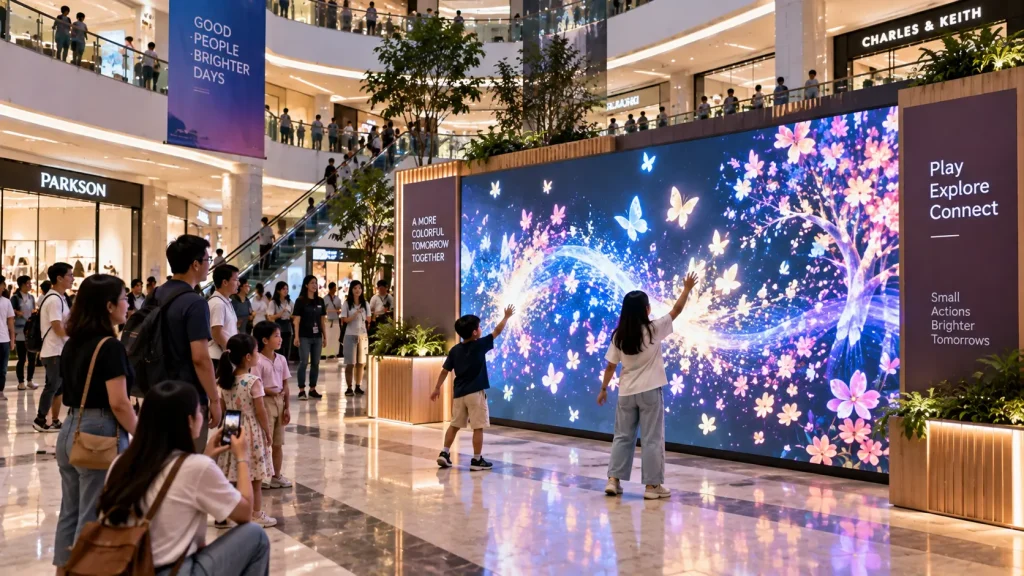
Mall Interactive Installations at a Glance
| Business Objective | Possible Interactive Approach |
|---|---|
| Attract passing shoppers | Large-format motion experience, projection or visual installation |
| Increase participation | Interactive game or challenge |
| Introduce a new product | Interactive product explorer or digital product display |
| Generate leads | Game or experience connected to QR registration |
| Encourage social sharing | Interactive photo, personalised content or shareable visual experience |
| Create seasonal engagement | Festive interactive installation or family activity |
| Improve the retail environment | Permanent digital installation integrated into the space |
Start With the Shopper Journey
Mall visitors rarely arrive specifically to use an interactive installation.
They may be walking to another store, meeting friends, having a meal or simply passing through the atrium.
This means the experience must communicate its purpose quickly.
A useful shopper journey can be simplified into five stages:
- Notice — Something visually attracts attention from a distance.
- Understand — The visitor quickly understands what they can do.
- Participate — The interaction is easy to begin.
- Reward — The visitor receives entertainment, information, a result or another form of value.
- Continue — The experience leads to a product, QR action, social share or another part of the campaign.
If visitors need a promoter to explain every step, the interaction may be too complicated for high-traffic retail environments.
1. Interactive Games for Mall Activations
Games are one of the most flexible forms of mall interaction because the mechanic can be adapted to different campaigns.
Examples can include:
- Reaction games
- Tap or button challenges
- Trivia games
- Motion-controlled games
- Digital racing
- Matching games
- Memory challenges
- Multiplayer competitions
The game does not need to be complicated.
For a mall activation, a short experience that can be understood within seconds may perform better operationally than a game requiring several minutes of instruction.
Brand elements, products and campaign messages can also be incorporated into the gameplay rather than simply placing a logo around an unrelated game.
For more examples, see our interactive games Malaysia guide.
2. Motion-Based Experiences That Attract Attention
Some interactive installations can begin responding before the shopper physically touches anything.
A large digital wall, for example, could react as people walk past it.
Depending on the creative concept, movement could:
- Reveal visual content
- Move digital objects
- Trigger animation
- Create particles or trails
- Control a character
- Activate a game
This can make the installation visible as an active experience even when nobody is intentionally using it.
It can be particularly useful in atriums, concourses and other areas where people approach from a distance.
Sensor position, tracking range, lighting conditions and surrounding foot traffic should be considered during technical planning.
See our sensor-based interactive installation guide for more information.
3. Interactive Product Discovery
Retail interaction does not always need to be entertainment.
For brands with multiple products, specifications or configurations, an interactive product explorer can help shoppers discover the range without displaying every piece of information simultaneously.
A shopper might select:
- Product category
- Model
- Colour
- Feature
- Specification
- Use case
- Comparison
The interface can then present the relevant content through images, video, animation or 3D visualisation.
This approach can be useful for automotive, electronics, appliances, property, furniture and other products where the purchase decision involves multiple options.
4. Physical Product + Digital Experience
A digital screen becomes more useful when it helps shoppers understand the physical product in front of them.
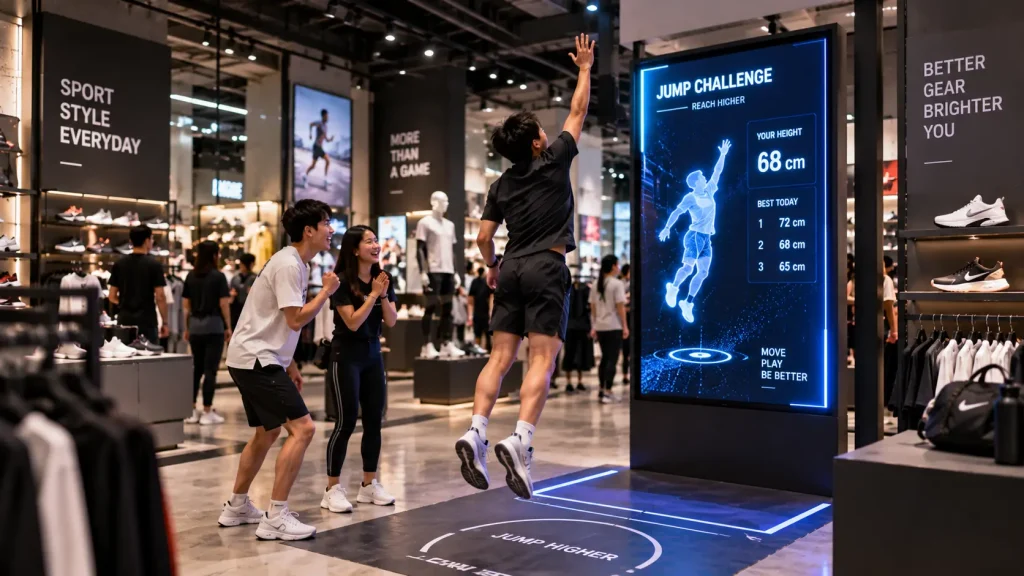
For example, a sports footwear display could allow shoppers to place or select a shoe and explore information about its cushioning, material, intended activity and construction.
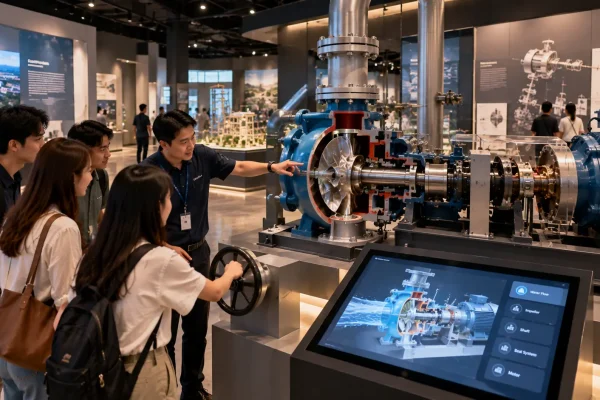
An appliance display could visually explain internal technology that cannot be seen from the outside.
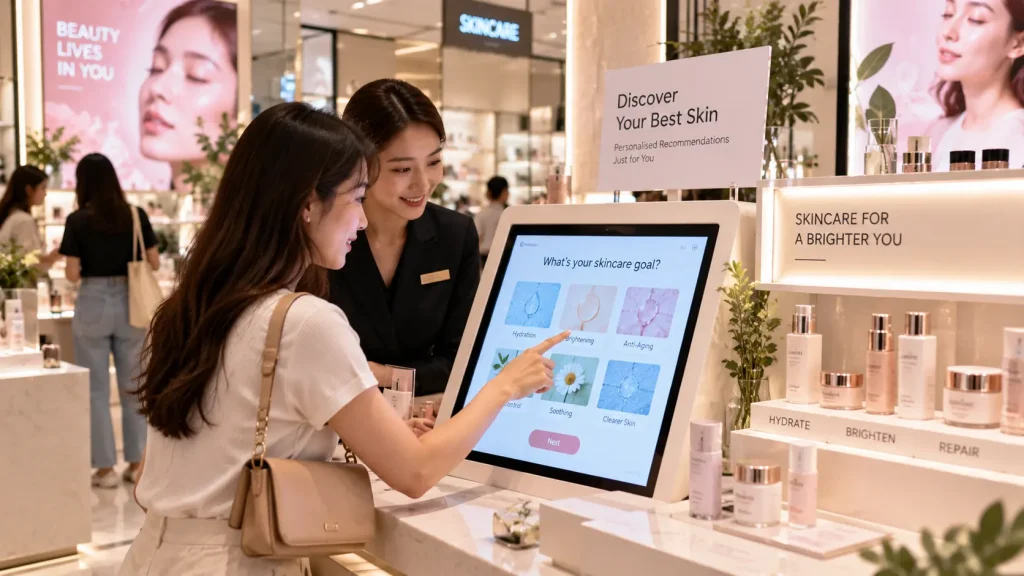
A beauty counter could guide shoppers through product categories based on their preferences.
The important relationship is:
Physical product → interaction → useful information → product decision.
The technology should bring attention back to the product rather than becoming a separate attraction.
5. Interactive Touchscreens for Retail Spaces
Touchscreens remain useful when shoppers need to browse structured information or make selections.
Applications can include:
- Digital catalogues
- Product comparison
- Store directories
- Campaign information
- Membership registration
- Product customisation
- Interactive quizzes
- Recommendation experiences
The interface should be designed for the actual installation rather than simply displaying a desktop website on a large touchscreen.
Button sizes, viewing distance, standing position, screen orientation and expected session duration all affect usability.
For more planning considerations, see our interactive touchscreen Malaysia guide.
6. Interactive Experiences for Beauty & Lifestyle Retail
Beauty and lifestyle retail provides opportunities for more personalised digital experiences.
Instead of presenting the same product message to every shopper, an interaction could ask a small number of questions and generate a relevant result.
For example, visitors could answer questions about preferences, lifestyle or desired product characteristics before receiving a suggested product category or personalised digital card.
The recommendation logic should be developed around information the brand can reasonably support rather than making unsupported medical or diagnostic claims.
The result can then direct the visitor toward the relevant physical products or a brand representative.
7. Social and Shareable Interactive Experiences
Some mall installations are designed not only for the participant but also for the participant’s social audience.
A digital experience might generate:
- A personalised image
- A branded digital card
- An animated result
- A themed photograph
- A score
- A character or visual identity
The result can potentially be accessed through a QR code or another campaign workflow.
This extends the interaction beyond the physical installation while giving visitors something connected to their participation.
8. Seasonal and Festive Mall Installations
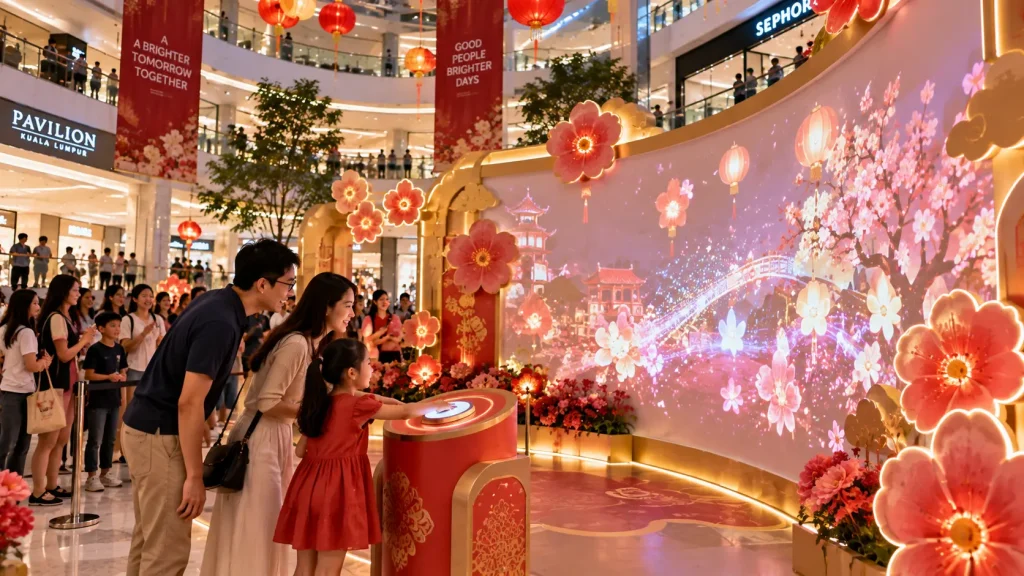
Shopping malls frequently transform common areas for festive periods and seasonal campaigns.
Interactive technology can become part of these environments rather than functioning as a separate kiosk beside the decoration.
For example, visitors might:
- Trigger festive animation through movement
- Play a family-oriented digital game
- Interact with projected scenery
- Create a personalised festive visual
- Contribute to a digital community wall
- Unlock different parts of a themed installation
The physical decoration and digital content should share the same visual direction so that the experience feels like one installation.
9. Interactive Installations for Mall Atriums
A mall atrium presents different technical requirements from a retail store.
The experience may need to compete visually with multiple floors, advertising displays, shopfronts and large volumes of pedestrian traffic.
Viewing distance also becomes important.
A small touchscreen may work once a visitor reaches the activation area, but it may not provide enough visual impact to attract someone viewing from an upper floor or across the atrium.
This is where larger visual elements, motion, projection, physical structures or coordinated lighting may support the interaction.
The installation should also account for:
- Public circulation
- Queue space
- Emergency access
- Power supply
- Ambient lighting
- Operating hours
- Noise level
- Setup and dismantling restrictions
10. Permanent Interactive Features in Shopping Malls
Not every mall interactive installation needs to be a temporary campaign.
Permanent installations can become part of the mall environment itself.
Possible applications include:
- Interactive directories
- Digital landmarks
- Family entertainment zones
- Interactive children’s areas
- Digital art installations
- Interactive information walls
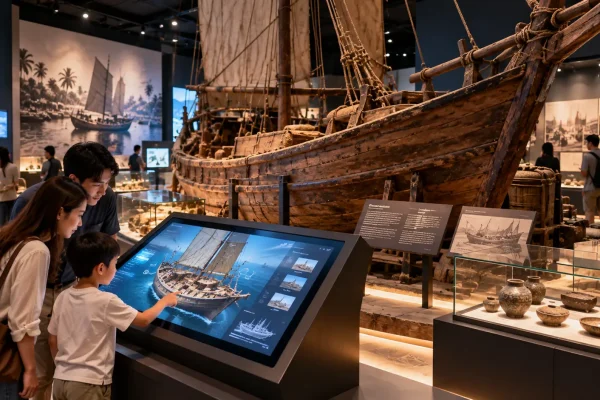
- Tourism or local discovery experiences
Permanent installations require a different technical approach from short-term activations because hardware reliability, maintenance access, content updates and daily operation become much more important.
Our permanent vs temporary interactive installation guide explains these differences in more detail.
Temporary Activation or Permanent Installation?
One of the first planning decisions is whether the interactive experience is intended for a short campaign or as a permanent part of the retail environment.
A temporary mall activation may operate for several days or weeks and usually prioritises fast participation, campaign visibility and efficient setup.
A permanent installation has different priorities. The hardware may operate every day for years, so reliability, maintenance and content management become more important.
| Consideration | Temporary Activation | Permanent Installation |
|---|---|---|
| Primary Objective | Campaign engagement and promotion | Long-term visitor or retail experience |
| Installation Period | Short-term | Long-term |
| Content | Campaign-specific | Designed for longer relevance and possible updates |
| Hardware | Rental or temporary setup may be suitable | Commercial-grade equipment is usually more important |
| Physical Structure | Designed for installation and dismantling | Integrated into the interior environment |
| Maintenance | Operational support during campaign period | Long-term service access and troubleshooting |
For a detailed comparison, see our permanent vs temporary interactive installation guide.
How Much Space Does an Interactive Installation Need?
The screen or equipment footprint is only one part of the space requirement.
The installation also needs enough room for people to approach, participate, watch and leave without obstructing surrounding traffic.
For example, a motion-controlled game may require an open tracking area in front of the display. A touchscreen may require less interaction space but can still create a queue during busy periods.
When planning the footprint, consider:
- Interaction zone
- Viewing distance
- Queue area
- Promoter position
- Spectator space
- Equipment housing
- Safety clearance
- Public circulation
This is particularly important in mall concourses where the installation shares space with normal shopper traffic.
Designing for High Visitor Traffic
A retail experience can behave very differently during a quiet weekday and a busy weekend.
If each participant requires several minutes to complete the experience, even a successful activation can quickly develop a long queue.
For high-traffic environments, it may be useful to design the interaction around:
- Short participation cycles
- Clear instructions
- Fast reset between users
- Multiple participants where suitable
- Visible results
- Simple registration flows
- Separate participation and collection areas
Some experiences can also entertain people who are waiting.
For example, a game score, live ranking or large visual response may allow spectators to understand what is happening before their turn begins.
Should Visitors Register Before Playing?
Registration can be useful when the campaign needs to collect leads, verify eligibility or connect participation to rewards.
However, adding registration also creates another step before the experience begins.
A campaign might use:
- QR registration before joining the queue
- A short form at the installation
- Membership identification
- A unique participation code
- No registration at all
The appropriate approach depends on the campaign objective.
If the main purpose is simply to create footfall and brand engagement, requiring a long form before participation may create unnecessary friction.
If lead generation is important, the registration flow should be planned as part of the complete visitor journey rather than added after the game has already been developed.
Connecting Interactive Experiences With Rewards
Rewards can provide an additional reason to participate, especially during promotional campaigns.
The reward mechanism can be connected to:
- Game completion
- Score thresholds
- Randomised results
- Trivia answers
- Lucky draw entries
- Voucher allocation
- QR redemption
Where prizes or vouchers have limited quantities, the software can potentially incorporate allocation rules so that the campaign does not distribute more rewards than planned.
The redemption process should also be considered. A digital result is only one part of the experience if staff still need to manually verify and distribute the reward afterwards.
Using Interactive Installations to Support Product Launches
Mall roadshows and retail spaces are frequently used for product launches.
Interactive technology can help shoppers move beyond simply viewing the new product.
For example, visitors could:
- Explore product features through a touchscreen
- View an animated internal product breakdown
- Compare different models
- Change colours or configurations digitally
- Complete a product-related challenge
- Generate personalised content related to the launch
The installation can therefore support both attraction and product education.
This is particularly useful when the product contains technology, engineering or features that are difficult to demonstrate through a static display.
Interactive Installations for Different Retail Categories
The same technology does not need to be used across every retail industry.
The experience should reflect how customers normally discover and evaluate the product.
| Retail Category | Possible Interactive Application |
|---|---|
| Automotive | Vehicle configurator, feature explorer, interactive game or 3D visualisation |
| Beauty | Preference quiz, product discovery or personalised result |
| Sportswear | Movement challenge, product comparison or performance experience |
| Electronics | Feature comparison, product simulation or interactive demonstration |
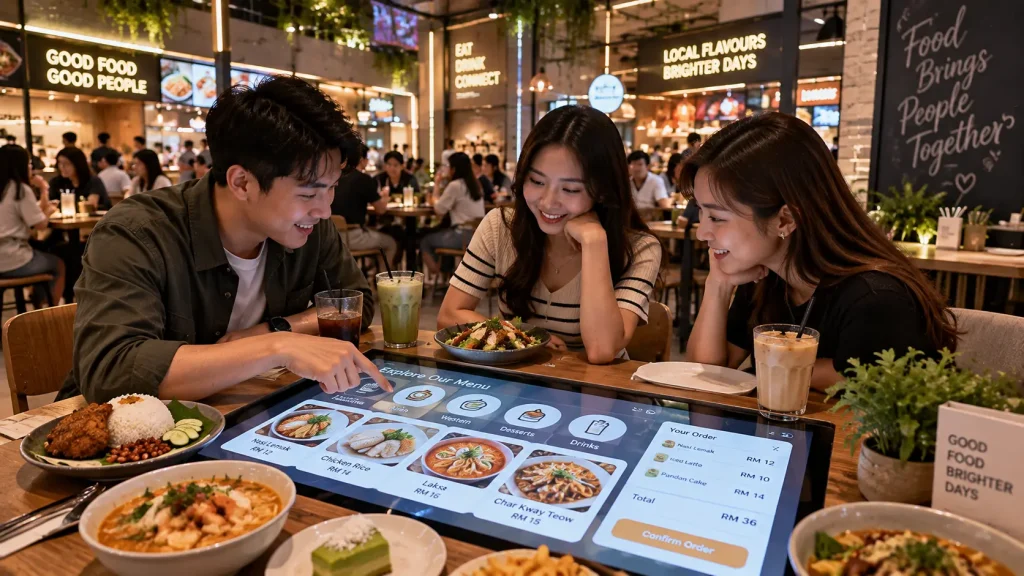
| F&B | Campaign game, product discovery, digital ordering concept or reward interaction |
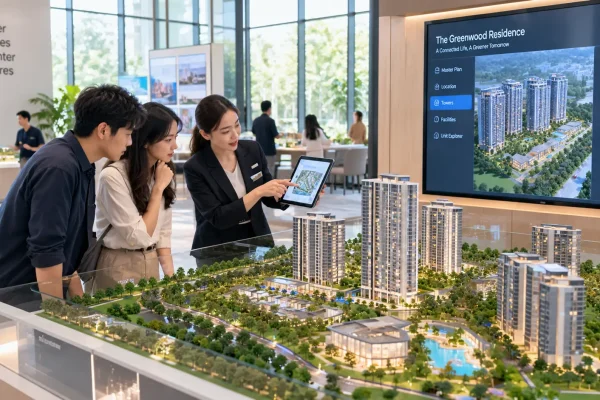
| Property | Interactive map, development explorer or unit visualisation |
| Children & Family | Educational games, motion interaction or creative activities |
| Lifestyle | Personalisation, digital discovery or social experience |
This is why the planning process should begin with the business objective and customer journey rather than selecting a technology first.
Technical Requirements for Mall Interactive Installations
Shopping malls introduce several practical technical conditions that should be considered before installation.
| Technical Area | Planning Consideration |
|---|---|
| Display | Screen size, brightness, orientation and viewing distance |
| Touch | Screen size, mounting height and expected number of users |
| Sensors | Tracking range, surrounding movement and installation position |
| Computer | Software requirements, graphics performance and ventilation |
| Internet | Whether registration, cloud services or online content require connectivity |
| Audio | Mall noise level and restrictions on campaign sound |
| Power | Available supply, cable routing and operating hours |
| Structure | Equipment mounting, stability and access for maintenance |
For temporary activations, setup and dismantling time may also affect the technical design because mall installation work is often completed outside normal operating hours.
Can the Experience Run Without a Promoter?
Some interactive installations can operate in a self-service format, while others benefit from staff support.
A self-service experience should make the next action obvious through visual cues, simple instructions and automatic resetting.
Promoters may still be useful when the campaign involves:
- Registration
- Prize redemption
- Product explanation
- Queue management
- Physical product handling
- Competition rules
The role of the promoter should therefore be determined during experience planning rather than assuming every interactive installation needs full-time supervision.
How Should a Mall Interactive Installation Be Planned?
A practical planning process can follow these steps:
- Define the campaign objective — Decide whether the priority is awareness, participation, product education, leads or sales support.
- Identify the target audience — Consider age, shopper profile and expected traffic.
- Review the location — Understand the available space, viewing distance, lighting and pedestrian flow.
- Design the shopper journey — Plan what happens from first attraction until the visitor leaves.
- Select the interaction method — Choose touch, movement, physical controls, QR or another suitable input.
- Develop the creative concept — Connect the interaction with the campaign and brand.
- Select the hardware — Determine suitable screens, sensors, computers and supporting equipment.
- Develop and test the software — Test the complete interaction under realistic conditions.
- Plan operations — Include queue management, promoters, prizes and daily startup procedures.
- Prepare installation and support — Coordinate mall access, setup, testing and dismantling where required.
For a broader project workflow, see our interactive installation design guide.
What Affects the Cost of a Mall Interactive Installation?
There is no single standard price because two installations occupying the same floor area can require very different technology and development work.
Typical cost factors include:
- Temporary rental or permanent installation
- Number and size of displays
- Touchscreen requirements
- Sensor and tracking technology
- Custom game or software development
- 2D or 3D content production
- Physical fabrication
- Registration and database requirements
- Reward or printing integration
- Installation duration
- On-site manpower
- Technical support
A simple touchscreen experience and a large motion-controlled atrium installation should therefore not be budgeted in the same way.
See our interactive installation cost Malaysia guide for a more detailed breakdown.
What Should You Prepare Before Requesting a Quotation?
If you are planning an interactive mall activation or permanent retail installation, useful information includes:
- Event or campaign dates
- Mall and location
- Available floor area
- Photos or floor plan
- Campaign objective
- Target audience
- Expected visitor volume
- Brand guidelines
- Preferred interaction concept, if any
- Prize or redemption requirements
- Internet availability
- Installation duration
- Approximate budget, if established
If the exact technology has not been decided, references showing the type of experience you want can also help during concept development.
How MyDigital Asia Supports Mall & Retail Interactive Projects
MyDigital Asia develops interactive experiences for shopping malls, retail brands, roadshows and promotional activations in Malaysia.
Depending on the project, the scope can include:
- Interactive concept development
- Custom interactive games
- Touchscreen applications
- Motion and sensor interaction
- Interactive product experiences
- QR and registration workflows
- Reward and voucher systems
- Personalised digital experiences
- 2D and 3D content production
- Projection and immersive experiences
- Hardware integration
- Installation and calibration
- On-site technical support
The objective is to develop the interaction around the shopper journey and campaign requirement instead of adding technology simply for visual effect.
Frequently Asked Questions
What interactive technology works well in shopping malls?
It depends on the objective and location. Interactive games, touchscreens, motion tracking, projection, personalised digital experiences and product explorers can all be suitable for different mall applications.
Can an interactive installation collect customer leads?
Yes. Registration or QR workflows can potentially be connected to the experience when lead collection is part of the campaign requirement.
Can interactive mall installations include prizes or vouchers?
Yes. Games and campaign software can be designed around prize allocation, voucher issuance or redemption workflows depending on the project requirements.
Can the same interactive system be reused for future campaigns?
Potentially. If reuse is planned from the beginning, the software and hardware architecture can be developed with future content or campaign changes in mind.
Can interactive installations work without internet access?
Yes. Many experiences can operate locally. Internet access becomes necessary when the project depends on online databases, cloud services, live content or other connected functions.
How early should we plan an interactive mall activation?
The timeline depends on the complexity of the software, content, fabrication and hardware. Custom experiences should allow sufficient time for development, integration and testing before installation.
Planning an Interactive Mall or Retail Experience in Malaysia?
If you are planning a mall activation, retail experience, roadshow, product launch or permanent interactive installation, start with what you want shoppers to notice, do and remember.
Send MyDigital Asia your campaign brief, location, floor plan, event dates, brand references and interaction ideas. We can evaluate suitable technology and develop the experience around the available space and campaign objective.
The strongest retail interaction is not necessarily the one with the most technology. It is the one that gives shoppers a clear reason to stop and participate.
Related Guides
- Interactive Installation Malaysia: Design, Technology & Applications
- Interactive Installation Cost in Malaysia
- Sensor-Based Interactive Installations: How They Work
- Permanent vs Temporary Interactive Installations
- How to Plan an Interactive Installation Project
Request a Free Consultation
Looking for Interactive Maps, Interactive Solutions or Event Technology?

LATEST POSTS