
Smarter Hospital Navigation
An interactive hospital map helps patients, visitors and staff find departments, clinics, wards, parking areas and facilities with less stress. In Malaysia, where major hospitals often serve high daily visitor volumes, clear digital wayfinding can improve arrival experience and reduce pressure on front-desk teams.
Modern medical centres are complex environments. Patients may need to locate specialist clinics, diagnostic centres, pharmacies, billing counters or emergency departments quickly. A touchscreen-based navigation system gives users a familiar, self-service way to search for destinations and follow simple routes.
For hospital operators, the solution is not only about directions. It also supports patient experience, operational efficiency, brand perception and accessibility. MyDigital Asia Sdn Bhd designs interactive navigation solutions that blend reliable technology with intuitive user experience for Malaysian healthcare environments.
Why choose interactive hospital map
An interactive hospital map turns a static floor plan into a practical digital guide. Instead of depending only on printed signage or verbal instructions, users can search, tap and view step-by-step routes on a screen placed in the right location.
This is especially useful in large hospitals with multiple blocks, different lift cores, complex corridors and changing department locations. The system can be designed for multilingual content, including English, Bahasa Malaysia, Mandarin and Tamil, based on visitor needs.
- Better patient experience: Visitors can find destinations faster and feel more confident within the facility.
- Reduced staff interruptions: Reception and security teams receive fewer repetitive direction enquiries.
- Improved accessibility: Routes can highlight lifts, ramps and wheelchair-friendly paths.
- Consistent information: Department names, facilities and floor layouts are presented in a standard format.
- Professional image: A premium touchscreen system reinforces a modern healthcare brand.
Interactive hospital map features
A well-designed solution should be simple enough for first-time visitors while flexible enough for ongoing facility updates. The interactive hospital map interface can include search, category filtering, floor switching, route preview and highlighted destination points.
Depending on the hospital layout, MyDigital Asia Sdn Bhd can develop the system for lobby kiosks, wall-mounted touchscreens, information counters or large-format interactive displays. The experience can also complement existing physical signage and reception workflows.
- Department search: Users can search clinics, wards, labs, pharmacies, cafes and administration offices.
- Floor-by-floor navigation: Clear visual guidance helps users understand movement between levels.
- Route guidance: The shortest or most accessible path can be displayed based on destination type.
- Service categories: Destinations can be grouped by outpatient services, inpatient areas, support facilities and amenities.
- Content management: Hospital teams can request updates when departments relocate or facilities change.
- Brand integration: Interface design can follow hospital colours, typography and customer experience standards.
Malaysia healthcare needs
Hospitals in Malaysia serve a wide range of users, from local patients and elderly visitors to international medical tourists. This makes wayfinding clarity a commercial and service priority, particularly for private hospitals, specialist centres and large public healthcare campuses.
A digital navigation system can support high-traffic areas such as main lobbies, emergency entrances, outpatient registration zones and car park lift lobbies. It can also help new visitors who arrive under pressure, such as family members attending appointments or locating admitted patients.
Hospital wayfinding should support accessibility, safety and patient-centred care. For broader healthcare context, refer to the Ministry of Health Malaysia at https://www.moh.gov.my/.
Planning your interactive hospital map
Planning should begin with the real visitor journey. A well-planned interactive hospital map considers where people enter, where they become confused, which destinations are most searched and how physical signage supports the digital experience.
Key planning steps include reviewing architectural layouts, defining destination categories, identifying kiosk locations, preparing bilingual or multilingual labels, and deciding how updates will be managed after launch.
- Site study: Review entrances, lobby flows, lift locations, corridors and service counters.
- Content structure: Standardise naming for departments, rooms, facilities and public amenities.
- User interface design: Build a clear touchscreen experience suitable for all age groups.
- Hardware selection: Choose reliable commercial-grade touchscreens for hospital operating hours.
- Testing: Validate routes, labels and usability before public deployment.
Touchscreen deployment options
Hospitals can deploy touchscreen maps in several formats depending on space, budget and visitor traffic. A freestanding kiosk works well in main lobbies, while a wall-mounted display may suit narrow corridors or lift waiting areas.
For premium hospitals and medical centres, large-format interactive displays create a more visible and impressive digital experience. They can also be positioned near reception counters to support staff-assisted guidance during busy periods.
To explore related solutions, visit https://mydigital.asia/interactive-maps/ and https://mydigital.asia/interactive-touchscreen-applications/.
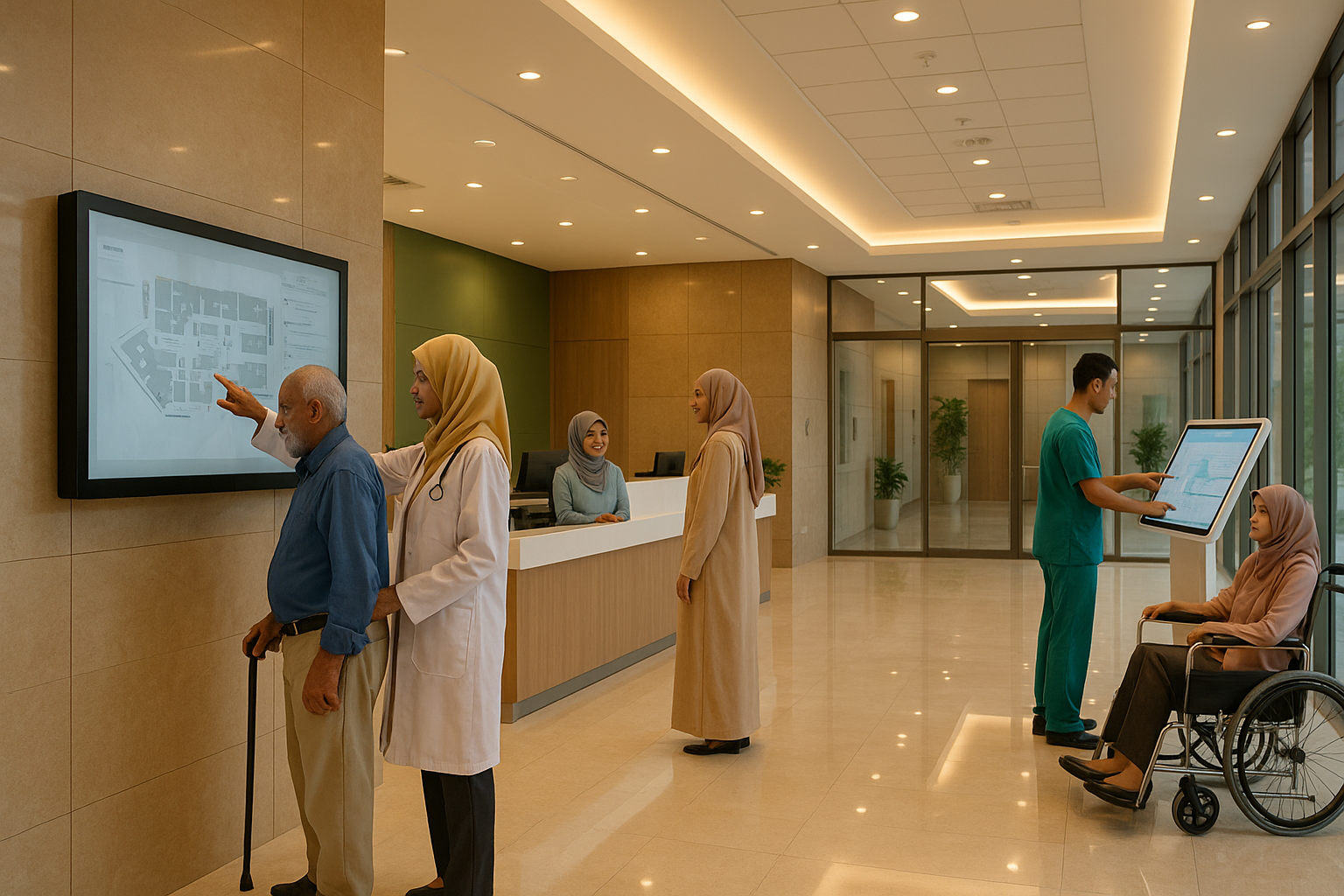
Image alt text: Patients and hospital staff using a premium touchscreen wayfinding kiosk in a modern Malaysian hospital lobby with green accent lighting.
Business benefits
For hospital management, digital wayfinding supports measurable service improvements. It can reduce confusion, shorten perceived waiting time and create a more organised arrival experience. For private healthcare brands, this contributes to patient satisfaction and stronger first impressions.
The system can also support facility teams by making updates more manageable compared with reprinting multiple static maps. As departments expand or relocate, digital interfaces can be revised to keep information relevant.
MyDigital Asia Sdn Bhd works with clients to align design, content and hardware so the final installation feels like part of the hospital environment, not an add-on screen.
FAQ
What is an interactive hospital map?
An interactive hospital map is a digital touchscreen wayfinding system that helps users search for destinations, view floor plans and follow routes inside a hospital or medical centre.
Where should it be installed?
It is commonly installed at main lobbies, outpatient entrances, lift lobbies, car park access points, information counters and other areas where visitors need direction support.
Can the map be updated?
Yes. The map can be updated when department names, room locations, public facilities or wayfinding information changes, depending on the selected content management workflow.
Is it suitable for private hospitals?
Yes. Private hospitals benefit from digital wayfinding because it improves visitor experience, supports a premium brand image and reduces repetitive direction requests at reception.
Can it support multiple languages?
Yes. The interface can be designed for multiple languages such as English, Bahasa Malaysia, Mandarin and Tamil, depending on the needs of the hospital audience.
Conclusion
Hospitals are busy, high-pressure environments where clear navigation matters. A smart wayfinding system helps patients and visitors move with confidence while supporting staff efficiency and a more professional healthcare experience.
For Malaysian hospitals planning to modernise their visitor journey, an interactive touchscreen map is a practical investment in service quality, accessibility and brand presentation.
Request a Free Consultation
Looking for Interactive Maps, Interactive Solutions or Event Technology?

LATEST POSTS